

Blog
POP TV Stand Designs in Nigeria: Built-In TV Wall Ideas & Costs
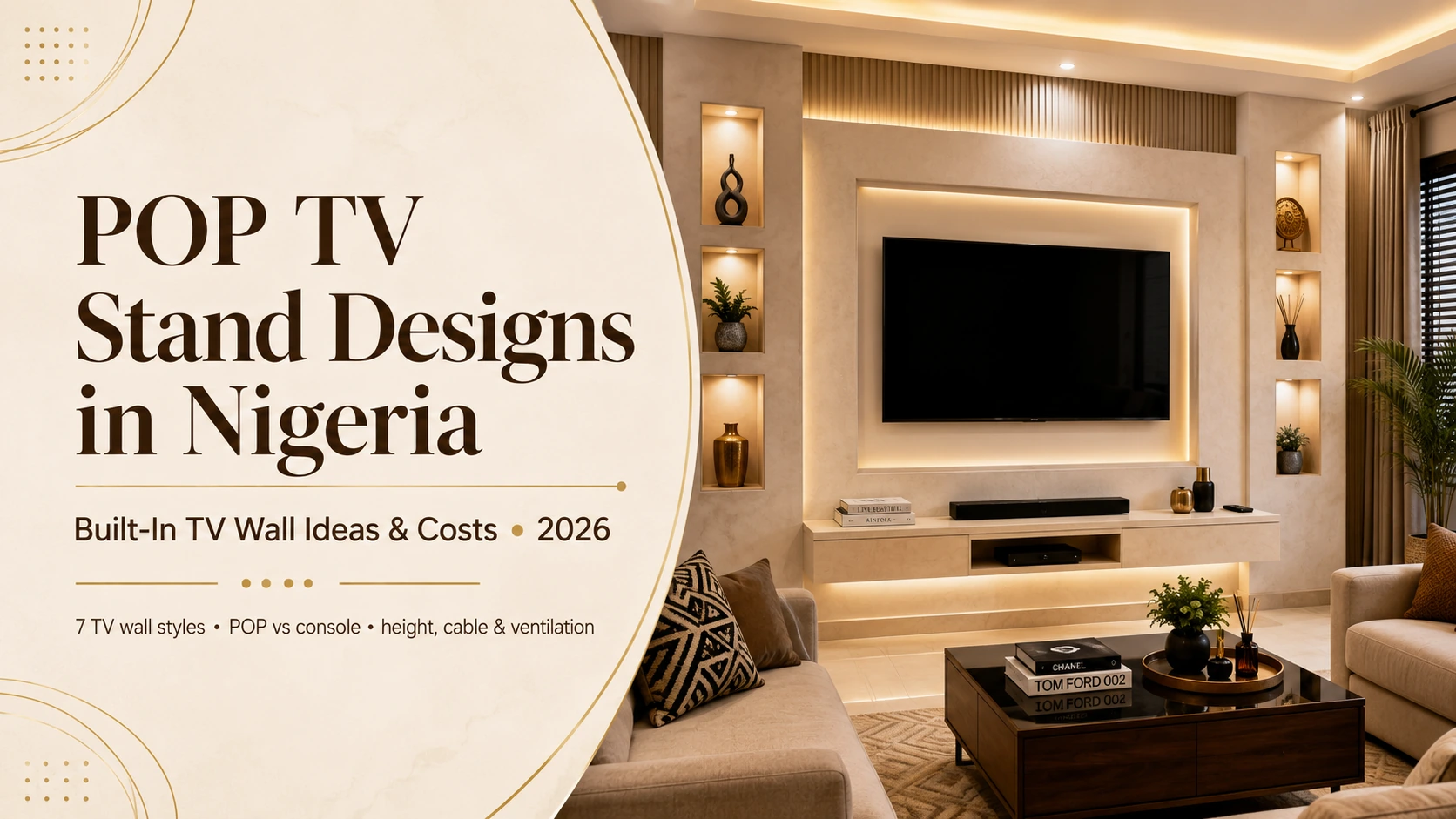
A POP TV stand in Nigeria is a television wall built in plaster of Paris rather than bought as furniture. It is quoted as a construction job, not a product: a simple recessed panel sits at the bottom of the range, while a full-height feature wall with cove lighting, niches and a stone inlay typically costs three to five times as much. The decisive point is permanence — it cannot be moved, resold or taken with you, which matters more than any price comparison.
The question Nigerian homeowners actually argue about is not which POP design is prettiest but whether to build the TV wall at all or buy a console instead. This guide answers that first, then prices the seven built-in designs that work in Nigerian sitting rooms, and covers the technical decisions — screen height, cable routing, ventilation — that separate a wall which still looks right in five years from one that has to be cut open.
Quick take: Ask for the plaster, electrical and painting figures separately before comparing quotes. Build it only if you own the property and the TV position is permanent. Run conduit and a double socket behind the screen before plastering, leave a ventilated void behind the TV, and set screen centre at 1,050–1,150mm from the floor.
POP TV wall or furniture console: the decision that comes first
This is a genuine fork, and Nigerian installers and furniture retailers each answer it in their own interest. The honest version depends on three things: whether you own the home, whether the room layout is settled, and how often you change your television.
When the built-in POP wall wins
A POP wall wins when you own the property, the sitting room layout is fixed, and you want the television to disappear into the architecture rather than sit on a piece of furniture. It also wins on cable management — conduit buried in the wall beats every furniture-based solution — and on rooms with awkward proportions, where a full-height feature wall can visually correct a room that is too wide or too tall.
When a furniture console wins
A console wins in rented homes, in rooms that are still evolving, and for anyone who upgrades screens regularly. It carries storage that a flat POP panel does not, it can be moved to another wall or another house, and it retains resale value. It is also dramatically faster: a console is delivered, while a POP wall is a week of site work with dust through the whole house. If that is your situation, our TV console design guide covers the furniture route in detail.
The hybrid, which is what most people actually want
The arrangement that satisfies both instincts is a simple POP treatment on the wall — a recessed panel or a framed niche with concealed lighting — with a freestanding console sitting in front of it. The POP handles the architecture and the light; the console handles storage, the decoder, the sound bar and the ability to change your mind. It is also the cheapest of the three, because the plaster work is minimal. Pairing a shallow POP recess with a unit from the TV stands range gives most of the built-in look at a fraction of the commitment.
What a POP TV wall costs in Nigeria
POP TV walls are usually quoted as a job rather than per square metre, because the area is small but the detailing is dense. Rates move with material and labour costs, so the table below ranks the designs against each other and gives the specifications that actually drive the quote. Ask for the plaster, the electrical first fix and the screeding and painting as three separate figures — comparing single lump sums between contractors tells you almost nothing.
| Design | Relative cost | Build time | Depth from wall | Notes |
|---|---|---|---|---|
| Simple recessed panel | ₦ | 2 – 3 days | 40 – 75mm | Best value; pairs with a console |
| Panel with cove lighting | ₦₦ | 3 – 4 days | 75 – 110mm | Fittings quoted separately |
| Floating POP shelf | ₦₦ | 3 – 5 days | 200 – 350mm | Needs a steel sub-frame |
| Niche-and-frame wall | ₦₦₦ | 5 – 7 days | 100 – 150mm | Storage niches; plan sizes first |
| Fluted or slatted feature | ₦₦₦ | 5 – 8 days | 60 – 120mm | Craft-dependent; see samples |
| Full-height feature wall | ₦₦₦₦ | 7 – 12 days | 100 – 200mm | Marble or tile inlay extra |
| Wall-to-ceiling continuous | ₦₦₦₦₦ | 10 – 15 days | Varies | Ceiling and wall as one design |
Three costs are consistently left out of first quotes: the electrical work to bring conduit, a double socket and data behind the screen; the screeding and painting after the plaster cures; and making good the floor and adjacent walls after a week of site dust. Together these commonly add 30–45% to the plaster figure, so budget for them at the start rather than discovering them at the end.
Seven POP TV wall designs for Nigerian sitting rooms
Simple recessed panel
A rectangle of wall set back 40–75mm, sized slightly larger than the television, with a clean shadow line around it. It costs the least, dates the slowest, and works in any room. If you are unsure what you want, this is the design that will not embarrass you in five years.
Panel with cove lighting
The same recess, with an LED strip concealed behind the returns so light washes out around the screen. Beyond looks, it serves a real purpose: a soft glow behind a television reduces the eye strain of watching a bright screen in a dark room. Use warm white and put it on a dimmer.
Floating POP shelf
A horizontal slab projecting from the wall beneath the screen, apparently unsupported, usually with light beneath it. It replaces a console visually while leaving the floor clear, which makes small rooms read larger. It must be built on a steel sub-frame — POP alone will crack along the root of the cantilever, and it will happen within a year.
Niche-and-frame wall
The screen sits in a central recess flanked by open niches for speakers, decoders, art or books. It is the most practical of the built-in designs, but the niches must be dimensioned around real objects before the frame goes up. Niches sized by eye end up too shallow for a decoder or too narrow for a sound bar.
Fluted or slatted feature
Vertical ribs run across the full wall, either moulded in POP or formed with timber slats set into it. The strong vertical rhythm makes a low ceiling read taller, which is useful in many Nigerian apartments. It lives or dies on setting-out accuracy: unevenly spaced flutes are visible from across the room.
Mixed POP with marble or tile
POP frames the composition; a slab of marble, porcelain or large-format tile forms the panel directly behind the screen. The mixed material adds depth and reads as considerably more expensive than plaster alone. Budget separately for the stone, and confirm the wall can carry the weight.
Wall-to-ceiling continuous
The TV wall treatment turns the corner and continues across the ceiling as a single form. It is the most dramatic option and the most demanding, requiring the ceiling and wall to be designed, set out and built as one piece. Reserve it for large rooms with high slabs, and coordinate it with your wider sitting room POP design rather than treating it as a standalone feature.
Getting the screen height and size right
The most common built-in error in Nigerian homes is mounting the television too high, usually because the design was drawn around the wall rather than around the viewer. Once it is set into POP, it cannot be adjusted.
Seated at a normal sofa height, your eye lands roughly 1,050mm to 1,150mm from the floor. That is where the centre of the screen belongs — not the bottom edge, and not above a notional mantel. For a 55-inch television, that puts the bottom edge around 700mm from the floor, which frequently surprises people who have seen showroom installations mounted far higher.
Size the recess to the screen you intend to own next, not the one you have. Televisions grow: a recess cut tight to a 43-inch screen becomes an expensive problem the day a 55-inch arrives. Leave at least 100mm of clearance on each side and 150mm above, and keep the panel proportional to the wall — a screen recess that fills more than about 60% of the wall width leaves the composition looking crowded.
Cable, power and ventilation
Everything behind the plaster has to be decided before the plaster goes on. Run at least two conduits from the screen position down to the console or socket position: one for power, one for HDMI and data, plus a spare if the run is easy. Terminate power in a recessed double socket behind the screen so no plug protrudes into the void.
Ventilation is the detail most often skipped. A television mounted flush against a sealed POP recess runs hot, and heat shortens panel life. Leave at least 50mm of air gap behind the set and, in a fully enclosed niche, provide a discreet vent at the top and bottom so air can move. The same applies to any decoder or amplifier tucked into a closed niche.
If the room also carries a sound system, plan speaker cable routes in the same pass. Retrofitting a single speaker cable through a finished POP wall means cutting a channel, re-plastering, re-screeding and repainting — for one cable.
Where POP TV walls go wrong
- Built in a rented home. It stays when you leave, and no landlord discounts rent for it.
- No conduit run before plastering. Every cable afterwards is a surface trunking compromise or a demolition job.
- Cantilevered shelf with no steel. POP has almost no tensile strength; unsupported shelves crack at the root.
- Recess cut tight to the current TV. The next screen will be bigger. It always is.
- Niches dimensioned by eye. Measure the decoder, the sound bar and the game console first.
- Cool-white lighting. It makes a sitting room feel like a corridor; use 2700K–3000K.
Making the wall work with the rest of the room
A feature wall pulls the entire room’s centre of gravity toward it, so everything else has to be re-balanced. Seating should face it squarely rather than at an angle, the centre table should sit on the same axis, and any strong pattern elsewhere in the room needs to be quietened — a busy feature wall competing with a busy rug reads as chaos.
Colour is the cheapest lever you have. A POP wall painted a tone or two darker than the surrounding walls recedes and makes the screen sit comfortably; the same wall painted brilliant white amplifies every shadow line and every imperfection in the plaster. If the room’s furniture is already dark, the reverse applies. For pricing on the furniture side of the same wall, our TV stand price guide sets out what consoles cost across the market, and the same POP principles applied to sleeping areas are covered in our POP bedroom guide.
Frequently asked questions
How much does a POP TV stand cost in Nigeria?
A POP TV wall is quoted as a construction job. A simple recessed panel sits at the bottom of the range, while a full-height feature wall with lighting and niches typically costs three to five times as much. Electrical work, screeding and painting add a further 30–45%, and stone or tile inlay is quoted separately.
Is a POP TV stand better than a furniture TV console?
Neither is universally better. A POP wall suits owned homes with a settled layout and gives the cleanest cable concealment, but it is permanent. A furniture console suits rented or evolving rooms, adds storage, moves with you and retains resale value. Many homes combine a shallow POP recess with a freestanding console.
How high should a TV be mounted on a POP wall?
The centre of the screen should sit 1,050mm to 1,150mm from the floor, which matches seated eye level on a normal sofa. For a 55-inch television that puts the bottom edge around 700mm up. Because the recess is permanent, the height must be confirmed before the frame is built.
Can you hang a TV directly on POP?
No. Plaster of Paris cannot carry a wall bracket on its own. The mount must be fixed through the POP into the structural blockwork or concrete behind it, or onto a steel sub-frame installed before plastering. Fixing into plaster alone will pull out, usually taking a section of the wall with it.
How long does a POP TV wall take to build?
A simple recessed panel takes two to three days, a niche-and-frame wall five to seven, and a full-height feature wall seven to twelve. Add curing time before screeding and painting. Electrical first fix must happen before plastering, so the trades need sequencing rather than booking separately.
Does a POP TV wall need ventilation?
Yes. Leave at least 50mm of air gap behind the television, and in a fully enclosed niche provide discreet vents at the top and bottom so warm air can escape. Televisions, decoders and amplifiers sealed into an airtight recess run hot, which shortens component life.
What size should the TV recess be?
Size it for the television you expect to buy next, not the one you own. Leave at least 100mm clearance on each side and 150mm above the screen. Keep the recess to roughly 60% or less of the wall width so the composition still reads as a panel rather than filling the wall.
Can a POP TV wall be removed later?
It can be demolished but not dismantled. Removal means breaking out the plaster and frame, then re-plastering, screeding and repainting the wall behind it, plus making good the floor. Budget for that work as part of the original decision, particularly if the property may be sold or re-let.
What lighting works best behind a TV wall?
Warm white LED strip at 2700K to 3000K, concealed in a cove behind the panel returns and controlled by a dimmer. Bias lighting behind a screen genuinely reduces eye strain in a dark room. Cool white makes a Nigerian sitting room feel clinical and exaggerates every imperfection in the plaster.
Do POP TV walls crack?
They crack when the frame moves or when a section is unsupported. The usual causes are a timber sub-frame that swells and shrinks with the seasons, and cantilevered shelves built in plaster without steel. A galvanised metal frame, proper curing time and steel support under any projection prevent almost all cracking.