

Blog
Sofa Chair Price in Nigeria: Single-Seater Styles & Costs
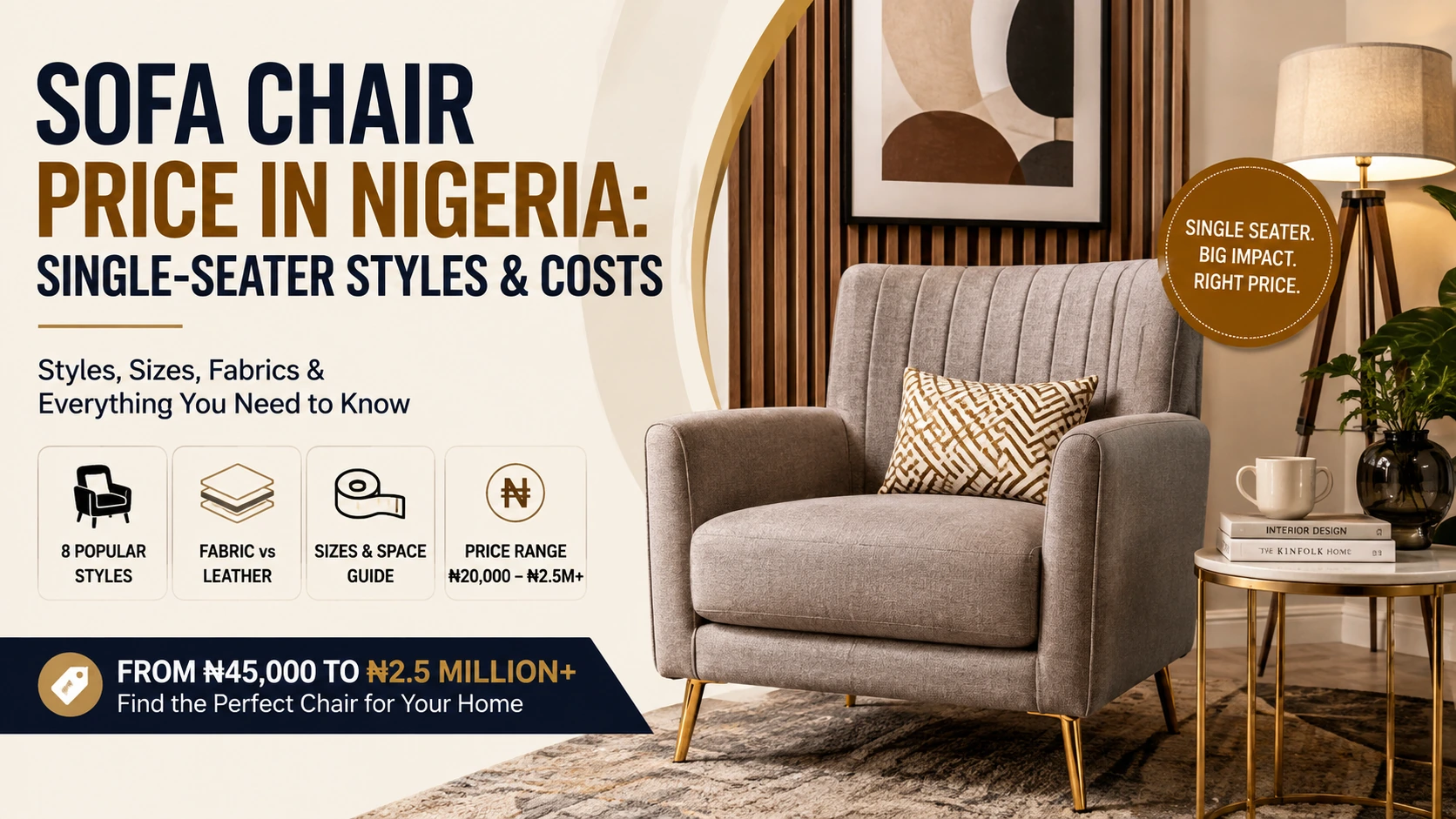
In Nigerian usage a “sofa chair” almost always means a single seater — one armchair, bought on its own or forming part of a suite — rather than a full sofa. Marketplace listings start from around ₦20,000 for the lightest imported models, locally made upholstered chairs from roughly ₦45,000, and carved royal armchairs are listed from about ₦850,000 upward. The spread is enormous because the name covers four very different products, and the frame underneath decides almost all of it.
That distinction is why so much sofa chair shopping goes badly. Search for one and you are shown seven-seater sets; ask a showroom for a price and you are quoted for a suite. This guide prices the single chair on its own terms, covers the eight styles that actually sell in Nigeria, and explains what separates a ₦80,000 chair from an ₦800,000 one — because in this category the gap is real and it is visible within two years.
Quick take: Prices move constantly with materials and exchange rate, so treat every figure as a starting point and confirm current pricing before you commit. Judge the frame and the foam density before the fabric. For Nigerian conditions, tight-woven fabric or genuine leather outlast bonded leather by years. Measure your door before you fall in love with a wide chair.
What Nigerians mean by “sofa chair”
Elsewhere the term barely exists; in Nigeria it is the standard phrase for a one-person upholstered chair. It covers the armchair that completes a three-plus-two arrangement, the standalone accent chair placed in a corner, the carved “royal” chair that anchors a formal reception, and the padded chair many households put in a bedroom or home office.
Because the phrase spans all of those, prices quoted online look wildly inconsistent — ₦20,000 next to ₦2.5 million, apparently for the same thing. They are not the same thing. The rest of this guide separates them by construction and use rather than by name.
Sofa chair prices in Nigeria by tier
The Nigerian market splits into four fairly clean bands. What moves a chair between them is, in order of impact: the frame material, the foam density and grade, the upholstery, and only then the brand or import origin. The figures below are the points each tier starts from in current listings — they move with materials and exchange rate, so use them to place a quote rather than as fixed prices.
| Tier | Listings start from | Frame | Upholstery | Realistic lifespan |
|---|---|---|---|---|
| Entry / mass market | from ~₦20,000 | Soft wood, stapled | Polyester blend, bonded leather | 2 – 4 years |
| Mid market | from ~₦90,000 | Seasoned hardwood, doweled | Heavy woven fabric, split leather | 6 – 10 years |
| Premium | from ~₦400,000 | Kiln-dried hardwood, corner-blocked | Full-grain leather, velvet, chenille | 12 – 20 years |
| Royal / designer | from ~₦850,000 | Carved hardwood, hand-finished | Imported leather, silk-blend, gilding | 20+ years |
Two notes on reading that table. First, a starting price does not place a chair in a tier — a heavily carved entry chair can carry a premium price tag with an entry frame underneath. Second, the lifespan column assumes Nigerian conditions: high humidity in the coastal south, dust and dry heat in the north, and considerably more daily use per seat than most imported furniture is engineered for.
One point worth being direct about: Vento does not sell standalone armchairs as separate items. Its single seaters come as part of complete suites, where the two- or three-seater and the matching single chairs are built together on the same frame specification and in the same leather or fabric. If you want one chair on its own, a marketplace or a local upholsterer is the right route, and that is a straight answer rather than a sales one. If you are furnishing a full sitting room, the sofa set price guide covers complete arrangements, which start from around ₦800,000 for a premium two-seater.
Eight single-chair styles that sell in Nigeria
Royal armchair
Carved hardwood frame, high back, often gilded or brass-detailed, with deep buttoned upholstery. It is the anchor chair of a formal Nigerian reception room and the reason so many searches for single chairs land in the millions. Buy it for a room that already has scale — a royal chair in a small parlour dominates everything around it.
Wingback
Tall back with side panels that project forward. Formal without being ornate, and genuinely comfortable for reading. The wings make it read as a solid mass, so it works better against a wall or in a corner than floating in the middle of a room.
Accent chair
A lighter, lower chair in a contrasting fabric or colour, chosen to break up a matching suite. This is the fastest-growing single-chair category in Nigerian homes, largely because it lets a household refresh a living room without replacing the sofa. Pairs naturally with a centre table in a complementary tone.
Recliner
Mechanised or manual, with a footrest and reclining back. The mechanism is the whole purchase — a cheap recliner mechanism fails long before the upholstery does, and it is rarely economical to repair in Nigeria. If you are buying at the entry price, buy a fixed chair instead.
Barrel or tub chair
Curved, enclosing back that wraps into the arms. Compact footprint for the amount of comfort it delivers, which makes it the strongest option for apartments and smaller sitting rooms. It also swivels well, so it works as a conversation chair.
Bergère and carved-frame chairs
Exposed wooden frame with upholstered seat, back and often arm pads. It sits between the royal chair and the accent chair — formal enough for a reception, light enough not to swallow a room. The exposed timber is where quality shows most obviously.
Swivel chair
A single seat on a rotating base, usually contemporary in shape. It suits open-plan rooms where the seating has to face both a television and a dining area. Check the base weight: an underweighted swivel tips forward when someone sits on the edge.
Slipper and armless chairs
Low, armless and compact. The cheapest way to add a seat without adding visual bulk, and the easiest to move between rooms. They are not primary seating — nobody wants to spend an evening in one — but they solve the extra-guest problem elegantly.
Fabric or leather, in Nigerian conditions
The fabric decision matters more here than in temperate markets, because heat, humidity and harmattan dust all attack upholstery differently.
Genuine leather is the most durable option and it wipes clean, which matters in dusty months. It does get warm to sit on in the south, and it needs conditioning perhaps twice a year to stop it drying and cracking. Bonded leather — offcuts glued to a backing, sold under names like “leatherette” or “PU leather” — looks identical in the showroom and begins to peel in sheets within two to three years in humid coastal conditions. It is the single most common regret in this category.
For fabric, weave density matters more than fibre name. A tightly woven chenille or a heavy-weight polyester blend resists abrasion and dust penetration far better than a loose linen-look weave, which traps dust in the pile and dulls within a season. Velvet performs surprisingly well if it is a short, dense pile. Whatever you choose, ask for the rub count if the seller can give it — anything below 20,000 double rubs is not built for a main chair. The same reasoning applies across a whole suite, which we cover in our guide to sofa set designs.
Sizing, placement and how many you need
A single chair is easier to get wrong than a sofa, because it has to relate to seating that already exists. Work through these before ordering:
- Measure the doorway and the stair turn, not just the room. Wide-armed and wingback chairs are the pieces most often stranded on a landing.
- Match seat height to your existing sofa within about 50mm, or conversation across the group feels off-balance.
- Leave 450mm of clear floor between the chair and the centre table so people can pass without turning sideways.
- Angle it 20 to 30 degrees toward the sofa rather than squaring it to the wall — it makes a room read as designed rather than arranged.
- Two chairs beat one in rooms over about 20m². A single chair in a large room looks like something is missing.
For proportion, a standard Nigerian sitting room of 4m × 5m comfortably takes a three-seater plus two single chairs, or an L-shape plus one. Beyond that you are filling floor rather than adding seating, and the room stops circulating. Our living room design guide works through full layouts.
What separates a ₦80,000 chair from an ₦800,000 one
Turn any chair over and the answer is visible in ninety seconds. The frame is first: entry chairs use soft wood held with staples and glue, which loosens as the timber dries and produces the creak that announces a failing chair. Better chairs use seasoned or kiln-dried hardwood with doweled or bolted joints and corner blocks at each leg.
Foam is second. Density, expressed in kilograms per cubic metre, decides whether the seat holds its shape. Low-density foam feels identical in the showroom and takes a permanent impression within a year of daily use. High-density foam, or a foam-and-fibre wrap over a sprung base, keeps its edge for a decade.
Third is the suspension under the foam — webbing, serpentine springs or a sprung platform. Many entry chairs have plywood under the cushion and nothing else. Finally comes the visible craft: whether patterns line up across seams, whether the stitching is even, whether the wood is finished on surfaces nobody normally sees. That last detail is the most reliable proxy for everything hidden, and it is what the luxury range is built around.
Buying a single chair without stranding your existing set
Most single-chair purchases in Nigeria are additions rather than fresh starts, and the risk is a chair that clashes with what is already there. Matching exactly is usually the wrong goal — a perfect match to a four-year-old suite highlights how faded the suite has become. Deliberate contrast works better: pick up one colour already present in the room, in a different texture and a different tone, and the new chair reads as intentional.
If you are buying in person, sit in the chair for a full two minutes rather than perching on it, and sit the way you actually sit at home. Showroom lighting and a thirty-second test flatter every chair equally; the differences only show once you settle. You can see how single seaters sit within complete suites at any Vento showroom across Lagos, Abuja, Port Harcourt and Kaduna, and browse the arrangements in the sofa sets category.
Frequently asked questions
How much is a sofa chair in Nigeria?
Listings for a single-seater sofa chair in Nigeria start from around ₦20,000 for the lightest imported models and roughly ₦45,000 for a locally made upholstered chair. Well-framed hardwood armchairs start from about ₦90,000, and carved royal armchairs from around ₦850,000. Frame material and foam density drive most of the difference.
What is a sofa chair?
In Nigerian usage, a sofa chair is a single-seater upholstered armchair — one seat rather than a full sofa. It may be bought alone as an accent or extra seat, or as the single chair that completes a three-plus-two suite. Elsewhere the same piece is usually just called an armchair.
How much is a single seater sofa in Nigeria?
Single seater sofas start from around ₦20,000 at the very entry level and from roughly ₦90,000 for a hardwood-framed chair with dense foam. Premium single seaters start from about ₦400,000. The same chair in bonded leather rather than genuine leather typically costs considerably less, and lasts far less time.
How much is a royal sofa chair in Nigeria?
Carved royal armchairs — hardwood frames with high backs, deep buttoning and often gilded detailing — are listed in Nigeria from around ₦850,000 and rise well past ₦2 million. Price is driven by the depth of carving, the hand-finishing time and the grade of leather or fabric used on the seat and back.
Is a leather or fabric sofa chair better in Nigeria?
Genuine leather lasts longer and wipes clean, which helps during harmattan dust, though it warms up in humid coastal areas. Densely woven fabric such as chenille performs almost as well and stays cooler. Avoid bonded or PU leather — it looks identical in the showroom but peels within two to three years.
How do I know if a sofa chair is well made?
Check the frame, foam and suspension before the fabric. Look for kiln-dried hardwood with doweled or bolted joints and corner blocks, high-density foam over webbing or springs rather than bare plywood, and patterns that line up across the seams. Even stitching on hidden surfaces signals quality throughout.
How many single chairs should a Nigerian living room have?
A standard 4m × 5m sitting room takes a three-seater plus two single chairs, or an L-shaped sofa plus one. In rooms above about 20 square metres, two single chairs look balanced while one looks like something is missing. Beyond that you are filling floor rather than adding usable seating.
What size should a sofa chair be?
Most single seaters measure 800mm to 950mm wide, 850mm to 1,000mm deep, with a seat height of 420mm to 480mm. Match the seat height of your existing sofa within about 50mm so conversation stays level, and measure your doorway and stair turn before ordering a wide-armed or wingback chair.
Can I buy one chair to add to an old sofa set?
Yes, and deliberate contrast usually works better than trying to match. An exact match to a suite that has faded for several years only highlights the difference. Instead pick up one colour already in the room, in a different texture and tone, so the new chair reads as a considered addition.
How long should a sofa chair last in Nigeria?
An entry-level chair typically lasts two to four years in daily use, a mid-market hardwood-framed chair six to ten years, and a premium chair twelve to twenty. Humidity in the south and dust in the north shorten these figures, and low-density foam is almost always what fails first.