

Blog
Bunk Bed Designs in Nigeria 2026 — 9 Modern Kids’ Room Ideas
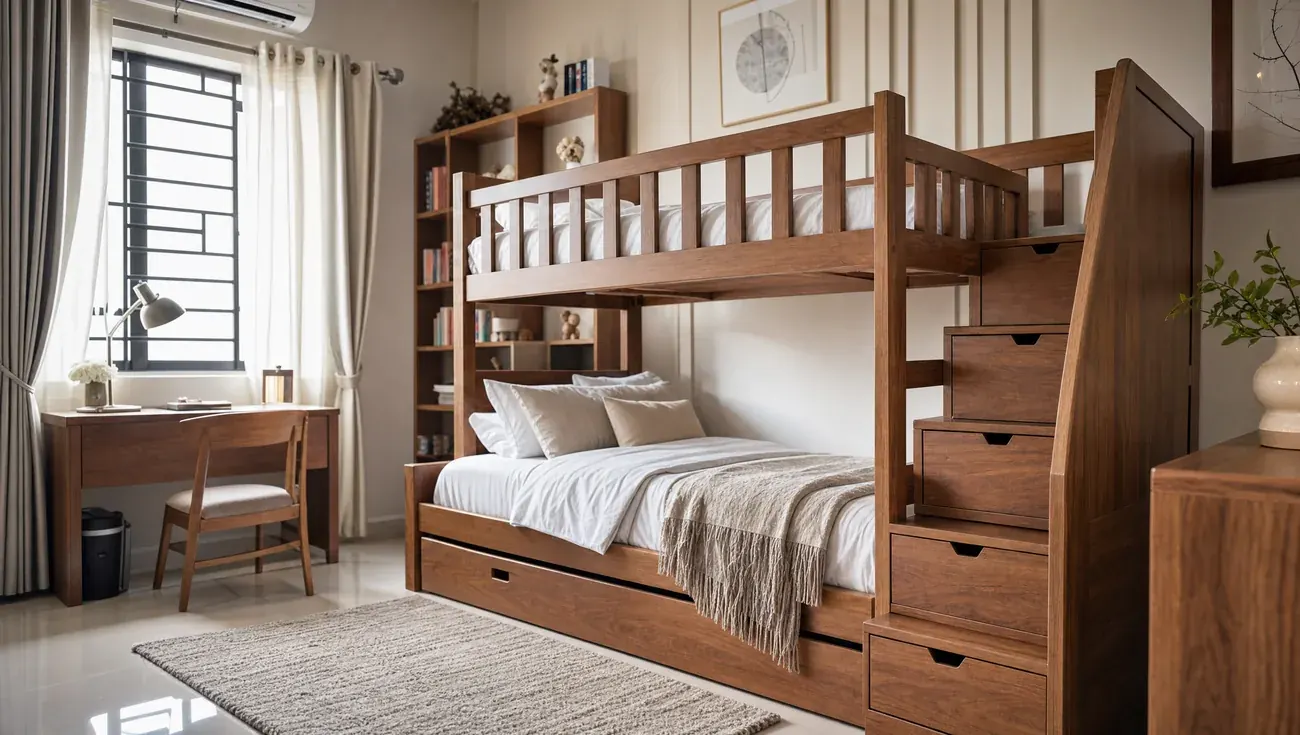
Last updated: 16 September 2026 — added Vento bunk bed and kids’ bed prices and a double decker bed guide.
A bunk bed for kids — often called a double decker bed in Nigeria — solves the problem every growing Nigerian family eventually meets: two or more children, one bedroom, and not enough floor for separate beds. Done right, a bunk bed gives each child their own sleeping space, frees the floor for play and study, and becomes the feature the children actually love. Done wrong, it is a safety risk and an awkward fit. This guide breaks down the nine bunk bed and kids’ bed designs we see most often in Nigerian children’s rooms in 2026, the safety rules that matter most, and how to match a design to your children’s ages and the room you have.
Vento Furniture currently sells two bunk beds for kids — the New Angel bunk bed with ladder and the Montessori Hut bunk bed with a matching study unit — and single children’s beds inside coordinated young room sets with wardrobe, study desk and storage, so the whole room shares one finish. Current prices are listed in the Vento section below. Browse the designs below, then shop full rooms in the young room collection or see our bedroom set designs for the rest of the home. To check build quality and safety rails in person, visit a Vento showroom in Lagos, Abuja, Port Harcourt or Kaduna.
9 Bunk Bed Designs for Kids in Nigeria (2026)
Style is the first decision because it sets how the bunk fits the room and how many children it sleeps. The nine designs below cover the full range we see across Nigerian children’s and shared bedrooms this year, from compact two-sleepers to full bunk-and-study units.
1. Standard Twin-Over-Twin Bunk
The classic two-tier bunk with matching single beds stacked vertically and a ladder up one side. The most space-efficient design for two children sharing a room — it uses one bed’s floor footprint for two sleeping spaces. Best for: two siblings, small and medium shared rooms, the most common Nigerian bunk choice.
2. L-Shaped Bunk
The top and bottom beds set at a right angle rather than directly stacked, freeing floor under the top bunk for a desk, shelves or play space. A flexible design that suits a corner and makes the room feel less boxy. Best for: corner layouts, rooms that need a study or play zone, slightly larger children’s rooms.
3. Bunk With Storage Stairs
A staircase instead of a ladder, with a drawer built into each step. Safer and easier to climb than a ladder for younger children, and the stair-drawers swallow clothes, toys and bedding. Best for: younger children, rooms short on wardrobe space, families that value storage.
4. Loft Bed With Desk
A single raised bed with the space beneath it built out as a study desk and shelves. The smart design for one older child in a small room — it stacks sleeping over studying and clears the rest of the floor. Best for: one school-age child, small bedrooms, study-focused rooms.
5. Triple Sleeper Bunk
Three sleeping spaces in one frame — usually a double or single on the bottom with a single on top, or an L-shaped three-bed arrangement. The answer for three children in one room or for sleepovers. Best for: three siblings, larger shared rooms, family homes that host cousins and guests.
6. Bunk With Trundle
A standard bunk with a third bed on castors that rolls out from underneath the bottom bunk. Sleeps three but stores as a two-tier footprint — the trundle tucks away by day. Best for: occasional third sleeper, sleepovers, rooms that need flexible capacity without permanent bulk.
7. Low Bunk for Toddlers
A reduced-height bunk built closer to the floor with full guardrails, for younger children not ready for a tall frame. Lowers the fall risk while still giving two sleeping spaces. Best for: toddlers and pre-schoolers, cautious parents, low-ceiling rooms.
8. House-Frame / Themed Bunk
A bunk built inside a house-shaped or themed frame — the design children fall in love with. The play-friendly choice that turns the bed into the centrepiece of the room, available in calm wood tones rather than only bright plastic colours in 2026. Best for: younger children, playful rooms, parents who want a feature piece.
9. Convertible / Split Bunk
A bunk engineered to separate into two standalone single beds when the children outgrow sharing or move to separate rooms. The long-value design — one purchase serves the shared-room years and then the separate-room years. Best for: growing families, parents planning ahead, anyone who wants the bed to last beyond the bunk phase.
Double Decker Bed vs Bunk Bed vs Loft Bed
Nigerian parents and sellers use several names for the same family of beds, which is why a search for a “double decker bed for kids” and a “bunk bed for kids” returns the same products.
- Double decker bed / bunk bed: two beds stacked one above the other on one frame, reached by a ladder or stairs. The two names mean the same thing.
- Loft bed: only one raised bed, with the space underneath used for a desk, wardrobe or play area. It sleeps one child, not two.
- Triple bunk: three sleeping spaces in one frame, usually a third bed on top or an L-shaped arrangement.
- Trundle bed: a single or bunk bed with an extra bed on castors that slides out from underneath.
For two children sharing a room, a double decker (bunk) bed saves the most floor. For one child in a small room, a loft bed with a desk underneath is usually the better use of the space.
Bunk Bed Safety Rules Every Nigerian Parent Should Know
A bunk bed is the one piece of children’s furniture where design and safety are inseparable, so this matters more than style. Follow these rules whatever design you choose:
- Guardrails on all four sides of the top bunk. The rails should sit at least 16 cm above the mattress top — and the mattress must not be so thick that it reduces that height. This is the single most important bunk-bed safety feature.
- Age 6 and above for the top bunk. Children under six should sleep on the bottom; their balance and judgement are not ready for the top tier. Keep toddlers on a low bunk or standard bed.
- A firmly fixed ladder or stairs. The climb should be attached to the frame, not leaning against it, with flat treads rather than round rungs for small feet. Storage stairs are safer than a ladder for younger children.
- Correct mattress size and thickness. The mattress must fit the frame with no gaps a child could slip into, and must not raise the sleeping surface above the guardrail line.
- Solid, well-tightened joints. Check that the frame is sturdy and re-tighten the bolts every few months — daily climbing works fittings loose over time.
- Clearance above the top bunk. Leave enough space between the top mattress and the ceiling or fan so a sitting child has headroom and is clear of a ceiling fan.
Bunk Bed Materials Compared
Material decides how safely and how long a bunk survives daily climbing, jumping and Nigerian conditions. The frame strength matters more here than on any adult bed.
Solid Wood & Marine Plywood
The strongest and safest bunk frame for daily children’s use. Solid hardwood and marine plywood hold bolts firmly through years of climbing, resist the swelling that humidity causes in coastal homes, and do not flex under active children. The right choice for a bunk you want to last and feel secure. Repairable and re-tightenable over time.
Engineered Wood (MDF / Particleboard)
Common on budget bunks and acceptable for lighter, lower-use frames, but the bolt-holes can loosen under the repeated stress of climbing, and particleboard swells if it meets moisture. If you choose engineered wood, prioritise the joint design and re-tighten regularly, and avoid it for tall or heavily-used bunks.
Metal Frames
Tubular steel bunks are light, affordable and strong if the welds are good — but they can develop a squeak or wobble over time and feel less warm in a children’s room than wood. Check the welds and joint rigidity carefully; a metal bunk is only as safe as its weakest joint.
Finishes & Child-Safe Paint
Whatever the frame, the finish should be a child-safe, low-odour, durable paint or lacquer that wipes clean — children’s beds take fingerprints, spills and the occasional crayon. Calm wood tones and soft neutrals are the 2026 direction, replacing the bright primary-colour plastic look, so the bed grows with the child rather than dating in two years.
Sizing a Bunk Bed by Age & Room
The right bunk depends on the children’s ages and the room’s dimensions — especially the ceiling height, which decides whether a tall bunk even fits. Use the guide below as a starting point, then confirm against your actual room.
| Children’s Age / Need | Recommended Design | Key Requirement |
|---|---|---|
| Toddlers / under 6 | Low bunk or house-frame | Low height, full guardrails, bottom bunk only |
| Two school-age siblings | Standard twin-over-twin or stairs bunk | Guardrails + fixed ladder/stairs |
| Three children | Triple sleeper or bunk + trundle | Larger room + ceiling clearance |
| One older child, small room | Loft bed with desk | Study zone beneath, ceiling height |
| Growing / future split | Convertible split bunk | Separates into two singles later |
| Low-ceiling room | L-shaped or low bunk | Avoids tall stacked clearance issue |
Measure the ceiling first. The most common Nigerian bunk-bed fit problem is a tall twin-over-twin in a room with a low ceiling or a ceiling fan — the top child has no headroom and is too close to the fan. Measure floor-to-ceiling, subtract the bunk height, and make sure a sitting child on the top bunk has clear space above. In a low room, choose an L-shaped or low bunk instead of a tall stack.
Vento Bunk Beds and Kids’ Beds: 2026 Prices
Vento’s young room collection includes two bunk beds and nine coordinated children’s room sets. Prices below are from our live catalogue on 16 September 2026.
| Product | What It Is | Price |
|---|---|---|
| New Angel Young Room | Bunk bed with ladder and safety rails | ₦2,500,200 |
| Montessori Hut Young Room | Bunk bed | ₦2,400,160 |
| Montessori Hut Young Room | Bunk bed + study unit set | ₦3,160,320 |
| Single children’s bed base | From 9 young room collections (e.g. Capy 100 × 200 cm) | ₦750,170 – ₦1,990,160 |
| Complete young room set | Bed with commode, study desk and, on most sets, wardrobe | ₦2,810,680 – ₦5,750,960 |
Most young room collections can be bought as a complete set or piece by piece — bed, commode, study desk and wardrobe are priced separately. If you need two separate single beds rather than a bunk, two single bed bases from the same collection keep the room matching.
2026 Bunk Bed Design Trends in Nigerian Homes
Three shifts are shaping what Nigerian parents choose in 2026. The first is built-in storage and study: bunks with stair-drawers, under-bunk desks and shelving, as families ask one piece of furniture to handle sleeping, storage and study in a single shared room. The second is the calm-tone aesthetic — soft wood, white and neutral finishes replacing the bright primary-colour plastic look, so the bed suits the room’s décor and grows with the child rather than dating quickly.
The third trend is convertible, long-life designs: bunks that separate into two standalone single beds when the children outgrow sharing, which makes the purchase serve many more years. What is moving out of fashion: flimsy thin-tube metal bunks with visible wobble, bright themed plastic frames that date and crack, and tall bunks crammed into low-ceiling rooms with no headroom for the top sleeper.
How to Choose the Right Bunk Bed Design
The right bunk falls out of three honest questions. Start with who sleeps in it and how old they are: two school-age siblings suit a standard twin-over-twin or stairs bunk; three children need a triple sleeper or a trundle; toddlers need a low bunk; one older child in a small room is best served by a loft bed with a desk. Age also decides the top bunk — keep under-sixes on the bottom.
Then measure the room, especially the ceiling. A tall bunk needs headroom above the top mattress and clearance from any ceiling fan; a low or L-shaped bunk is the answer in a low-ceiling room. Confirm the floor footprint leaves space for the ladder swing or stairs and for the children to dress and play. The bed should fit the room with room to spare, not fill it wall-to-wall.
The final filter is safety and longevity together. Choose a solid wood or marine-ply frame with four-sided top guardrails, a fixed ladder or stairs, and joints you can re-tighten — and where you can, pick a convertible design that splits into singles later so the bed lasts beyond the shared-room years. Looks matter, but on a bunk they come after the frame strength and the guardrails.
Check the build and rails in person. A bunk bed’s safety lives in details a photo cannot show — the rigidity of the frame, the height of the guardrails, the fixing of the ladder. Visit any Vento Lagos, Abuja, Port Harcourt or Kaduna showroom to feel the build quality and check the safety features, and our team will match a design to your children’s ages and the room. For the full room, see the young room collection.
Browse Young Room Sets Ask About Bunk Beds
Bunk Bed Mistakes to Avoid
A short list of avoidable mistakes accounts for most bunk-bed problems — and on a children’s bed, several are safety issues, not just regrets:
- Skipping or under-height guardrails. The top bunk needs rails on all four sides, at least 16 cm above the mattress. Never compromise here.
- Putting a young child on top. Keep under-sixes on the bottom bunk — their balance and judgement are not ready for the top.
- Ignoring ceiling and fan clearance. A tall bunk in a low room leaves no headroom and puts the top child near the fan. Measure first; choose a low or L-shaped bunk if needed.
- Choosing a flimsy frame. Thin tube metal or loose particleboard wobbles and loosens under active children. Prioritise a solid wood or marine-ply frame with tight joints.
- Forgetting the mattress fit. A mattress too small leaves a dangerous gap; too thick and it raises the child above the guardrail. Match the mattress to the frame exactly.
Caring for a Bunk Bed in Nigerian Conditions
A children’s bunk takes more daily stress than any adult bed — climbing, jumping, spills — so maintenance is part of keeping it safe. Re-tighten every bolt and joint on the frame, ladder and guardrails once a month; daily use works fittings loose, and a loose joint on a bunk is a safety issue, not a cosmetic one. Wipe the frame with a barely-damp cloth to clean fingerprints and spills, and air the mattresses regularly — the top bunk especially, where heat builds up against the ceiling in a warm room.
Protect against the climate too. In coastal-humid Lagos and Port Harcourt, keep the bed away from a damp external wall and air the room to prevent mildew in the mattresses; in Harmattan season, dust the frame and rails weekly. Check the ladder treads and guardrail fixings as part of the monthly tighten-up, and replace any worn or cracked part immediately rather than waiting — on a bunk bed, a small repair done early prevents a fall.
Pairing the Bunk Bed With the Rest of the Kids’ Room
The bunk is the anchor of a children’s room, and the rest of the room reads against it. The most coordinated Nigerian kids’ rooms match the bunk to a young room set where the bed, wardrobe and study desk share one finish and tone — the most efficient way to furnish a child’s room in a single visit rather than chasing matching pieces. A calm wood-tone bunk pairs with a matching wardrobe and a study desk in the same finish, giving the room a put-together look that still feels like a child’s space.
Think about how the room works, not just how it looks. Pair an L-shaped or loft bunk with a study desk in the freed floor space; pair a stairs bunk with the storage the stair-drawers add; leave clear floor for play. Tie the curtains and wall colour into the bunk’s tone, and for the rest of the home see our bedroom set designs. For the full child’s room in one coordinated set, the young room collection pairs the bunk with wardrobe and desk.
Frequently Asked Questions
What age is safe for a child to sleep on the top bunk?
Children should be at least 6 years old before sleeping on the top bunk — younger children’s balance and judgement are not ready for the height. Keep under-sixes on the bottom bunk, and use a low bunk or a standard bed for toddlers. Whatever the age, the top bunk needs guardrails on all four sides at least 16 cm above the mattress.
What are the most popular bunk bed designs in Nigeria in 2026?
The most-requested 2026 bunk designs are standard twin-over-twin bunks for two siblings, bunks with storage stairs that add drawers and a safer climb, and L-shaped bunks that free floor space for a desk or play area. Convertible bunks that split into two single beds later are growing fast as parents look for longer value.
How much ceiling height do I need for a bunk bed?
Measure floor-to-ceiling and make sure a child sitting up on the top bunk has clear headroom and is well below any ceiling fan. The most common Nigerian bunk fit problem is a tall twin-over-twin in a low-ceiling room. If your ceiling is low, choose an L-shaped or low bunk instead of a tall vertical stack.
What is the safest bunk bed material?
Solid wood or marine-grade plywood is the safest and longest-lasting bunk frame — it holds bolts firmly through years of climbing and resists humidity swelling. Engineered wood is acceptable for lighter use but the joints can loosen, and metal frames are strong only if the welds are good. Whatever the material, re-tighten the joints monthly and check the guardrails.
Can a bunk bed be separated into two single beds?
Yes — a convertible (split) bunk is designed to separate into two standalone single beds when the children outgrow sharing or move to separate rooms. It is the best-value design because one purchase serves both the shared-room years and the separate-room years. Confirm the bunk is built to convert before buying if this matters to you.
Do bunk beds come with storage in Nigeria?
Yes — bunks with storage stairs build a drawer into each step, and many designs add under-bed drawers or shelves. These are popular in Nigerian homes where a shared children’s room is short on wardrobe space. A stairs bunk is also a safer climb for younger children than a ladder.
What size mattress does a bunk bed take?
Most Nigerian bunks take standard single mattresses, but the mattress must fit the frame exactly — no gaps a child could slip into, and not so thick that it raises the sleeping surface above the guardrail line. Always match the mattress to the specific frame; an ill-fitting mattress is a safety risk, not just a comfort one.
Are bunk beds good for small bedrooms?
Yes — a bunk bed is one of the best space-savers for a small Nigerian bedroom because it gives two sleeping spaces in one bed’s floor footprint. For one child in a small room, a loft bed with a desk beneath frees even more floor. Just measure the ceiling height first to be sure a stacked bunk fits with headroom to spare.
How do I keep a bunk bed safe over time?
Re-tighten every bolt on the frame, ladder and guardrails once a month — daily climbing works them loose, and a loose joint on a bunk is a safety issue. Check the guardrail height and the ladder fixing regularly, replace any worn or cracked part immediately, and keep the mattress fitted correctly. Regular maintenance is what keeps a bunk safe for years.
What is a double decker bed?
A double decker bed is another name for a bunk bed: two beds stacked one above the other on one frame, with a ladder or stairs to the top bed. A loft bed is different — it has only one raised bed, with a desk or storage underneath.
How much is a bunk bed for kids at Vento?
Vento’s bunk beds cost ₦2,400,160 (Montessori Hut bunk bed) and ₦2,500,200 (New Angel bunk bed with ladder); the Montessori Hut bunk bed with its study unit costs ₦3,160,320. Single children’s bed bases from Vento young room collections cost ₦750,170 – ₦1,990,160 (prices checked 16 September 2026).
Where can I buy quality bunk beds in Nigeria?
Vento Furniture builds bunk beds and children’s beds into coordinated young room sets with the wardrobe and study desk in matching finishes. Visit any Vento showroom in Lagos (Ikoyi, Lekki, Ajah), Abuja (Wuse 2), Port Harcourt or Kaduna to check the frame strength and safety rails in person. Free Lagos delivery and assembly included.
One thought on “Bunk Bed Designs in Nigeria 2026 — 9 Modern Kids’ Room Ideas”
Comments are closed.