

Blog
Dining Chair Designs in Nigeria: Styles, Sizes & Prices
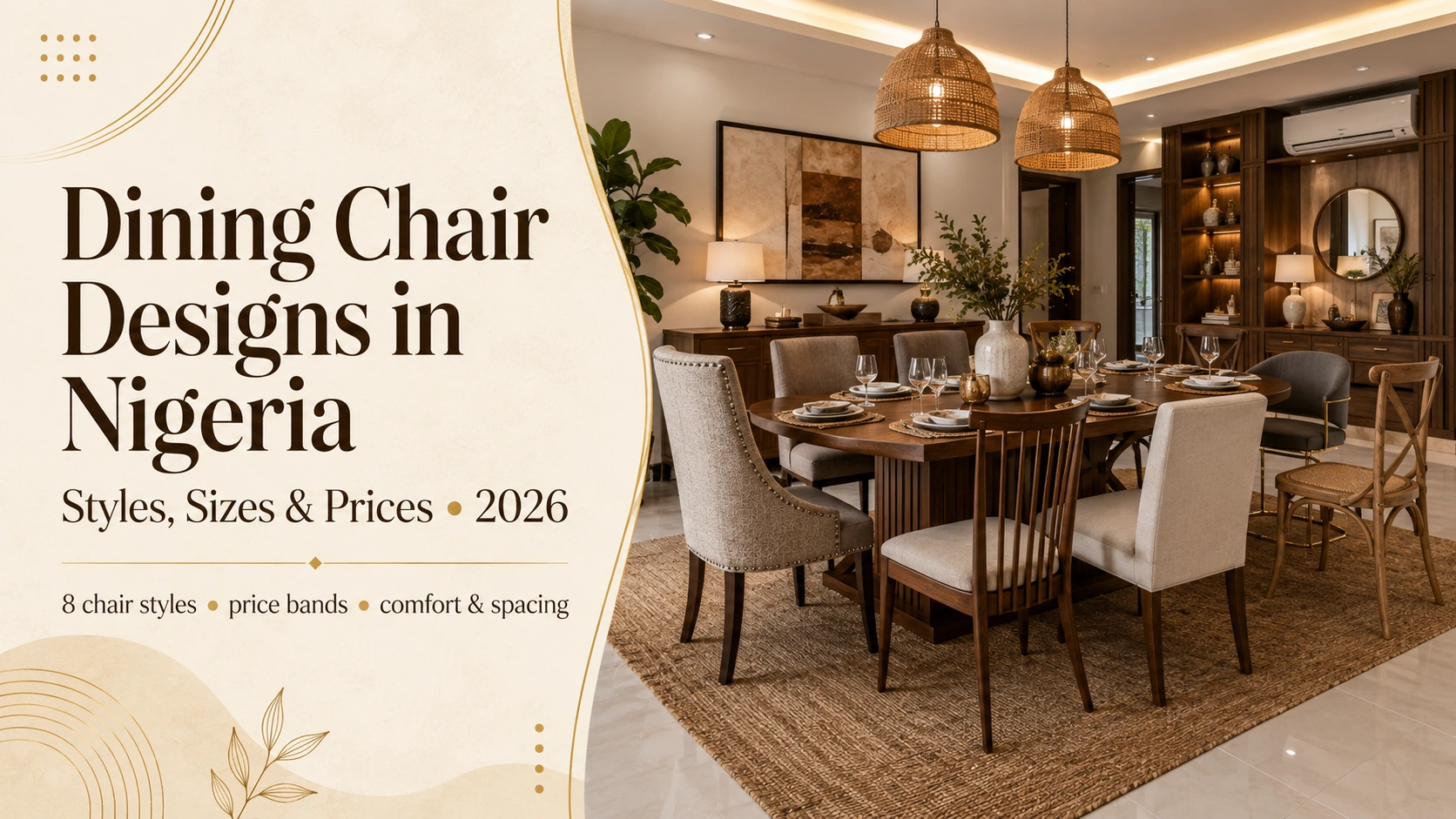
Dining chair designs in Nigeria fall into eight recognisable styles: upholstered high-back, wooden slat-back, fully upholstered Parsons, cross-back and cane, acrylic, metal-frame, carver head chairs and bench seating. Nigerian listings start from about ₦6,000 per chair on marketplaces, from roughly ₦55,000 for a solid wooden dining chair, and from around ₦220,000 for a well-built upholstered one; Vento’s own hardwood range starts from ₦306,096. The two measurements that decide comfort are seat height, which should be 450–480mm, and the 300mm gap between seat and tabletop.
Dining chairs get chosen last and regretted first. They are bought to match a table, often in a hurry, and their real failure points — a seat that is 30mm too high, a joint that loosens after a year of being dragged across tiles, upholstery that shows every spill — only appear months later. This guide covers the styles that actually suit Nigerian dining rooms, the dimensions that make a chair comfortable to sit in for two hours, and the construction details worth paying for.
Quick take: Treat every price as a starting point — chair prices move with materials and exchange rate. Seat height 450–480mm, with 300mm clear between seat top and table underside. Allow 600mm of table edge per person and 900mm behind each chair to pull out. Buy the frame and joinery first, upholstery second, and choose a wipeable, tightly woven fabric or leather if the table is used daily.
Eight dining chair styles in Nigerian homes
Upholstered high-back
A tall padded back, often buttoned or channelled, on a hardwood frame. This is the dominant formal style in Nigerian dining rooms and the one most often supplied with a full suite. The height gives the room presence, though genuinely tall backs can block sightlines in an open-plan space and make a small room feel enclosed.
Wooden slat-back
An all-timber chair with vertical or horizontal slats across the back and either a shaped wooden seat or a slim upholstered pad. It is the most durable everyday chair in this list, tolerates being dragged, wiped and stacked, and suits households with children. It is also the easiest style to repair locally.
Fully upholstered Parsons
A clean rectangular back and seat, upholstered on all faces with no exposed frame. It looks contemporary and reads as expensive, and it is the most comfortable style for long meals. The trade-off is maintenance: with no wipeable surface anywhere, the fabric choice carries the entire burden.
Cross-back and cane
An X-braced timber back, often with a woven rattan or cane seat. Light, airy and increasingly popular in Nigerian homes because it suits both a modern and a relaxed traditional setting. Cane seats need dry conditions and do sag over years of heavy use; a timber seat under a cane-look back is the more durable compromise.
Acrylic and ghost chairs
Moulded transparent or tinted polycarbonate. They visually disappear, which makes them a genuinely clever choice for small dining areas where six solid chairs would overwhelm the room. They scratch over time and are not comfortable for extended sitting, so they suit occasional-use dining rather than a family’s everyday table.
Metal-frame chairs
Slim steel or aluminium frames, usually powder-coated black or brass-finished, with an upholstered or timber seat. They pair well with glass, marble and mixed-material tables and take up little visual space. Check the floor protectors — bare metal feet will mark polished tiles and hardwood within weeks.
Carver and head chairs
The two armchairs placed at the ends of a formal table, usually wider and taller than the side chairs. They signal the head of the table and add a layer of formality. Measure carefully: carvers with arms must clear the table apron, and many do not.
Bench seating
A single bench along one side, usually paired with chairs opposite. It seats more people in less space, tucks fully under the table when not in use, and suits younger households and casual dining. It is less comfortable for long meals and awkward for anyone seated in the middle.
What dining chairs cost in Nigeria
Chairs are usually priced individually but almost always bought in sets of four, six or eight, so the per-chair figure multiplies quickly. The starting points below are drawn from current Nigerian listings across marketplaces, retailers and showrooms; they move with materials and exchange rate, so use them to place a quote rather than as fixed prices.
| Tier | Listings start from | Typical seller | Frame & joinery | Typical life |
|---|---|---|---|---|
| Mass market | from ~₦6,000 | Online marketplaces | Soft wood or thin steel, screwed | 2 – 4 years |
| Mid market | from ~₦55,000 | General retailers | Seasoned hardwood, doweled | 5 – 8 years |
| Upper mid | from ~₦220,000 | Interior retailers | Kiln-dried hardwood, glued and pinned | 10 – 15 years |
| Premium | from ~₦306,000 | Manufacturer showrooms | Hardwood, hand-finished, corner-blocked | 15 – 25 years |
| Imported designer | Higher again | Specialist importers | Engineered or moulded, factory-finished | 20 years + |
Dining chairs take more mechanical abuse than any other seat in a home — dragged sideways, tilted back, sat on heavily — so the step up from mass market buys more durability here than in almost any other furniture category. Vento’s own chairs sit in the premium band and are a genuine standalone product rather than set-only items; you can see the current range and specifications in the dining chairs category, and complete table-and-chair arrangements in the dining room sets range.
The measurements that decide comfort
Chair comfort is dimensional before it is anything else, and the numbers are unforgiving.
Seat height should be 450mm to 480mm from the floor. Below 440mm, knees rise above hips and the chair feels like a low stool; above 500mm, shorter adults lose contact with the floor. The clearance between the top of the seat and the underside of the tabletop should be about 300mm — less and thighs press against the apron, more and diners hunch to reach their plates. Since most Nigerian dining tables stand 750mm to 780mm high, a 460mm seat lands correctly.
Seat width matters for upholstered chairs, where 450mm to 500mm is the working range. Wider chairs seat fewer people per metre of table, which is exactly how a six-seater table ends up comfortably seating four. Seat depth should be 400mm to 470mm; deeper seats force shorter people to perch forward and lose all back support.
Back height is the one dimension that is genuinely a matter of taste, but it has a practical limit: in open-plan rooms, backs above about 1,050mm start to block the view across the space, and a row of tall backs can wall off a dining zone from a sitting area.
Upholstery that survives a Nigerian dining room
Dining chairs face a specific set of hazards — palm oil, stew, red drinks, and small hands. That argues strongly for wipeable surfaces on the seat, whatever is used on the back.
Genuine leather and quality faux leather both wipe clean instantly, which is why they remain the default for family dining chairs. Bonded leather should be avoided: it looks identical when new and delaminates within two to three years, and on a dining chair the wear is concentrated exactly where it will show. Among fabrics, tightly woven performance textiles, dense chenille and treated velvets handle daily use well; loose weaves and pale linens trap stains permanently.
A practical compromise many Nigerian households arrive at is a leather or wipeable seat with a fabric back, or removable seat pads that can be re-covered in a few years for a fraction of the cost of new chairs. Ask whether the seat pad unscrews from below — if it does, the chairs have a second life built in.
How many chairs, and how much space they need
- Allow 600mm of table edge per person, and 700mm if the chairs have arms. A 1.8m table seats six comfortably, not eight.
- Leave 900mm behind each chair to pull it out and stand up; 1,100mm if people need to walk behind seated diners.
- Check apron clearance for carvers — armchairs that will not tuck under the table are the most common sizing mistake.
- Buy at least one spare if the design is likely to be discontinued; matching a single chair later is usually impossible.
- Fit felt or rubber protectors on every leg before the chairs are first used, not after the floor is marked.
Matching chairs to your table
The safest approach is not to match at all but to relate. Buying the chairs that came with the table guarantees coherence and guarantees the room looks like a showroom set; choosing chairs separately gives a room character but demands one deliberate link — a shared timber tone, a shared metal finish, or a shared line in the leg profile.
Weight is the balance to watch. A heavy pedestal table with delicate metal chairs looks unstable; a slim glass table surrounded by bulky upholstered high-backs looks crowded. Roughly match visual mass, then let colour and texture differ. Our guide to dining table designs covers table shapes and the room proportions each suits.
Mixing chairs deliberately
Mismatched dining chairs are now a mainstream look rather than a compromise, but only when the mixing follows a rule. The three that work: same chair in different colours; different chairs in the same material; or matching side chairs with two contrasting carvers at the ends. What does not work is buying whatever is available and hoping — the eye reads unstructured variety as accidental, and a dining room is the one space where that always looks unfinished.
Where the dining area opens onto the kitchen, the chairs are the pieces most visible from both zones, which makes them a useful bridge between the two palettes — a point covered further in our guide to kitchen cabinet designs. If you would rather compare finishes in person, every Vento showroom displays full dining arrangements under consistent lighting.
Frequently asked questions
How much does a dining chair cost in Nigeria?
Dining chair listings in Nigeria start from about ₦6,000 on marketplaces, from roughly ₦55,000 for a solid wooden chair at general retailers, and from around ₦220,000 for a well-built upholstered chair. Premium hardwood ranges start from about ₦306,000 per chair. Prices move with materials and exchange rate.
What is the standard dining chair height?
A dining chair seat should sit 450mm to 480mm from the floor, giving about 300mm of clearance between the seat top and the underside of the table. Since most Nigerian dining tables stand 750mm to 780mm high, a 460mm seat height lands correctly for the majority of adults.
What are the dining chair trends for 2026?
The clear directions are curved and rounded backs replacing hard rectangles, warm timber tones over dark stained wood, and boucle and textured fabrics on upholstered seats. Cross-back and cane-detailed chairs continue to grow, and fully matching six-piece sets are giving way to matched side chairs with contrasting carvers.
How much space does each dining chair need?
Allow 600mm of table edge per person, or 700mm if the chairs have arms, and leave 900mm of clear floor behind each chair so it can be pulled out. Where people must walk behind seated diners, increase that to 1,100mm. A 1.8-metre table seats six comfortably, not eight.
What is the most durable dining chair for a Nigerian home?
A wooden slat-back chair on a kiln-dried hardwood frame with doweled joints is the most durable everyday option. It tolerates dragging, wiping and heavy use, and it can be repaired locally. If upholstery is wanted, a removable seat pad with a wipeable cover gives durability plus the option to re-cover later.
Should dining chairs match the table?
They should relate rather than match exactly. Buying the chairs supplied with a table guarantees coherence but produces a showroom look. Choosing separately adds character provided one element links them — a shared timber tone, metal finish or leg profile — and the visual weight of chairs and table is broadly similar.
What upholstery is best for dining chairs in Nigeria?
Genuine leather or a quality faux leather on the seat, because both wipe clean instantly after spills. Among fabrics, tightly woven performance textiles and dense chenille perform well. Avoid bonded leather, which delaminates within two to three years, and avoid loose weaves and pale linens on a daily-use table.
Can you mix different dining chairs?
Yes, if the mix follows a rule. The three that work reliably are the same chair in different colours, different chairs in a shared material, or matching side chairs with two contrasting carvers at the ends. Unstructured variety reads as accidental rather than designed.
How many dining chairs do I need?
Count 600mm of table edge per person: a 1.4m table seats four, 1.8m seats six, and 2.4m seats eight. Buy one spare if the design may be discontinued, since matching a single chair years later is usually impossible. Benches seat more people but suit casual rather than formal dining.
Why do dining chairs become wobbly?
Wobble comes from joints working loose under sideways force — chairs are dragged rather than lifted, and tilted back while seated. Screwed soft-wood frames loosen fastest; doweled or glued and pinned hardwood frames with corner blocks resist it far longer. Fitting floor protectors reduces the drag force considerably.