

Blog
How to Arrange Furniture in a Nigerian Living Room
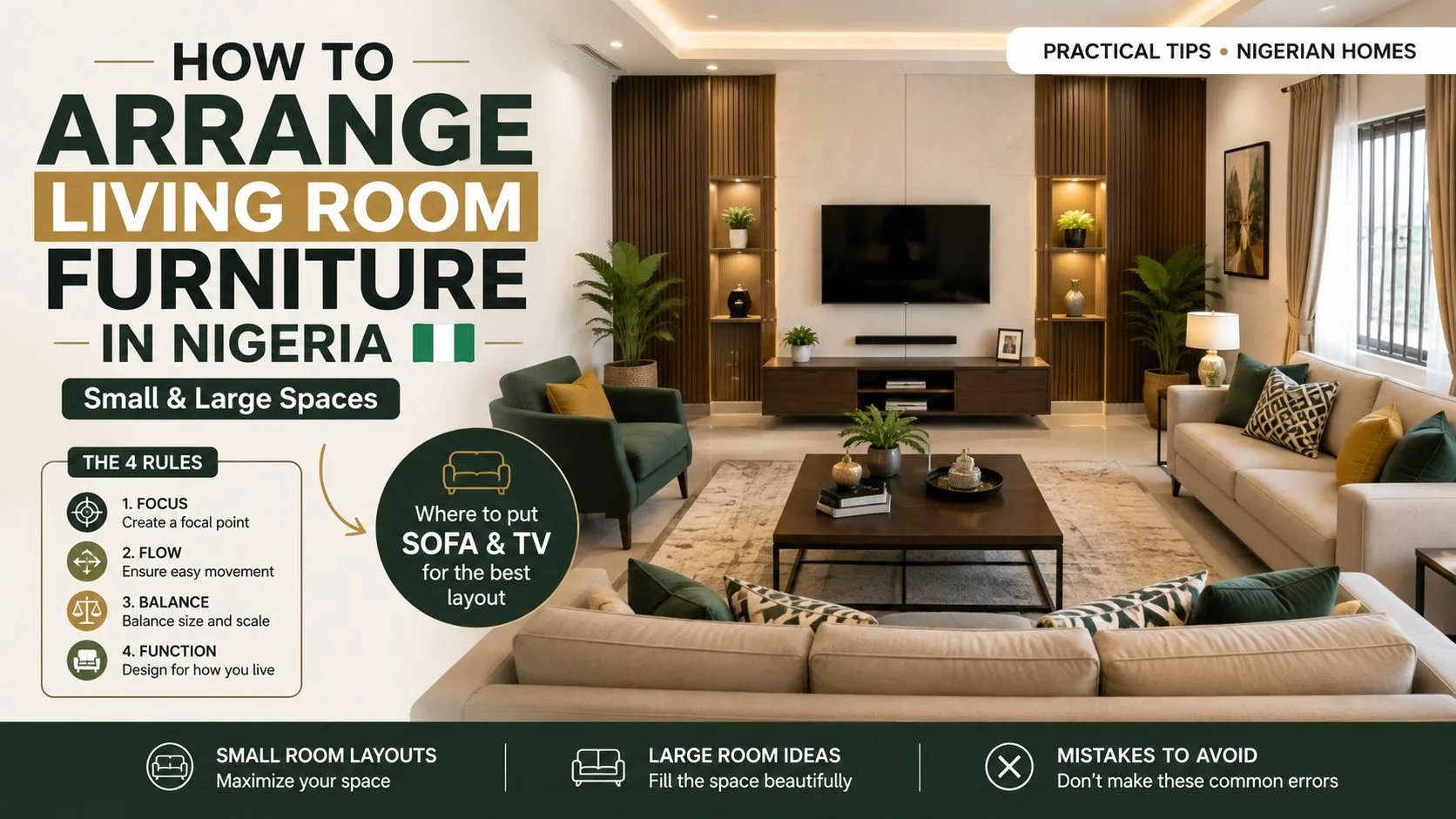
Quick answer: To arrange furniture in a Nigerian living room, start by choosing a focal point — usually the TV wall or a large window — and face the seating toward it. Follow the four rules of good arrangement: keep clear traffic flow, anchor the room with a focal point, balance the furniture’s visual weight, and match every piece to the room’s scale. Leave at least 90 cm of walkway for people to move through, group the sofa and chairs within about two to three metres for easy conversation, and use a rug to tie the seating together. In a small parlour, float a slim 3-seater and an accent chair rather than crowding the walls; in a large room, create two seating zones.
A living room can hold beautiful furniture and still feel wrong if the pieces are in the wrong places — too far apart to talk across, blocking the walk to the door, or pushed flat against every wall so the middle sits empty. Arrangement is the free, invisible half of a good sitting room: it costs nothing, yet it decides whether the space feels welcoming and easy to live in or awkward and cramped. This guide explains exactly how to arrange living-room furniture in a Nigerian home — the rules that always work, where to put the sofa and TV, how to handle a small parlour or a large open-plan space, and the placement mistakes to avoid.
Plan the Layout Before You Move Anything
The best time to plan a living-room layout is before the furniture arrives — or, if it is already in place, before you start dragging heavy pieces around the room. A few minutes of planning saves a lot of lifting and a lot of second-guessing.
Measure and sketch the room
Measure the room’s length and width and make a rough scale sketch on paper or your phone. Mark the sofa, chairs, centre table and TV console to scale and move them around on the drawing first — it is far easier to test three layouts on paper than to shift a seven-seater three times. This step also tells you honestly whether the furniture you have, or plan to buy, actually fits the space.
Note the fixed points
Mark the things you cannot move: the doorways, the windows, the power sockets and the aerial or TV point. These fixed points dictate a lot of the layout — the TV usually goes near its point and away from window glare, and the walkways have to link the doors. Planning around them from the start avoids the common frustration of arranging a beautiful room only to find the television cannot reach its socket. If you are buying new, note these measurements before you visit a Vento showroom so the team can help you choose pieces that fit.
The 4 Golden Rules of Furniture Arrangement
Whatever the size or shape of your living room, four simple principles underpin every arrangement that works. Get these right and the rest follows.
1. Function and Traffic Flow
Arrange the room around how people actually use and move through it. Identify the main paths — from the door to the seating, from the seating to the passage or kitchen — and keep those routes clear. Furniture should never force people to squeeze past or detour, so plan the walkways first and place the pieces around them.
2. A Clear Focal Point
Every good living room has one thing the eye is drawn to and the seating is arranged around — most often the television wall, but it can equally be a large window, a feature wall or a striking piece of art. Choosing the focal point first gives the whole room a centre of gravity and tells you where the sofa should face.
3. Balance and Symmetry
Spread the visual weight around the room so one side does not feel heavy and the other empty. If a large sofa sits on one wall, balance it with a console, a tall plant or a pair of chairs opposite. Balance does not mean everything must match perfectly — it means the room feels evenly composed rather than lopsided.
4. Proportion and Scale
Match every piece to the size of the room. An oversized suite swallows a small parlour, while dainty furniture looks lost in a large reception room. Before you arrange — or buy — measure the space, and choose seating and tables scaled to it. Correct proportion is the difference between a room that feels considered and one that feels stuffed or bare.
Start With the Focal Point
Because the focal point anchors everything, decide it before you move a single chair. In most Nigerian living rooms the television is the natural focal point, so the main sofa faces or angles toward the TV wall. If your room has a beautiful window with a view or a feature wall, that can take the role instead, with the television positioned as a secondary focus. Avoid giving a room two competing focal points on different walls — it splits the seating and makes the layout feel undecided. Once the focal point is set, everything else — the sofa, the chairs, the centre table — arranges naturally around it.
Where to Place the Sofa and TV
The sofa-and-TV relationship is the backbone of most Nigerian living-room layouts, and getting the placement and distance right matters for both comfort and viewing.
Placing the sofa
Position the main sofa so it faces or frames the focal point, ideally with its back to a wall or, in a larger room, floated slightly inward. Contrary to habit, sofas do not have to be pushed flat against the wall — floating the seating a few centimetres in often makes a room feel more designed and less like a waiting room. Place accent chairs to form an L or a U around the centre table so everyone can see each other and the screen.
Placing the TV
Mount or stand the television on the focal wall at comfortable eye level when seated — roughly the centre of the screen at eye height. As a rule of thumb, sit about 2 to 2.5 metres back from a typical Nigerian living-room television for comfortable viewing, and keep it off a wall in direct sunlight to avoid glare on the screen. A low, wide TV console keeps the wall balanced and hides cables and devices.
Creating Conversation Zones
A living room is for people, so arrange the seating to make talking easy. Keep the main sofa and the accent chairs grouped within about two to three metres of one another, angled slightly toward each other around the centre table rather than strung out along the walls. Seats placed too far apart make a room feel cold and force people to raise their voices; seats grouped in a tight, friendly cluster make even a large room feel intimate. In a big living room, it is better to create one well-defined conversation group — or two smaller ones — than to spread single chairs thinly around the perimeter.
Leave Clear Walkways
Circulation is where most living-room arrangements go wrong. Leave at least 90 centimetres of clear space for the main routes through the room and around large furniture, so people can move without turning sideways or stepping over legs. Keep the path from the door to the seating and on to any passage completely clear of obstacles. The single most common furniture mistake is simply too much furniture in one space, which chokes the circulation — when a room feels cramped, the fix is almost always to remove a piece rather than rearrange the ones that are there.
Arranging a Small Nigerian Living Room
Compact parlours in Lagos, Abuja and other cities need smarter placement, not less ambition. The moves that make the biggest difference on a small footprint:
- Choose a slim 3-seater and one accent chair instead of a bulky suite, and float it slightly off the wall to give the room depth.
- Pick furniture with raised legs and a glass-top centre table — visible floor space makes a small room feel larger.
- Angle the seating toward the focal point and keep the centre of the room open rather than filling it.
- Use a large mirror on one wall to bounce light and double the sense of space, and keep the palette light.
- Mount the TV on the wall and use a slim console so the floor stays clear.
Done well, a small living room with a few well-placed pieces feels more intentional and inviting than a large one crammed with furniture. The goal is always breathing room around the seating, not more seats.
Arranging a Large or Open-Plan Living Room
A large or open-plan living room brings the opposite challenge: filling the space so it feels grouped and warm rather than empty and echoing. The key technique is zoning. Use a rug and a tight furniture grouping to define the sitting area within the larger space, and float the sofa well away from the walls so the seating forms an island rather than hugging the perimeter. In an open-plan sitting-and-dining layout, place a sofa or a console back-to-back with the dining area to divide the two zones without a wall, and keep a clear walkway running between them. Two smaller conversation groups often work better than one enormous circle of seats in a very large room.
Using Rugs and Anchor Pieces to Define the Layout
A rug is the single most useful tool for pulling a seating arrangement together, because it visually ties the furniture into one group and marks out the sitting zone. Choose a rug large enough that at least the front legs of the sofa and chairs sit on it — a rug that is too small makes the whole grouping look adrift. Anchor pieces do the same job vertically: a console table behind or beside the sofa, a bookshelf, a tall plant or a pair of side tables give the arrangement structure and stop it feeling like furniture floating in a room. Together, a well-sized rug and a couple of anchor pieces turn a scattered set of furniture into a composed, deliberate layout.
Living-Room Layouts That Work in Nigerian Homes
The best layout depends on the shape and size of your room. This table matches common Nigerian living-room situations to a layout that works.
| Room type | Recommended layout | Seating | Key move |
|---|---|---|---|
| Small parlour (under 14 m²) | L-shape against two walls, floated slightly in | 3-seater + 1 accent chair | Keep the centre open; raised-leg furniture |
| Standard living room | Facing pair or U-shape around a rug | 5- to 6-seater set | Group seating within 2–3 m of the centre table |
| Large reception room | U-shape or two seating zones | 7-seater or L-shaped set + chairs | Float the sofa; anchor with a rug |
| Open-plan (sitting + dining) | Back-to-back zoning with a sofa or console | Sofa set zoned by a rug | Divide zones; keep a clear walkway between |
| Long, narrow room | Seating across the width, not lined up the length | Facing sofas or sofa + chairs | Break the “corridor” feel with a crosswise group |
Common Furniture Arrangement Mistakes to Avoid
A few recurring mistakes hold back otherwise good Nigerian living rooms. Avoiding them costs nothing:
- Too much furniture — the biggest error of all; a crowded room feels smaller and blocks circulation. Less is more.
- Everything pushed against the walls — leaves a dead centre; floating the seating slightly inward reads as more designed.
- Seats too far apart — makes conversation awkward; group the sofa and chairs close around the centre table.
- Blocking the walkways — never place furniture across the natural path from the door to the seating.
- Furniture the wrong size for the room — an oversized suite in a small parlour, or lost pieces in a big room; measure and scale first.
- A rug that is too small — a mat-sized rug makes the grouping look adrift; go large enough to sit under the seating.
How Furniture Choice Affects Your Layout
The best arrangement in the world cannot fix furniture that is the wrong size for the room, so placement and buying go hand in hand. A right-sized Vento sofa set — a 3-seater plus a chair for a small parlour, a 5- to 7-seater for a family room — is the foundation everything else arranges around. A centre table in proportion to the sofa grounds the seating without blocking the walkway, and a low, wide TV console keeps the focal wall balanced and the cables hidden. Well-chosen curtains frame the focal window and soften the room. For the design directions to pair with your layout, see our Nigerian living room design ideas, and if you are furnishing from scratch, our guide to furnishing a Nigerian home covers what to buy first.
Where to Find Furniture Sized for Your Room
Because scale is half the battle, seeing furniture in person — and knowing its exact dimensions — is the surest way to arrange a room that works. Vento Furniture displays complete living-room settings, from compact 3-seaters for small parlours to large L-shaped suites for reception rooms, across ten showrooms in Lagos, Abuja, Port Harcourt and Kaduna, so you can judge scale before you buy. Browse the range online and visit your nearest Vento showroom for advice on sizing furniture to your space, with delivery and installation nationwide. Bring your room measurements and a note of where the door, windows and TV point sit, and the showroom team can steer you toward a sofa set, centre table and console that arrange comfortably in the space you actually have — the surest way to avoid the all-too-common mistake of falling for a suite that overwhelms the room once it is delivered. Getting the scale right at the buying stage makes every arrangement decision that follows far easier.
Frequently Asked Questions
What are the four rules of furniture arrangement?
The four rules of furniture arrangement are: consider function and traffic flow so people can move freely, create a clear focal point for the seating to face, balance the visual weight of the furniture around the room, and match every piece to the room’s proportion and scale. Together they make almost any living room feel considered.
Where should the sofa and TV go in a living room?
Place the television on the focal wall at seated eye level, and position the main sofa facing or angling toward it, ideally about 2 to 2.5 metres back for comfortable viewing. Keep the TV off a wall in direct sunlight to avoid glare, and arrange accent chairs in an L or U around the centre table so everyone can see the screen.
How do I arrange furniture in a small living room in Nigeria?
In a small Nigerian living room, use a slim 3-seater and one accent chair instead of a bulky suite, choose raised-leg furniture and a glass-top centre table, and keep the centre of the room open. Float the seating slightly off the wall, mount the TV, and add a large mirror to make the space feel bigger.
Should a sofa be against the wall or in the middle?
A sofa does not have to be against the wall. In small rooms, placing it against a wall saves space, but floating it a few centimetres inward — or well into the room in a large space — often looks more designed and helps define a seating zone. The key is that the sofa faces the focal point with clear walkways around it.
What is the biggest mistake in arranging furniture?
The biggest mistake is putting too much furniture in one room, which makes the space feel cramped and blocks the circulation. When a living room feels wrong, the fix is usually to remove a piece rather than rearrange what is there. Other common errors are pushing everything against the walls and spacing the seats too far apart.
How much walking space should I leave in a living room?
Leave at least 90 centimetres of clear walkway for the main routes through the room and around large furniture, so people can pass comfortably without turning sideways. Keep the path from the door to the seating and any passage completely clear of furniture.
How far should a sofa be from the TV?
For a typical Nigerian living-room television, sit roughly 2 to 2.5 metres back for comfortable viewing, adjusting for the screen size — larger screens suit a little more distance. The centre of the screen should sit at about eye level when you are seated on the sofa.
How do I arrange an open-plan living and dining room?
Zone the two areas without a wall: place a sofa or a console table back-to-back to separate the sitting area from the dining area, use a rug to define the seating group, and keep a clear walkway running between the zones. Coordinate the furniture finishes so the open-plan space still reads as one room.
Do I need a rug to arrange a living room?
A rug is not essential, but it is the single most effective tool for tying a seating arrangement together and defining the sitting zone, especially over hard tiled floors. Choose one large enough that at least the front legs of the sofa and chairs rest on it; a rug that is too small makes the grouping look adrift.
How do I make a small living room look bigger?
Make a small living room look bigger by keeping the palette light, choosing raised-leg furniture that shows floor space, floating slim seating slightly off the walls, mounting the TV, and adding a large mirror to bounce light. Above all, avoid over-filling the room — open space around the seating is what makes it feel larger.