

Blog
Office Table Designs in Nigeria: Types, Styles & How to Choose (2026)
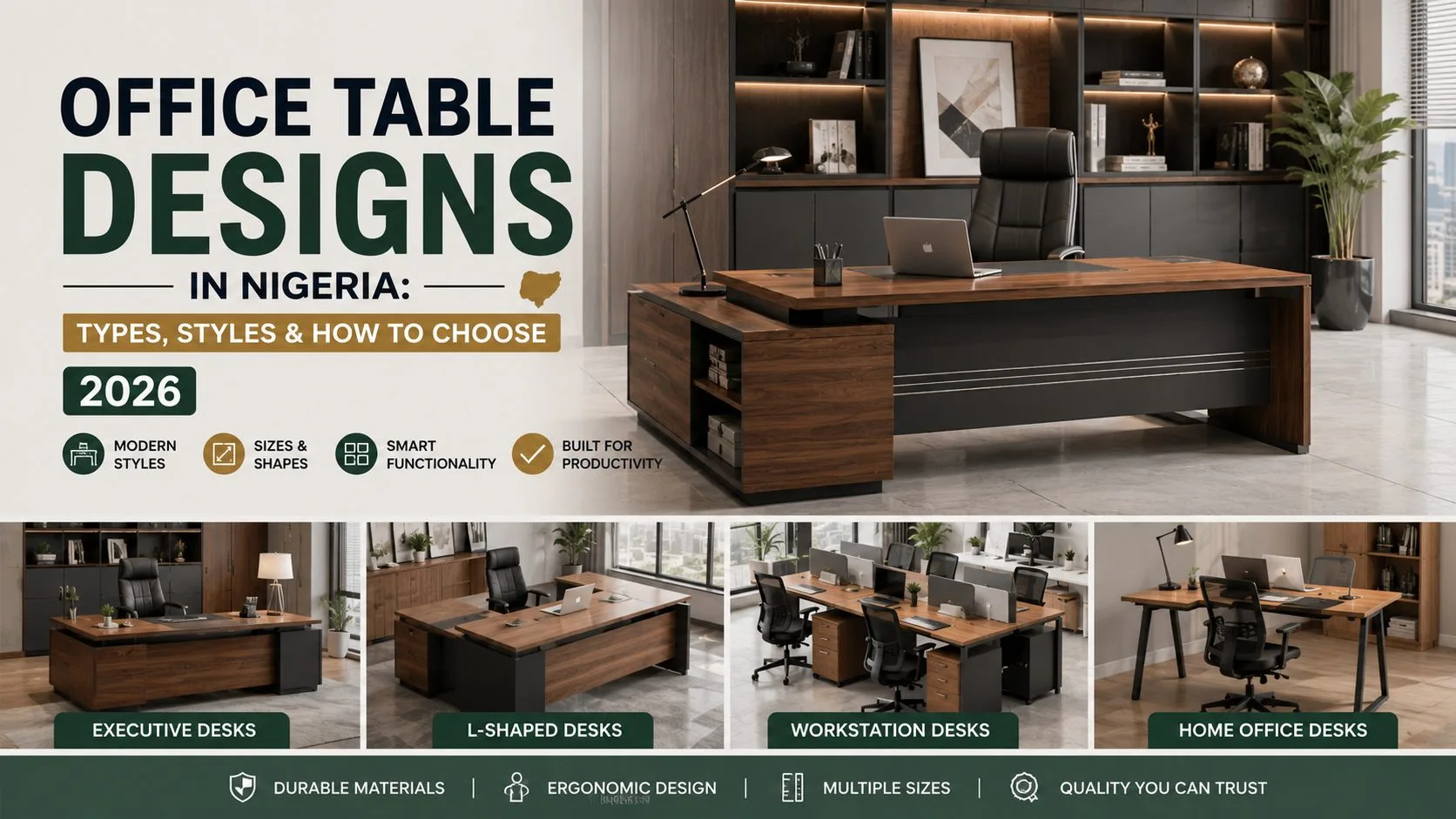
Quick answer: The most popular office table designs in Nigeria in 2026 are the executive desk, the L-shaped executive table, the modern metal-and-wood workstation, the compact home-office desk, the glass-top contemporary desk and the reception front desk. The right design depends on who uses it and the room it sits in: an executive in a private office wants a wide hardwood-veneer desk that signals authority, while a hybrid worker at home wants a compact 1.2–1.4 m desk with tidy cable management. Choose the style for the setting first, then match the size to the equipment and floor space. Browse current models and prices in our executive office tables collection.
Your office table is the piece of furniture you sit behind for most of your working life. It shapes how you work — whether two monitors and your paperwork fit comfortably, whether cables stay tidy, whether a visitor can pull up a chair — and, in an executive office, it quietly signals rank and seriousness before a word is spoken. Getting the design right matters as much as getting the size right. This guide walks through the office table designs working in Nigerian offices and home offices in 2026 — the styles, the shapes, the materials and how to choose the look for your workspace — so you pick a desk that works as hard as you do and looks the part for years.
8 Office Table Designs for Nigerian Offices in 2026
There is no single “best” office table design — the right one depends on the role, the room and the impression you want to make. These are the eight designs we see most often across Nigerian offices and home offices today, from the boardroom to the spare-bedroom desk.
1. Executive Desk
The classic boss desk: a wide 1.6–2 m surface, a full modesty panel to the front, integrated drawers to one side and a hardwood or hardwood-veneer finish. This is the design that communicates authority and permanence, built for a private office where the desk faces the door and hosts visitor conversations across its surface. It is the default choice for directors, managers and senior professionals.
2. L-Shaped Executive Table
An L-shape adds a second wing at ninety degrees to the main desk — a dedicated space for a printer, filing, or a small stand-up meeting with one visitor. It fills a corner efficiently and gives far more usable surface without eating extra wall length, which is why it is the most-requested premium configuration for senior executive offices. It suits a room with a spare corner and a professional who switches between heads-down work and quick consultations.
3. Modern Workstation Desk
A lighter, contemporary look: a metal frame with an engineered-wood or laminate top, often with privacy panels and a slim mobile drawer unit underneath. This is the design for open-plan offices, co-working spaces and Lagos and Abuja tech environments where a clean, minimal footprint and easy reconfiguration matter more than heavy presence. Workstation desks group neatly in rows or clusters.
4. Home Office & Compact Desk
Built for hybrid and remote work, the compact desk is 1.0–1.4 m wide with just enough surface for a laptop or single monitor plus paperwork, and tidy cable routing so a spare-bedroom corner does not look like a server room. The best home-office designs balance a small footprint with real build quality, because a desk used eight hours a day still has to survive daily wear.
5. Glass-Top & Contemporary Desk
A tempered-glass top over a metal or wood base keeps a small office feeling open and light, and reads as sleek and modern rather than corporate-traditional. Glass suits contemporary interiors and creative studios; the trade-off is that it shows fingerprints and needs regular wiping, so it is best where the desk is not buried under paperwork all day.
6. Reception & Front Desk
The reception desk is the first piece of furniture a visitor meets, so its design carries the brand. A raised front counter conceals the receptionist’s work surface and equipment while presenting a clean, often logo-ready face to the room. Finish and colour here should echo the company’s identity — warm wood for a professional-services firm, crisp white or metal-and-glass for a modern brand.
7. Boardroom & Conference Table
A boardroom table is a long or oval surface seating six to twelve, designed as the centrepiece of a meeting room. The design job is proportion — the table should fill the room with clear chair clearance all round — and coordination, matching the finish of the executive desks and seating elsewhere in the office for a unified look across the floor.
8. Computer & Study Desk
The smallest of the family: a compact desk sized for a computer, a student or a single-task corner, sometimes with a keyboard tray or a small shelf stack. It is the practical choice for a study, a child’s room or a junior staff position, and the design priority is a small footprint and a comfortable, correct working height rather than presence.
Office Table Design by Workspace — Which Style Fits Where?
Before you choose a finish, match the design to the workspace and the person using it. This table pairs each design with the setting it suits, the typical size and the look it projects — for current models and pricing across these tiers, see the Vento office table collection.
| Design | Typical width | Best office setting | Look & feel |
|---|---|---|---|
| Executive desk | 1.6 – 2.0 m | Private director / manager office | Authoritative, warm, permanent |
| L-shaped executive | 1.6 m + 1.4 m wing | Senior executive with meeting corner | Substantial, multi-purpose |
| Modern workstation | 1.0 – 1.4 m | Open-plan, co-working, tech office | Light, clean, contemporary |
| Home office / compact | 1.0 – 1.4 m | Remote & hybrid home working | Neat, unobtrusive, practical |
| Glass-top contemporary | 1.2 – 1.6 m | Creative studio, modern small office | Sleek, open, minimal |
| Reception front desk | 1.6 – 2.4 m | Office entrance / lobby | Branded, welcoming, polished |
| Boardroom table | 2.0 m + | Meeting & conference room | Formal, coordinated centrepiece |
What size should an office table be?
Standard office desks stand about 74–76 cm high — the comfortable seated working height for most adults. For width, a home office or supervisor runs well on 1.0–1.4 m; a manager or mid-executive with dual monitors needs 1.4–1.6 m; a director or CEO desk sits at 1.8–2.0 m or an L-shape. Whatever the size, leave at least 90–110 cm of clearance behind the desk so the chair can push out, and about 60 cm on the visitor side for guest chairs.
Choosing the Right Shape — Rectangular, L-Shape or U-Shape
Shape is the first design decision, because it drives both how the desk works and how much room it needs. The rectangular desk is the most common and the most flexible: it fits almost any wall, suits every role from junior to CEO, and is the easiest to place. It is the safe default when the room or the routine is undecided.
The L-shape adds a return wing for a second surface — ideal when you juggle a computer setup on one side and paperwork, a printer or a visitor consultation on the other. It uses a corner efficiently but needs roughly a 3.5 × 3 m footprint to sit properly. The U-shape (a desk with returns on both sides) wraps the user in work surface and is reserved for senior executives with the room to spare. As a rule, choose rectangular for flexibility and small rooms, L-shape for multitasking executives with a corner, and U-shape only for a large private office.
Materials & Finishes That Shape the Look
The material is where an office table’s design personality lives, and it also decides how the desk copes with Nigerian heat, humidity and daily use. Solid hardwood and hardwood-veneer tops give warmth, depth and a sense of permanence — the finish of choice for executive and boardroom desks where the furniture communicates rank. Engineered wood (MDF or HDF) with a wood-look laminate is lighter and more affordable, and perfectly suited to home offices and open-plan workstations, though budget laminate wears faster under daily use.
Metal frames paired with a wood or laminate top read modern and industrial, keep the visual weight light, and are the backbone of contemporary workstation designs. Tempered glass tops feel sleek and open but show marks. Finish and colour carry the brand too: warm walnut and oak tones suit professional-services and traditional corporate offices; white, grey and black with metal accents suit modern and tech interiors. As a rule, pick the finish to match your office’s character and the impression you want a visitor to form.
Executive Table vs Standard Office Desk — a Design Perspective
The two terms are used interchangeably in Nigerian listings but describe different pieces of furniture. A standard office desk is functional and compact — typically 1.0–1.4 m, basic drawer storage, engineered-wood construction — designed for daily task work in open-plan offices and home setups. An executive table is larger (1.4–2.0 m or L-shaped), with integrated multi-drawer storage, a modesty panel, hardwood or hardwood-veneer construction, cable management and a visible presence built to communicate seniority.
From a design point of view, the difference is scale, storage and the message the desk sends. A junior workstation should be efficient and unobtrusive; a director’s desk should anchor the room and read as considered and substantial. Match the tier to the role — an over-large boss desk crowds a small office, while an under-specified desk undercuts a senior professional. The Vento executive table range covers the full spectrum, and for the seating that completes the setup our guide to the best office chairs in Nigeria pairs directly with the desk designs here.
Designing a Home Office Desk Setup
With hybrid work now normal in Lagos, Abuja and beyond, the home office desk has become one of the most-searched furniture designs in Nigeria. The design goal is a workspace that performs like an office but disappears into a home — so scale matters most. A 1.2–1.4 m desk gives room for a laptop or single monitor plus notes without dominating a spare bedroom or living-room corner, and a design with built-in cable routing keeps the setup looking calm rather than cluttered.
Position the desk to make the most of natural light and, increasingly, to give a tidy background for video calls — a growing consideration in 2026 office design. Invest in build quality even at compact sizes: a desk used for full working days needs solid joints and a stable top, because the cheapest home desks loosen and wobble within a year of daily use. A well-chosen compact desk paired with a supportive chair is the foundation of a home office that is comfortable to work in day after day.
Office Table Design for Small Offices
Compact offices and home workspaces call for smarter design choices, not smaller ambitions. The moves that make the biggest difference:
- Choose a rectangular or wall-hugging desk over an L-shape when floor space is tight — it fits flush and leaves the room open.
- Pick a design with a slim mobile drawer unit that tucks under the desk instead of a bulky attached pedestal.
- Use a light finish or glass top and a metal frame to keep the desk visually weightless and the room feeling larger.
- Prioritise cable management — grommets and under-desk trays — so a small space does not read as messy.
- Leave a clear 90 cm behind the desk for the chair; a desk you cannot push back from always feels cramped, however compact.
Done well, a small office with one well-proportioned desk and tidy cabling can feel more focused and professional than a large one filled with mismatched furniture.
Matching Your Office Table to the Whole Office
The most common Nigerian office-furniture mistake is buying the desk in isolation and forgetting the pieces around it. A desk works as part of a set: start with a supportive, well-matched Vento office chair in a finish that complements the desk, then add visitor chairs and a side filing cabinet in the same wood species and hardware palette so the office reads as one considered scheme.
For offices with a consultation or waiting area, a compact visitor sofa and a coffee table extend the design out from the desk, while well-chosen office curtains or blinds control glare on screens and double as a tidy backdrop for video calls. Coordinating these pieces to a single finish is what separates a professional office from a collection of furniture that happens to share a room.
2026 Office Table Design Trends in Nigeria
Nigerian office design is moving toward warmth, flexibility and quiet technology rather than the heavy, dark-timber boardroom look of a few years ago. The strongest trends we are seeing in 2026:
- Warm wood over cold minimalism — walnut and oak tones are replacing stark black-and-chrome for a more human, welcoming workspace.
- Built-in cable management — grommets, under-desk trays and routing channels are now expected, not optional, as multi-device setups become standard.
- Video-call-ready design — desks positioned and finished with a clean background in mind, a direct result of hybrid working.
- Ergonomic-friendly proportions — correct desk heights and generous depth to sit comfortably with monitors at the right distance.
- Modular workstations — lighter metal-and-wood desks that reconfigure as teams grow, replacing fixed heavy suites in open-plan offices.
The through-line is a workspace that supports how people actually work today — flexible, tidy and comfortable — while still looking professional. Choosing a desk in these directions is the simplest way to keep an office feeling current for years rather than seasons.
Caring for an Office Table in Nigerian Conditions
An office table earns its keep over long working days, and Nigeria’s heat, humidity and strong sunlight test furniture hard — so a little care protects the design for years. Keep the desk out of direct, all-day sunlight where you can; constant sun fades wood finishes and can warp thin laminate tops over time. In humid regions like Lagos and Port Harcourt, position the desk with a little air circulation behind it rather than pressed hard against an exterior wall.
Wipe wood and veneer surfaces with a soft, dry or slightly damp cloth rather than harsh cleaners, use a coaster for drinks to protect the finish, and clean glass tops with a proper glass cleaner to avoid streaks. Tighten frame and leg bolts once or twice a year — a desk in daily use takes real weight and a well-locked frame stays stable and silent. A quality office table cared for this way holds its look and structure far longer than a bargain desk that loosens and sags within a couple of years of use.
Common Office Table Design Mistakes to Avoid
A few recurring mistakes hold back otherwise good Nigerian offices. The most common is buying a desk too large for the room — an imposing 2 m executive desk in a small office leaves no clearance and feels cramped rather than impressive. Others include ignoring cable management and ending up with a tangle of wires on show, choosing a finish with no relationship to the office’s branding or interior, pairing an expensive desk with a poor chair that undermines both comfort and the look, and under-buying at the budget end so the desk loosens within a year of daily use. The fix for all of them is the same: plan the desk around the role, the room and the rest of the office before you buy.
Where to See & Buy Office Tables in Nigeria
Seeing a desk in person — judging its scale, running your hand over the finish, testing the drawers — is the surest way to choose before you commit. Vento Furniture displays executive tables, workstation desks and complete office settings across ten showrooms in Lagos, Abuja, Port Harcourt and Kaduna, so you can compare designs and picture them in your own workspace. Browse the full range online through our office table collection and visit your nearest Vento showroom for delivery and in-room installation nationwide. Furnishing a whole office or a corporate floor? Request a bulk quote and our commercial team will plan desks, chairs and meeting-room furniture to one coordinated finish.
Frequently Asked Questions
What is the most popular office table design in Nigeria in 2026?
The most popular office table design in Nigeria in 2026 is the executive desk — a wide 1.6–2 m hardwood-veneer table with integrated drawers and a modesty panel. For open-plan and home offices, the lighter modern workstation and compact home-office desk with tidy cable management are the fastest-growing designs.
What are the different types of office tables?
The main types of office tables are the executive desk, the L-shaped executive table, the modern metal-and-wood workstation, the compact home-office or computer desk, the glass-top contemporary desk, the reception front desk and the boardroom conference table. Each is designed for a different role and office setting.
What is the best shape for an office table?
The best shape depends on the space and the role. A rectangular desk is the most flexible and fits any office, an L-shape gives extra surface for multitasking executives with a corner to spare, and a U-shape wraps a senior executive in work surface in a large private office. Rectangular is the safe default for small rooms.
What is the standard size of an office table?
A standard office table is about 74–76 cm high, with widths from 1.0–1.4 m for home and supervisor desks, 1.4–1.6 m for managers with dual monitors, and 1.8–2.0 m or L-shape for directors and CEOs. Allow 90–110 cm of clearance behind the desk for the chair.
What is the difference between an office table and an executive table?
A standard office table is compact (1.0–1.4 m) with basic storage and engineered-wood construction for everyday task work, while an executive table is larger (1.4–2.0 m or L-shaped) with multi-drawer storage, a modesty panel, hardwood construction, cable management and a presence designed to communicate rank.
What office table design is best for a small office or home office?
For a small office or home office, a compact rectangular desk of 1.0–1.4 m with a slim mobile drawer unit, a light finish or glass top and built-in cable management is the best design. It fits flush against a wall, keeps the room feeling open and still leaves clearance for the chair.
Should I choose a wooden or metal-frame office table?
Choose a wooden or hardwood-veneer office table for private executive offices and boardrooms where warmth, authority and permanence matter, and a metal-frame desk with a wood or laminate top for open-plan offices, co-working spaces and modern interiors where a lighter, contemporary look is preferred.
What are the latest office table design trends in Nigeria for 2026?
The latest office table trends in Nigeria for 2026 are warm walnut and oak finishes replacing cold black-and-chrome, built-in cable management as standard, video-call-ready desk positioning, ergonomic-friendly proportions, and lighter modular workstations that reconfigure as teams grow.
How do I match an office table to my office branding?
Match an office table to your branding through finish and colour: warm wood tones suit professional-services and traditional corporate offices, while white, grey or black with metal accents suit modern and tech brands. Carry the same finish through the desk, chairs, reception and storage so the whole office reads as one identity.
Where can I buy office tables in Nigeria?
You can buy office tables — from compact home desks to executive and boardroom tables — from Vento Furniture, both online and across ten showrooms in Lagos, Abuja, Port Harcourt and Kaduna, with delivery, in-room installation and bulk options for corporate fit-outs nationwide.