

Blog
POP Design for Sitting Room — 10 Best Ideas in Nigeria 2026
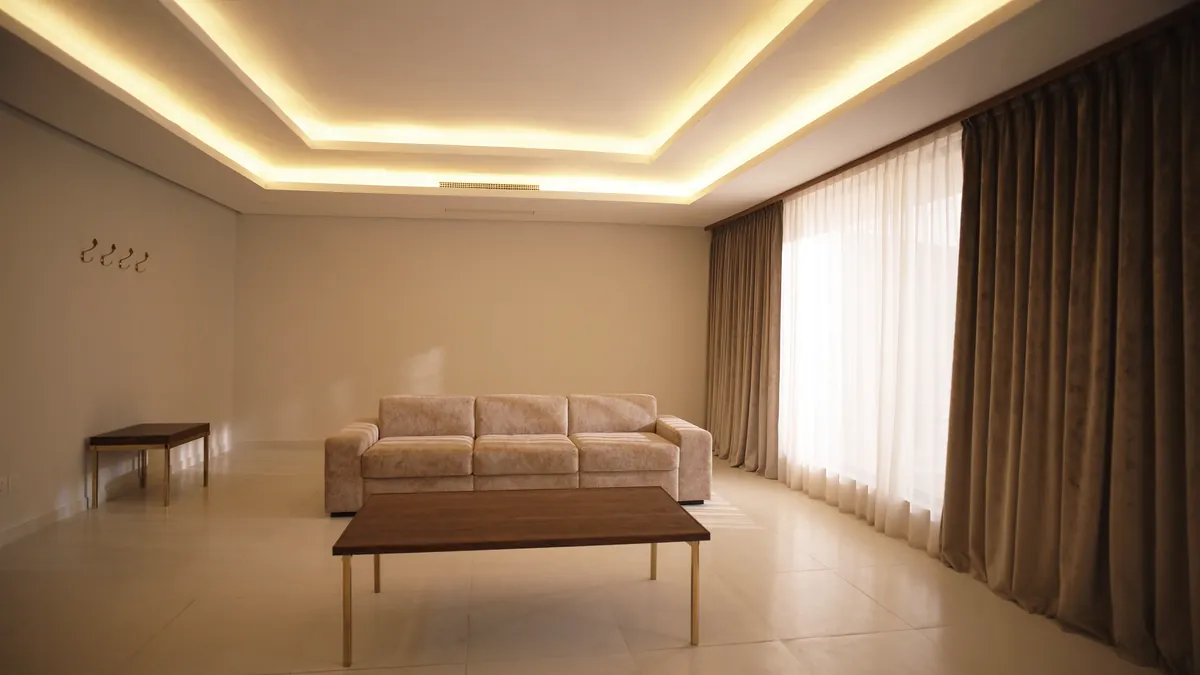
The best POP design for a Nigerian sitting room is a simple tray ceiling with hidden warm LED cove lighting, scaled to your room size and ceiling height. Multi-layer, coffered and curved POP work suits larger rooms with higher ceilings, while cornices and single trays protect small rooms. This guide compares ten styles, materials, per-square-metre costs and furniture pairings.
A POP ceiling is the first thing a guest looks up at, the surface that hides cables and wiring, and the frame for the sofa set, center table and curtains below it. Vento Furniture has showrooms in Lagos, Abuja, Port Harcourt and Kaduna where you can see how furniture sits in a finished room. For layouts, seating and colour schemes beyond the ceiling, read our guide to sitting room design in nigeria.
10 POP Design Styles for Nigerian Sitting Rooms
Style is the first design decision because it sets the mood of the whole room and decides how strongly the ceiling competes with the furniture beneath it. Each style below names the room it suits and a relative cost level, with real naira figures in the cost section further down. Our overview of interior design styles explains each look across the whole room.
1. Simple Tray Ceiling With Cove Lighting
A single clean rectangular tray recessed into the centre of the ceiling, with a hidden LED strip running around the inner lip. It is the most requested simple POP design for living room projects because it works in a standard flat and pairs with any sofa colour. Best lighting is warm white at 2700 – 3000 K. Cost level: entry.
2. Multi-Layer POP With Recessed Spotlights
Two or three stepped POP layers, each smaller than the last, with recessed downlights set into the lowest layer. This modern POP design for living room rewards higher ceilings of about 3 m and looks balanced above a neutral, low-profile sofa. Best for formal sitting rooms of 18 – 25 m². Cost level: mid.
3. Coffered POP Ceiling
A grid of recessed square or rectangular panels, the classical coffered look. It is reserved for double-volume sitting rooms with ceilings of 3.5 m or more, where the grid has height to breathe. It pairs with large-format center tables and heavy upholstery. Best for estate sitting rooms and formal entertaining spaces. Cost level: high.
4. POP Ceiling With Wooden Panel Insert
A POP perimeter framing a central panel in walnut or oak veneer. Smooth white plaster against warm timber is a popular contemporary contrast, especially when it echoes a wooden coffee table. Match the timber finish to your furniture, and read our guide to types of wood for furniture before you choose. Cost level: mid to high.
5. Step-Down (Stepped) POP Ceiling
The opposite of a tray ceiling. The centre stays at standard height while the perimeter steps downward in two or three layers, creating a visual frame around the seating zone. It works well in long, rectangular sitting rooms such as those in terrace duplexes. Best for rectangular rooms of 18 – 28 m². Cost level: mid.
6. Curved POP Ceiling With Smooth Edges
Curved, organic shapes instead of straight rectangular trays. The curves soften a boxy room and catch LED light gently along each edge. Circular and medallion shapes also give a chandelier a natural focal point. Best for modern minimal interiors and statement rooms. Curved work needs a skilled installer who can mould it on site. Cost level: mid to high.
7. Coloured POP Ceiling
Most POP is painted bright white, but the recessed section of a tray can carry a muted accent such as sage green, dusty rose, charcoal or deep navy. It works best with neutral walls so the ceiling becomes the focal point. Best for design-forward homes and eclectic interiors. Cost level: the tray cost plus painting.
8. Floral and Geometric Pattern POP
Hand-moulded floral motifs or geometric grids across the ceiling face, the closest a POP ceiling gets to traditional craftsmanship. It suits formal Nigerian parlours where the furniture is upholstered in deep tones such as burgundy or royal blue. Detail density drives the price, so ask for a sketch before work starts. Cost level: high.
9. POP With a Planned Ceiling Fan Position
The common question about a pop design for sitting room with fan is whether a fan ruins the design. It does not, provided the POP is planned around it. Decide the fan position before the framework goes up, and keep cove lighting clear of the blades. The lighting section below explains how to brief your installer. Cost level: tray cost plus fixing work.
10. POP Feature Wall and TV Backdrop
POP is not only a ceiling material. A vertical feature wall behind the TV stand, with grooved lines, arches or recessed niches, turns a flat wall into a focal point and hides cables. Many current designs combine a simple tray ceiling with a sculpted wall instead of putting all the detail overhead. See our guide to POP TV wall designs. Cost level: priced per wall.
POP vs Gypsum vs PVC — Ceiling Materials Compared
The word POP gets used loosely in Nigerian construction for anything resembling a moulded white ceiling, but three materials behave differently. Choose by how the ceiling will be used, not by what your installer happens to prefer.
POP (Plaster of Paris)
POP is calcined gypsum that sets hard within minutes of mixing with water. A false ceiling is built by fixing a framework under the slab, covering it with POP board or mesh, then finishing with plaster by hand. It is the only material flexible enough for trays, coving, curves and sculptural detail, and skilled artisans are available in almost every state capital. Its weakness is water.
Gypsum Board
Gypsum board is a factory-made panel screwed onto a metal frame. It installs faster than wet-applied POP and offers better fire resistance. A standard 12.5 mm sheet of 1.2 m by 2.4 m costs about ₦4,500 – ₦7,000 as of November 2026, and installation rates are similar to or slightly below POP. Like POP, it softens and collapses when saturated by a roof leak.
PVC Ceiling
PVC ceilings are interlocking plastic strips that are waterproof, termite-proof and quick to fit. They cost about ₦2,500 – ₦4,500 per m² installed, which makes them the budget tier, and they are popular in kitchens, bathrooms and verandas. The design range is limited and the look is less premium than moulded POP in a formal sitting room.
Many installers combine materials, using gypsum board for the flat field and POP for the perimeter, trays and moulded detail. That keeps the sculptural look where it shows and speeds up the flat sections. A false ceiling of any kind also hides electrical conduit, air-conditioning ducts and wiring, and traps an air gap that gives a modest reduction in heat and noise from above.
Pros and Cons of a POP Ceiling
Before you commit to POP, weigh what it gives you against what it asks of you. The balance is favourable in most Nigerian homes, but only when the roof is sound and the installer is skilled.
What POP Does Well
POP lets a skilled artisan build almost any shape in one material, from a flat ceiling with a cornice to coffered panels, rosettes and sculptural curves. It conceals conduit, air-conditioning ducts, pipes and wiring that would otherwise show below the slab. The trapped air gap gives a modest reduction in heat and sound from above, and cove lighting gives an immediate sense of luxury.
Where POP Needs Care
Water is the main enemy, because a single serious roof leak can stain, sag and crack a ceiling that took weeks to build. Cracking is the most common complaint, and the usual causes are movement in a young building, fasteners expanding in the day-night temperature swing, and a mix with too much water, which sets weak and shrinks. Quality depends heavily on the artisan, so check past work.
Is It Worth the Investment
Many homeowners treat a well-finished POP ceiling as a long-term finishing investment, because it improves lighting, hides services and sets the tone of the room. The sensible approach is to pick a simpler design done well over a complex design done cheaply, and to protect the result with a sound roof and routine inspection.
POP Design by Sitting Room Size
Room area and ceiling height filter the design choice before style ever enters the conversation. Match the tier of POP work to the actual dimensions of your sitting room using the guide below.
- Compact, under 14 m² and under 2.7 m high. Cornices only, or a single-layer tray with cove lighting. Avoid multi-layer, coffered and dropped-step designs.
- Small, 14 – 18 m² and 2.7 – 2.9 m high. A simple tray, a wooden panel insert or a single-tier curve. Avoid coffered and deep multi-layer work.
- Medium, 18 – 25 m² and 2.9 – 3.2 m high. Multi-layer trays, step-down ceilings and coloured trays all work, and a fan position can be planned in.
- Large, 25 – 35 m² and 3.2 – 3.5 m high. Coffered grids, sculptural curves and carved floral or geometric designs have room to read properly.
- Extra large, over 35 m² and over 3.5 m high. Full coffered ceilings, multi-zone designs and POP feature-wall combinations. Plain, unaccented ceilings look lost.
Small Sitting Rooms
In a small room, light colours reflect more light and a single-layer ceiling with small recessed lighting keeps the space open. Overly complex designs make the ceiling feel lower and the room smaller. For furniture scale, layouts and storage in compact rooms, see our guide to small sitting room design ideas.
Large Sitting Rooms
Large rooms give you creative freedom, including multiple ceiling levels, bold geometric patterns and a chandelier centre. Cover the zone above the seating area rather than the whole ceiling, so the design draws the eye exactly where the family gathers instead of turning the room into a hotel lobby.
Parlour and Sit-Out Ceilings
Many Nigerians search for a parlour or sit-out design rather than a sitting room, and the principles are the same. A parlour inside the house takes any style above, scaled to its size. A sit-out or veranda is exposed to wind-blown rain, so a water-resistant finish such as PVC is often the safer ceiling there, with POP kept indoors.
How Much Does POP Ceiling Design Cost in Nigeria in 2026?
Most Lagos, Abuja and Port Harcourt installers price per square metre of finished ceiling area, with separate lines for cove lighting, recessed downlights, painting and scaffolding. The figures below come from the nigeriabuildingcost.ng POP calculator, plus one contractor rate from charismakproject.com, checked on 12 November 2026, and are guidance only. Collect at least three written quotes before you sign.
| Design | Per m² | Note |
|---|---|---|
| Basic flat ceiling, economy finish | From ₦4,500 | Secondary-city rate |
| Standard finish in Lagos | ₦10,555 | 14 m² room, ₦147,775 all-in |
| Standard POP ceiling rate | ₦13,500 | Contractor rate, charismak |
| Coffered ceiling | 70 – 100% above flat | Extra framework and layers |
| Premium waffle ceiling | Up to ₦22,000 | Highest-cost POP design |
| PVC ceiling, for comparison | ₦2,500 – ₦4,500 | Installed, limited designs |
As a worked example, a 16 – 20 m² sitting room priced across the ₦4,500 – ₦13,500 band comes to roughly ₦72,000 – ₦270,000 before painting, wiring and scaffolding. The Lagos standard-finish rate of ₦10,555 per m² puts an 18 m² room near ₦190,000. These are estimates built from the sources above, not a Vento quotation, and Vento Furniture does not install ceilings.
What Changes the Price
Three factors move the quote most. Ceiling area scales the cost in a straight line. Design complexity matters because a coffered ceiling costs 70 – 100% more per square metre than a flat one. Finish level and city matter too, since Lagos and Abuja carry a premium for skilled POP artisans. Ceiling height above 3 m adds scaffolding.
What the Quote Usually Leaves Out
Ask whether the quoted rate covers materials and labour or labour only. Rates in the calculator above exclude painting, scaffolding for ceilings above 3 m and electrical wiring for lights. Light cut-outs add roughly ₦3,500 each, and a cove recess adds roughly ₦3,500 per metre of perimeter, so an 18 m perimeter adds about ₦63,000 before the LED strip itself.
Ways to Keep the Budget in Check
Choose a simple modern design, because fewer layers mean less labour and material. Request quotes from several experienced installers and ask each to itemise materials, labour, lighting and painting. Settle the design before work starts, since changes after installation begins usually raise labour cost, and buy quality plaster and framing, which tends to reduce repair costs later.
Lighting and Fans in a POP Ceiling
Lighting decides how good a POP ceiling looks at night, and it has to be planned before the plaster goes on. The conduit, junction boxes and wiring are fixed first, because cutting holes afterwards is possible but can crack the surrounding plaster.
Cove and LED Strip Lighting
A continuous channel around the perimeter hides an LED strip so the ceiling is washed with soft, indirect light instead of harsh downward beams. Warm white at 2700 – 3000 K suits a sitting room, bedroom or dining room, while 4000 K is the usual choice for kitchens and offices. Avoid very cool white in a parlour because it turns the room clinical.
Recessed Downlights
Recessed LED downlights give sharper, more functional light for reading corners and the TV wall. In a room with a 3 m ceiling, a sensible layout places them about 600 mm from the walls and 1.2 – 1.5 m apart, centre to centre. Combine them with cove strips rather than relying on downlights alone, which can leave hotspots.
Chandeliers and Centre Roses
If your sitting room has a central chandelier, a circular or medallion POP feature draws attention to the fixture and makes the room feel more finished. Pendants suit modern interiors, and a chandelier needs a fixing point that the installer plans into the framework. Confirm the weight of the fixture with your electrician before the ceiling is built.
Ceiling Fans
A fan and a POP design can share a ceiling, but the position has to be agreed before the framework is built. Tell the installer the fan model, mark the fixing point, and keep the cove channel and any tray edge well clear of the blades. Follow the fan maker’s clearance advice, and ask your electrician to confirm the fixing is strong enough.
POP Ceiling Colours and 2026 Design Trends
White remains the most popular ceiling colour because it reflects light, makes a room feel larger and matches every interior style. Off-white, cream, light grey, beige and warm white are the usual alternatives, and neutral shades keep the ceiling timeless.
The Nigerian POP guides published through 2026 keep returning to the same directions. Hidden LED everywhere. Cove lighting has moved from a luxury upgrade to the default expectation, so visible bulbs and bare ceiling fixtures look dated. Floating and drop ceilings. The centre appears suspended, with light glowing around its edges at night, which suits television rooms.
Geometric patterns and double layers. Hexagons, rectangles and interlocking shapes pair well with LED lighting, and large rooms can carry two ceiling levels. Minimalist borders. Straight lines, simple borders and hidden lighting suit contemporary furniture. POP plus a feature wall. Instead of packing all the detail into the ceiling, designers run POP work down a single wall behind the TV or the longest sofa.
How to Choose the Right POP Design for Your Sitting Room
Three questions narrow the choice from ten styles to the right one for your room.
1. What is your ceiling height? If your ceiling is under 2.7 m, stick to cornices, single-layer trays or a POP feature wall, because multi-layer and coffered designs visually shrink the room. At 3 m or more, almost any style works, and coffered work and sculptural curves come into their own at 3.2 m and above.
2. What does the furniture below look like? A heavy multi-layer ceiling above a small two-seater sofa looks unbalanced. A useful rule is ornate ceiling, simple sofa; simple ceiling, ornate sofa. If you are still shopping, decide on the sofa set first, because its scale tells you how much ceiling drama the room can hold.
3. How will the room be used? A daily family room with children needs a simpler ceiling with fewer carved edges to gather dust. A formal sitting room for guests can carry a multi-layer or coffered ceiling. For a room that does both, split the difference with a multi-layer tray plus a single feature wall.
Visit a showroom. Photos do not capture POP ceilings well, and they do not show how furniture scale reads beneath a ceiling either. Visit a Vento showroom in Lagos (Ikeja, Ikoyi, Lekki or Ajah), Abuja (Wuse II or Kado), Port Harcourt or Kaduna to see the sofa sets, center tables, TV stands and curtains in person.
Browse Sofa Sets Contact Vento Furniture
POP Design Mistakes to Avoid in Nigerian Sitting Rooms
Six avoidable mistakes come up again and again, and the fix is almost always cheaper if you catch it before installation begins.
1. Designing the ceiling before measuring the room. Every design on Pinterest was photographed in a specific room. Copying a 30 m² penthouse ceiling into a 16 m² flat never works, so take floor area and ceiling height before you browse styles.
2. Hiring without seeing finished work. Ask for at least three completed projects you can visit in person, not photographs. Check how straight the cornice lines are, how sharp the panel corners are and how smooth the ceiling looks under side light, which reveals flaws that normal lighting hides.
3. Planning the lighting last. Cove channels, downlight positions and wiring routes are set during the POP installation, not afterwards. Decide on every fixture before the first plaster mix.
4. Ignoring the roof above. POP is durable in dry conditions and fails under water. If your roof has any history of leaks, fix it first, or the new ceiling will stain and may sag.
5. Mismatching ceiling drama and furniture scale. A coffered ceiling above a thin glass center table looks unbalanced. The ceiling and the furniture should signal the same level of formality, both ornate or both restrained.
6. Changing the design mid-job. Modifications after installation starts usually raise labour cost, so settle the sketch, the lighting plan and the finish before work begins.
How POP Ceilings Are Built and Maintained
Knowing the build sequence helps you judge whether your contractor is doing the work properly. A correctly installed ceiling follows five stages.
- Fix a level metal or timber framework under the slab with hanger rods or plugs.
- Fix POP board, or stretch wire mesh for curved and three-dimensional designs.
- Apply a rough scratch coat, then comb it to give the finish coat a key.
- Apply the smooth finish coat and attach cornices and mouldings with wet POP.
- Let the ceiling dry for 24 – 48 hours before painting.
Everyday Care
Dust the moulded edges with a soft long-handled brush or a microfibre duster on an extending pole, especially during the Harmattan months when dust settles fast on cornices and tray lips. Do not wash a POP ceiling with water. Yellowing, stains and mildew patches almost always point to moisture from above, so treat the roof, not just the surface.
Roofs, Cracks and Termites
Inspect the roof and gutters after each heavy rainy season, and repair leaks the week they appear. Hairline cracks in the finish coat can be filled with fresh POP, feathered and repainted, but cracks wider than 3 mm or cracks that follow movement joints need a specialist. Metal furring channels avoid the termite risk that timber battens carry.
Pairing POP Design With the Right Sitting Room Furniture
The point of investing in a POP ceiling is that the rest of the room rises to meet it. If you are building the room from scratch, start with our guide on how to furnish a home, and use our overview of types of furniture to understand the pieces you are choosing between. For style direction across the whole room, see our interior decoration sitting room ideas.
Simple Tray and Cove Lighting
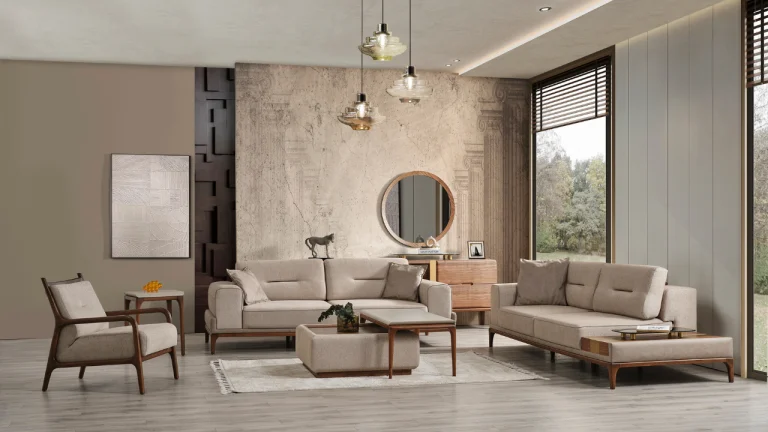
A simple tray works best above a neutral sofa set in cream, beige or grey, with a plain wooden center table and cream or champagne curtains. The pairing reads modern and minimal, and it suits compact and small rooms. The Icon sofa set below shows the kind of calm, light-toned seating that sits well under a tray with cove lighting.
Multi-Layer and Coffered POP
Multi-layer ceilings pair with a low-profile contemporary sofa in a 3+2+1 arrangement and a center table sized to the seating zone. Coffered ceilings suit large rooms and demand equally substantial furniture, such as deep upholstery, a large center table with matching side tables and heavy floor-length curtains. Place the center table so the ceiling feature sits directly above the seating zone.

Feature Wall and TV Stand
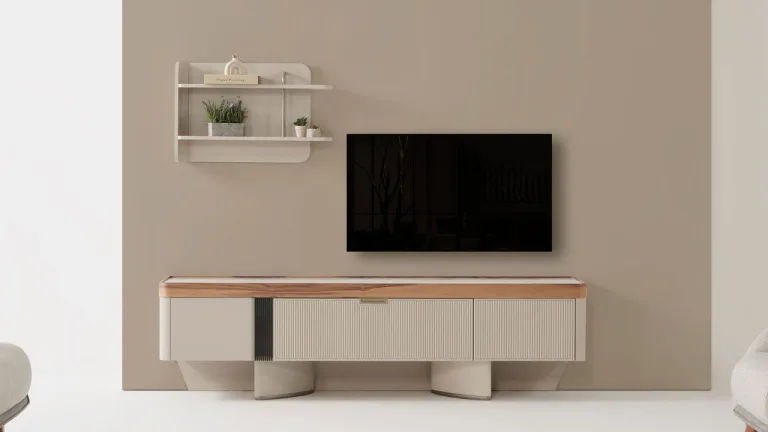
A POP feature wall with a simple ceiling reverses the formula, so choose a quiet TV stand and plain curtains that do not compete with the wall detail. A soft neutral stand with a ribbed front suits a recessed or arched backdrop. Work out where the sofa and the TV face each other using our guide on how to arrange living room furniture.
Curved or sculptural ceilings work with a curved modular sofa and a round or pebble-form center table that echo the ceiling’s geometry. Coloured trays need a neutral sofa in a tone that complements the paint, with curtains that pick up the tray accent. Floral and geometric carved ceilings belong in formal parlours with deep-toned, button-tufted upholstery and carved hardwood tables.
POP Design Beyond the Sitting Room
Many homes carry the same ceiling language through several rooms, which makes the whole house feel planned. Keep the sitting room as the most detailed ceiling and simplify the rooms around it.
Bedroom and Dining Room
Bedrooms generally call for simpler ceilings with a perimeter cove for a relaxed atmosphere, and the dining room often takes a decorative centre panel above the table. Our guides to pop design for bedroom spaces and pop design for dining room layouts cover the styles, lighting and furniture pairings for each.
Open-Plan Kitchens
In an open-plan home the sitting room ceiling often runs straight into the kitchen. Keep the kitchen section simple and easy to clean, and use warm or neutral white strips so the colour temperature does not jump at the join. If you are planning the kitchen itself, see our guides to kitchen cabinet designs and the kitchen cabinet buying guide.
Frequently Asked Questions
What is POP design for a sitting room?
POP design is ceiling and wall finishing built with Plaster of Paris, a gypsum-based plaster that sets into a smooth, paintable surface and can be moulded into trays, cornices and curves. Nigerians also call it POP work. In a sitting room it usually means a tray ceiling with cove lighting, cornices, multi-layer ceilings or a feature wall behind the TV.
How much does a POP ceiling cost in Nigeria?
Published Nigerian rates in November 2026 run from about ₦4,500 per m² for a basic economy flat ceiling to ₦22,000 per m² for a premium waffle design, with a standard Lagos finish near ₦10,555 per m². A 16 – 20 m² sitting room therefore lands roughly between ₦72,000 and ₦270,000 before painting, wiring and scaffolding.
Which POP design is best for a small sitting room?
For a sitting room under 14 m² or with a ceiling below 2.7 m, choose a single-layer tray with cove lighting, or just perimeter cornices. Both add visual height and keep the room open. Avoid multi-layer, coffered and step-down designs in small rooms, because they lower the perceived ceiling and make the space feel smaller.
Which is more costly, gypsum or POP ceiling?
The two cost about the same in Nigeria. Gypsum board installation rates are similar to or slightly below standard POP, and gypsum installs faster, but POP gives far more design freedom for trays, curves and cornices. Price depends on area, layers, lighting and city, so compare written quotes that state whether materials are included.
Is POP better than PVC for a sitting room?
For a formal sitting room, POP is usually the better choice because it allows moulded detail, a seamless matt finish and hidden cove lighting. PVC costs about ₦2,500 – ₦4,500 per m² installed and is waterproof and termite-proof, so it suits kitchens, bathrooms and verandas better than a formal parlour.
Can I install a POP design with a ceiling fan?
Yes. A pop design for sitting room with fan is routine, but the fan position must be decided before the framework is built. Tell the installer which fan you will use, mark the fixing point, and keep the cove channel and tray edge clear of the blades. Ask your electrician to confirm the fixing is strong enough.
What colour is best for a POP ceiling?
White is the most popular choice because it reflects light, makes the room feel larger and matches almost every interior style. Off-white, cream, light grey, beige and warm white are good alternatives. If you want colour, paint only the recessed section of a tray in a muted accent and keep the rest white.
What lighting works best with a POP ceiling?
Warm white LED strips at 2700 – 3000 K hidden in a cove channel give the softest effect, and recessed downlights add focused light over seating and the TV wall. Use 4000 K only in kitchens and offices. Always fix the conduit and wiring before the POP board goes up, not after.
Is POP good for Nigeria’s climate and roof leaks?
POP performs well indoors in Nigeria, and the real enemy is water, not humidity. A roof leak can make a POP ceiling stain, sag and crack, so fix any leak first and inspect the roof after each rainy season. Dust edges with a soft brush and never wash the ceiling with water.
Where can I buy furniture that suits a POP ceiling in Nigeria?
Vento Furniture sells sofa sets, center tables, TV stands and curtains, and you can see them at our showrooms in Lagos (Ikeja, Ikoyi, Lekki and Ajah), Abuja (Wuse II and Kado), Port Harcourt and Kaduna. Choose a ceiling first, then pick furniture whose scale and formality match it.
2 thoughts on “POP Design for Sitting Room — 10 Best Ideas in Nigeria 2026”
Comments are closed.