

Blog
Curtain Fabric Types — Sheer, Blackout, Velvet and Linen

The main curtain fabric types are sheer fabrics such as voile and tulle, linen, cotton and polyester blends, velvet and blackout fabric, and they differ mainly in how much light, heat and outside view they let through. Sheers soften daylight, velvet and blackout darken a room, and linen and cotton sit in between.
Last updated: 24 November 2026 — fabric properties checked against The Fabric Mill, Sinocomfort, Spotlight, James Dunlop Textiles, Dunelm and Zafrin Bliss, and Vento curtain details checked against the live catalogue. This guide compares each fabric for light, privacy and heat, answers whether blackout curtains keep a Nigerian room cool, explains sheer and voile curtains and how to layer them, and covers lining, cleaning and the right fabric for each room.
Curtain Fabric Types at a Glance
Every curtain fabric is a trade-off between four things: how much daylight it lets in, how much of the room it hides from the street, how well it holds back the sun’s heat, and how much care it needs. The table puts the six fabric groups you will meet in Nigerian shops side by side, drawing on The Fabric Mill and Sinocomfort fabric guides.
| Fabric | Light | Privacy | Best room |
|---|---|---|---|
| Sheer, voile, tulle | Soft, diffused daylight | Daytime only | Sitting room, layering |
| Linen | Filters, airy glow | Light to medium | Sitting room, dining |
| Cotton and blends | Light to medium filtering | Medium | Study, kitchen |
| Polyester | Filtering to blackout | Medium to full | Any room, humid rooms |
| Velvet | Blocks most light | Full | Bedroom, formal parlour |
| Blackout | Blocks nearly all | Full, day and night | Bedroom, media room |
How to read the table: the same fibre can sit in more than one row. Polyester can be woven as a fine voile or as a dense blackout cloth, and any fabric becomes darker once a lining is sewn behind it. Ask what the fabric is and whether it is lined, not only what colour it is.
Light, privacy and heat
Light and privacy usually move together. A fabric that hides the room from the street also blocks more daylight, which is why most homes in Lagos, Abuja and Port Harcourt use two layers rather than one. Heat follows weight, since Google’s overview of the topic and The Fabric Mill both name thick, tightly woven fabrics such as velvet, lined cotton and blackout as the best at keeping a room cool.
Weight and how a fabric hangs
The Fabric Mill notes that medium-weight fabrics such as linen, cotton blends and polyester give the most natural drape, while very light sheers float and very heavy velvets fall in deep, structured folds. Weight is quoted in GSM, grams per square metre, and Google’s overview puts velvet at roughly 300 to 450 GSM and blackout fabrics at 250 to 400 GSM. Weight also decides the hardware. Sinocomfort warns that velvet needs a sturdy rod, and a fully lined blackout curtain is heavier again, so plan the track before you choose the fabric.
Do Blackout Curtains Keep a Nigerian Room Cool?
Yes, a well-fitted blackout curtain keeps a sunny room noticeably cooler, because it stops most of the sunlight that would otherwise heat the floor, the walls and the furniture. Google’s overview, citing Dunelm and retail guides, describes blackout curtains as using dense weaves or special linings to block light, reduce heat and dampen outside noise.
How blackout fabric works
Sinocomfort explains that “blackout” describes a function rather than a single fibre. It is usually achieved with a tight triple weave or with a foam or acrylic coating bonded to the back of a base cloth such as polyester or velvet. Depending on thickness and lining, Google’s overview puts the light blocked at roughly 85 to 99 per cent or more. Curtains sold as thermal add an insulating layer for the same purpose.
Heat, sun and air conditioning
West- and south-facing windows take the strongest afternoon sun, so those are the windows where a blackout layer pays back first. Closing it before the hottest hours keeps heat from building up in the room, which means the air conditioner or fan has less work to do when NEPA light or the generator is on. Leave it open in the cool morning to air the room.
Blackout versus room-darkening
True blackout panels block nearly all light, while room-darkening curtains leave a soft glow around the room. Light also leaks round the edges of any curtain, so the fit matters as much as the fabric. Google’s overview advises mounting the rod wider and higher than the window to limit gaps at the sides and the top.
Sheer and Voile Curtains
A sheer curtain is a lightweight, translucent panel that filters daylight and gives light daytime privacy while keeping the room bright. Online Curtains lists the main sheer fabrics as voile, linen sheers, chiffon, silk sheers and lace, and Google’s overview adds organza and tulle. Sheers are the layer most Nigerian sitting rooms keep closed all day against glare and passing eyes.
How see-through sheers are
Sheers are translucent rather than transparent. In daylight you see out clearly while people outside see mostly reflected light and the fabric, so the room feels private. At night the effect reverses: with lights on inside, shapes and movement show through to the street. That is why a sheer on its own suits daytime, and a second, heavier curtain is needed after dark.
Voile, tulle, nets and lace
Voile is a smooth, finely woven, semi-transparent cloth, usually polyester or cotton. Tulle is a very fine net, the fabric many Turkish-style sheers are called after, and it is often embroidered. Nets are open mesh panels, and lace has a decorative open pattern. Chiffon and organza are the most see-through and suit soft draping more than privacy. Sheers hang from eyelet, rod-pocket, tab-top, pinch-pleat or ripple-fold headings, and ripple fold suits a ceiling track best.

Semi-sheer and light-filtering sheers
Between a true sheer and a solid curtain sits the semi-sheer, a slightly denser weave such as linen or textured polyester. It hides more of the room while still letting a soft glow through. Semi-sheers work well where a full curtain would make a room gloomy, such as a narrow parlour window or a staircase window facing a neighbour.
How to Layer Curtain and Sheer
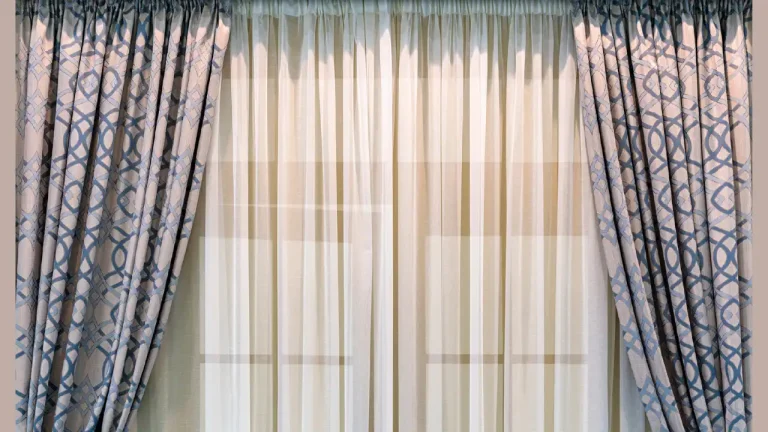
Layering a curtain and sheer is the most practical answer to Nigerian light and heat. The sheer stays drawn in the daytime to cut glare and give privacy, and the heavier curtain closes in the evening or during the hottest afternoon. Zafrin Bliss, whose layering guide ranks for this search, puts the blackout layer on the inner rod, closest to the glass, for maximum darkness and lets the sheer fall over it from the outer rod. Many Nigerian homes reverse the order, keeping the sheer by the window and the decorative curtain facing the room.
Double track or double rod
A double rod or a double ceiling track holds both layers on separate runners, so each opens and closes on its own. A track recessed into a POP ceiling hides the hardware completely, which suits a modern sitting room. Make sure the front runner sits far enough forward that the heavier curtain does not drag on the sheer behind it.
Getting the proportions right
Proportion is what makes a layered window look finished rather than crowded. These steps follow Zafrin Bliss’s measuring advice and the mounting tip in Google’s overview, and they apply whether you buy ready-made panels or have curtains sewn to size.
- Measure the window width and add 15 to 30 cm on each side, so both layers can stack off the glass when open.
- Fix the rod or track well above the frame, closer to the ceiling, to make the window look taller and stop light leaking over the top.
- Let both layers reach the floor, or just kiss it, for a premium look in a sitting room.
- Choose a sheer with at least as much fullness as the main curtain, so it does not look thin when drawn, and if a tailor sews the curtains, give the finished width and drop rather than the window size.
- Keep the sheer lighter in colour than the main curtain, or in the same tone, so the window reads as one design.
Velvet, Linen and Cotton-Blend Curtains
These are the main curtains in front of the sheer, and they set the mood of the room. Velvet reads as formal and rich, linen as relaxed and natural, and cotton or polyester blends as easy, everyday fabrics. The right choice depends on how dark you want the room, how much cleaning you are willing to do and how humid the house gets.
Velvet curtain fabric
Velvet curtain fabric has a dense cut pile that gives depth of colour and a soft sheen. Sinocomfort notes that the pile blocks light almost as well as a dedicated blackout fabric and also absorbs sound and holds back heat. Its weight gives curtains rich, structured folds, but it needs a strong rod and most velvets should be dry cleaned.

Linen and semi-sheer linen
Linen has a relaxed, slightly textured look and filters a soft, warm light. Google’s overview of curtain fabrics notes that it creases easily and can mildew in damp rooms, which matters in coastal cities in the rainy season. Poly-linen blends keep the look while resisting creases, so they suit busy homes that do not want to iron curtains.

Cotton, polyester and blends
Cotton is breathable, easy to sew and comes in endless prints, but it can shrink if washed wrongly and usually needs a lining for real light control. Polyester and its blends are the most durable choice, resisting fading and wrinkles, and Google’s overview singles them out for humid and high-traffic rooms. Jacquard and damask weave the pattern into the cloth, so the design does not fade like a print. Rayon, nylon, acrylic and chenille mostly appear in blends, while showroom labels such as chintz, a glazed cotton, moiré, a watered sheen, and ikat describe a finish or weave rather than a new fibre.
Lining, Weight and Cleaning by Fabric
The face fabric is only half of a good curtain. A lining protects it from the sun, adds weight so it hangs straight and can turn a light fabric into a darkening one. Cleaning also differs sharply from one fabric to the next, so check the care label before you choose a fabric for a room that gets dusty. Sinocomfort lists anti-mildew and water-resistant finishes as worth asking about for humid rooms.
Linings and interlinings
A standard lining is a plain cotton or polyester layer sewn behind the curtain. It shields the face fabric from fading, which matters most for silk and bright cottons, and makes the curtain look fuller. A blackout lining turns almost any fabric into a darkening curtain, and Sinocomfort lists blackout-lined finishes as a way to add opacity and insulation to any base fabric.
Weight, rods and tracks
Heavy fabrics pull on their fixings every time they are opened. Velvet and lined blackout curtains need a solid rod with brackets fixed into the wall or a strong ceiling track, while sheers and voiles hang well on a slim rod or a light track. Fit the brackets close to each end and add a centre support on a long window.
Cleaning each fabric
Harmattan dust settles on curtains quickly, so a soft vacuum brush every few weeks keeps every fabric fresher. Beyond that, Sinocomfort’s care guidance and the Ceejay Interiors sheer care tips give a simple rule for each fabric group.
- Cotton and polyester can usually go on a gentle, cold machine cycle and be hung to dry.
- Voile and other sheers prefer a hand wash or a delicate cycle in cold water, then a light steam instead of a hot iron.
- Linen does best on a delicate cycle, hung to dry and steamed while still slightly damp.
- Velvet and silk should be dry cleaned to protect the pile, colour and sheen.
- Coated blackout fabric is usually wiped clean, because machine washing can damage the coating.
Which Fabric for Which Room
Start with what the room is used for and when. A sitting room used all day needs light and privacy, a bedroom needs darkness at night and sometimes in the afternoon, and a kitchen needs a fabric that shrugs off steam and grease. For measuring, fullness and hardware, our curtain buying guide walks through the rest of the decision.
Sitting room and parlour
A sheer or semi-sheer behind velvet, linen or a jacquard curtain gives daytime privacy and an elegant evening look. Match the curtain colour to the sofa or rug so the window ties the room together. If you are planning the whole space, the curtains should follow the same palette as your sitting room design in nigeria, from the POP ceiling to the centre table.
Bedroom
Bedrooms benefit most from blackout fabric or a blackout lining, because light from security lamps and the early sunrise disturbs sleep. Velvet is the premium alternative and adds warmth to the room’s look, and the curtain colour should follow your wider bedroom design in nigeria. Keep a sheer behind it if the bedroom is also used in the daytime, so you can have privacy without shutting out all the light.
Dining room, kitchen and study
Dining rooms suit silk-look polyester, jacquard or linen for a formal finish. Kitchens need short, washable cotton or polyester kept clear of the cooker, and where a curtain is impractical, as over a sink, a roller blind is the usual alternative, with a sheer hung over it if you want softness. A study or home office does best with a light-filtering fabric that cuts glare on screens without making the room dark. For ideas on style, pleats and colour, see our guide to curtain designs.
Fabrics in Vento Curtains
Vento names a fabric only where a product description states it, so this section quotes those descriptions as of November 2026 and does not generalise across the range. Browse all Vento curtains to compare styles, and ask the sales team about the fabric of any listing that does not name it.
What the listings state
The Turkuaz Tulle Drape is described as tulle with a sheer material that lets soft natural light filter through. The Lustrous Linen Curtain is described as linen with a semi-sheer nature. Sultan’s Velvet Shades and the Velvet Glimmer are described as velvet that still lets a soft, filtered glow through.
Blackout and what to ask before ordering
The Velvet Vista description mentions a rich velvet texture with light filtering. None of the Vento curtain descriptions checked for this guide calls its fabric blackout, so for a fully dark bedroom ask a Vento showroom in Lagos, Abuja or Port Harcourt about adding a lining. For current figures, see our curtain price in nigeria guide.
Curtain Fabric FAQ
What is the difference between sheers and curtains?
Sheers are thin, translucent panels that filter daylight and give daytime privacy, while curtains are heavier, opaque or lined fabrics that block light and hide the room at night. Many homes hang both on a double rod, using the sheer in the daytime and closing the curtain for evenings and the hottest afternoons.
Are sheer curtains transparent?
No, sheer curtains are translucent rather than fully transparent. In daylight they let you see out while people outside mostly see the fabric, so the room feels private. At night, with the lights on inside, shapes and movement show through, which is why sheers are usually paired with a heavier curtain for evenings.
What are the three types of curtains?
The three main types of curtains by fabric are sheer curtains, light-filtering curtains and blackout curtains. Sheers soften daylight and give daytime privacy, light-filtering fabrics such as linen and cotton dim the room while letting a glow through, and blackout curtains use dense weaves or linings to block nearly all light and much of the heat.
What are the sheer curtains called?
Sheer curtains are also called sheers, voiles, net curtains or nets, and tulle curtains when the fabric is a fine net. In Nigerian shops you will often hear net or lace for patterned sheers. The names describe the same idea, a light, see-through panel that filters daylight and gives daytime privacy.
Do blackout curtains make a room hotter or cooler?
Blackout curtains make a sunny room cooler. They stop most of the sunlight that would otherwise heat the floor and furniture, so less heat builds up and the air conditioner or fan works less. Close them before the hottest part of the afternoon and open them in the cooler morning to let the room breathe.
How far past the window should blackout curtains extend?
Blackout curtains should extend well past the window on every side to stop light leaking round the edges. A practical rule is 15 to 30 cm beyond the frame on each side, with the rod fixed well above the frame and the curtain reaching the floor or at least clearly below the sill.
What fabric is used for sheer curtains?
Sheer curtains are usually made from voile, tulle, chiffon, organza, lace or a light linen. Most ready-made sheers are polyester voile because it is durable, easy to wash and does not crease much. Linen sheers give a softer, textured look, and embroidered tulle is a popular decorative choice in Nigerian sitting rooms.
What’s the difference between nets and voiles?
Nets are open mesh panels with visible holes, often with a lace pattern, while voiles are smooth, finely woven fabrics that look like a continuous veil of cloth. Voiles give a cleaner, more modern look and slightly more privacy, while nets and lace suit a decorative, traditional window style.
Are sheer curtains good for privacy?
Sheer curtains are good for daytime privacy but not for night-time privacy. In daylight the bright outside makes the fabric hard to see through from the street. After dark, when the room is lit, people outside can see shapes and movement, so add a heavier curtain or blackout layer in front.
Is velvet curtain fabric good for a hot climate?
Yes, velvet curtain fabric works well in a hot climate when it hangs at sunny windows, because its dense pile blocks most light and holds back heat. It is heavy and best dry cleaned, so it suits bedrooms and formal sitting rooms more than kitchens, and it should hang on a strong rod or track.