

Blog
Kitchen Cabinet Buying Guide for Nigerian Homes (2026)
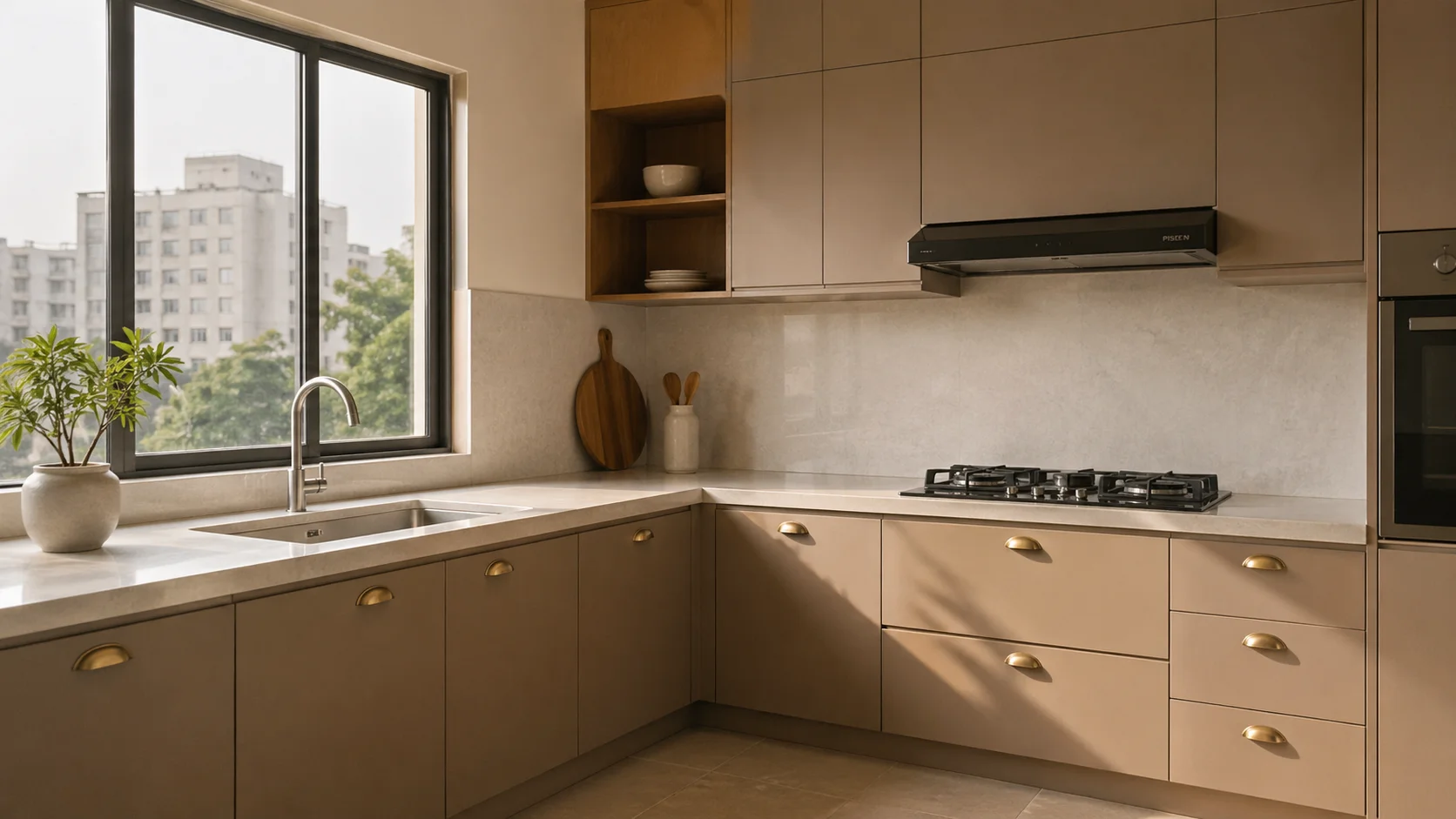
Choosing kitchen cabinets in Nigeria is rarely a price-tag decision. The same ₦1.5 million quote can buy you a build that lasts fifteen years or one that warps after the first wet season — and the difference sits almost entirely in material choice, joinery quality, and the way the install team handles your concrete walls. At Vento Furniture, we do not retail kitchen cabinetry — our showrooms across Lagos, Abuja, and Port Harcourt focus on living room, dining, and bedroom furniture — but our customers regularly walk into showroom consultations mid-renovation, kitchen quote in hand, and the same questions surface every time. This 2026 guide is the version of that conversation we wish we could hand to every first-time Nigerian buyer: the four cost drivers, the five substrates you will actually be quoted on in Lagos and Abuja, the layout sizes that fit real Nigerian kitchens, and the install-stage mistakes that quietly halve cabinet lifespan.
Quick Summary
- Material: marine-grade plywood box paired with MDF or HDF doors is the best mid-range substrate for the Nigerian humidity cycle
- Price tier: ₦1.4–2.1 million covers most 4×3 metre apartment kitchens at solid mid-range build quality
- Best for: families balancing a ten-year ownership horizon against finish quality and budget
- Avoid: particleboard substrates, generic hinges, and any quote that reads “supply only” without the install scope written in
How Kitchen Cabinet Cost Stacks Up in Nigeria
When a Lagos carpenter or an Abuja showroom hands you a per-running-foot price, that number is built from four inputs stacked on top of each other. Reading the stack accurately is what separates a fair quote from a fair-looking quote. The four inputs interact — choosing premium hardware on a particleboard substrate, for example, gives you a kitchen that still fails in two years — so the framework below is meant to be applied across all four together, not picked piecemeal.
Material substrate
Substrate is the single largest cost variable in any Nigerian kitchen quote. A cabinet box built from solid hardwood — iroko, oak, or African mahogany — runs three to five times the price of the equivalent geometry built from medium-density fibreboard. Plywood lands between them, closer to solid wood in durability but closer to MDF in cost, especially when you choose marine-grade or BWP-grade sheets. The substrate alone can double the quote depending on what is hidden under the finish, so always ask the carpenter to specify which substrate is in the box and which is in the door panels.
Finish and door style
A flat slab door in melamine laminate is the cheapest finish on any serious cabinet. Shaker-style doors with a flat centre panel and raised frame add roughly 15–25 per cent in labour. Raised-panel and glass-insert doors add another 20–30 per cent on top of that. A high-gloss European-style lacquer finish that mimics the imported showroom aesthetic can equal the cost of the substrate underneath it. Match your door style to how often you cook — gloss finishes show every fingerprint and palm oil splash within a week. To see these door styles installed, browse our kitchen cabinet designs.
Hardware
Hardware gets underestimated by almost every first-time Nigerian buyer. Soft-close hinges, full-extension drawer slides, and decent handles together add ₦15,000–₦40,000 per linear metre depending on brand. When a quote comes in dramatically below competitors, hardware is usually where the corner has been cut — the cabinet box itself may be sound, but the drawers will sag inside a year and the hinges will rust through within two rainy seasons. Insist on Hettich, Blum, or Hafele equivalents in writing.
Installation and site prep
Installation is the most commonly omitted line in a written quote. Levelling an uneven Nigerian concrete floor, sealing the wall behind the back panel, running new plumbing for a modern sink position, and cutting a clean countertop aperture for a gas hob can add 20–35 per cent to a bare cabinet figure. Always confirm whether the number you are looking at is “supply only” or “supply and install”, and ask which of those four site-prep tasks is included.
The Five Materials You Will Be Quoted On
Every retailer in Lagos, Abuja, and Port Harcourt works with some subset of these five substrates. Each one has a personality — knowing the trade-offs before you visit the showroom will save you from buying the wrong material for your climate, your cooking style, and your ten-year plan. The key dimensions to compare across the five are moisture resistance (critical in coastal Lagos and Port Harcourt), screw-holding strength (matters most for upper cabinets carrying weight), surface finish quality (the visible difference between a premium and a budget kitchen), and refurbishment capacity (whether you can sand and re-finish in five years rather than replacing). Most Nigerian cabinet quotes mix substrates — plywood box with MDF doors, for example — so understanding which substrate is doing what work in the build is more useful than picking a single “best” material.
1. Medium-density fibreboard (MDF)
MDF is compressed wood fibre held together with resin binder. It takes paint and laminate exceptionally well, which is why nearly every flawless high-gloss showroom door is MDF underneath. It is dimensionally stable — it does not warp like solid timber — and it is the cheapest substrate that can still look genuinely premium. Its weakness is water: once moisture penetrates the edge banding, MDF swells permanently. For a Nigerian kitchen, MDF is acceptable for upper cabinets and door panels but questionable for base cabinets around the sink unless every edge is meticulously sealed.
2. Plywood
Plywood is multiple thin veneers cross-laminated under pressure. It holds screws far better than MDF, resists moisture better — especially marine-grade or BWP-grade — and carries weight without sagging over the years. It is the substrate most experienced Nigerian custom-kitchen makers default to for the cabinet box, even when the visible door is MDF with a fancy finish. Good plywood costs 30–50 per cent more than MDF but doubles functional life in a humid kitchen, which is why most ten-year-warranty offers are written against plywood boxes.
3. Particleboard (chipboard)
Particleboard is a lower-grade cousin of MDF — looser fibres, less resin, much more vulnerable to water. It is the substrate behind most flat-pack “modular” kitchens sold cheaply in Lagos furniture markets. If you see a quote that seems too good to be true for the size of kitchen on offer, particleboard is usually the reason. For a primary home kitchen anywhere in Nigeria, you should rule it out — it is acceptable for a temporary rental fit-out at most.
4. Solid hardwood
Iroko, oak, African mahogany, and teak make up the premium tier. They look stunning, age gracefully, can be sanded and refinished multiple times across a lifetime, and hold up to decades of heat and moisture exposure. Iroko in particular is the West African workhorse hardwood — it tolerates the regional humidity cycle better than imported temperate-zone hardwoods. The downsides are cost (three to five times MDF), weight (reinforced wall anchors are non-negotiable), and the natural expansion-contraction movement of real timber with humidity — a high-skill carpenter is required to engineer the joints correctly. Solid hardwood cabinetry is an investment worth making if you are building a permanent home you intend to live in for fifteen years or more.
5. HDF with acrylic or PET finish
High-density fibreboard with an acrylic or PET (polyethylene terephthalate) thermo-fused finish is the modern European import segment. It gives the high-gloss seamless look most clients picture when they say “European kitchen”, with better water resistance than standard MDF and a finish that resists fingerprints and stains better than lacquered MDF. Expect to pay 60–90 per cent more than equivalent plywood-and-MDF builds, and confirm that the finish edges are hot-pressed rather than glued — glued edges peel in the Nigerian heat within four to five years.
Sizing Cabinets to Real Nigerian Kitchens
Nigerian kitchen layouts vary more than European ones because the housing stock is more varied — terrace flats, duplex apartments, and traditional bungalows all impose different geometries. The three layouts below cover roughly 80 per cent of the apartment and townhouse kitchens our customers describe when they walk into our showrooms. Each layout has a typical linear-footage envelope (the total length of cabinet runs the room can carry) and a standard counter-height window (the comfortable working surface elevation for the average Nigerian adult). Plan to your actual room dimensions rather than to a showroom display kitchen — display setups are usually built to the layout the showroom wants to sell rather than to the layout that will serve your cooking pattern best. Measure the room before any showroom visit, sketch the appliance positions, and bring both to every consultation.
Galley layout (3.0–3.6 metre length)
The galley layout suits one-cook kitchens in two-bedroom Lagos and Abuja apartments. Cabinets run along two parallel walls with a 90–110 cm passage between them. Plan 60 cm of base-cabinet depth on the cooking wall and 35–40 cm on the storage wall to keep the passage workable. Total cabinet linear footage typically lands between 4.5 and 6 metres, so a mid-range plywood-and-MDF build should quote ₦950,000–₦1.6 million supply-and-install.
L-shape layout (4×3 metre footprint)
The L-shape is the most common layout for three-bedroom Nigerian apartments and small terrace homes. Cabinets follow two adjacent walls, freeing the third wall for a window or a casual breakfast table. Plan 5–7 metres of total cabinet linear footage and add a small island only if you have at least 90 cm of clearance on every side. Mid-range builds for this footprint typically quote ₦1.4 million–₦2.4 million depending on door style and hardware.
U-shape layout (4×4 metre and larger)
The U-shape works in larger duplex kitchens where you have walls on three sides. It maximises both storage and counter space, but it eats floor space — minimum 3.5 metres of clear floor between any two parallel runs to remain comfortable for two cooks. Plan 8–11 metres of linear footage. Mid-range plywood-and-MDF builds quote ₦2.2 million–₦3.8 million; imported HDF-acrylic systems can land closer to ₦5–7 million for the same geometry.
Installation Mistakes That Halve Cabinet Lifespan
The cabinets themselves are only half the story. Three install-stage mistakes account for the majority of two-to-three year failures we hear about from customers redoing kitchens that were originally fitted by under-specified teams. The pattern is consistent across price tiers — a ₦2 million cabinet set installed badly fails faster than a ₦600,000 set installed properly. Site work happens at the end of the project, after the budget pressure of the cabinet purchase itself has tightened the schedule, so corner-cutting at the install stage is the rule rather than the exception. The three mistakes below are the ones that show up most often in failure cases brought to us during follow-up consultations.
Skipping wall sealing behind base cabinets
Nigerian concrete walls breathe moisture, especially in coastal Lagos and Port Harcourt. If the install team does not seal the wall behind the back panel with a moisture-barrier paint or membrane before fixing cabinets, that humidity migrates straight into the back of the box. Marine-grade plywood handles this for a while; MDF and particleboard fail within eighteen months. Always specify wall sealing in writing, and verify it visually before the cabinets go up.
Using non-rated wall anchors
A loaded upper cabinet with crockery and dry goods can carry 80–110 kg. If the install team uses general-purpose wall plugs sized for picture frames, the cabinet will pull away from the wall — usually within the first year, sometimes catastrophically when a stack of plates hits the counter. Insist on M8 sleeve anchors or chemical anchors rated for the specific wall substrate, and ask the foreman to walk you through the anchor type before installation begins.
Levelling the floor with shims instead of grinding
If a kitchen floor has a 15 mm slope across its length — which is common in older Nigerian builds — there are two ways to install level cabinets on it. The right way is to grind the high spots and screed the low spots before any cabinet goes up. The wrong way is to stack plastic shims under the base cabinet legs and hope the kick-plate hides them. Shimmed cabinets transfer drawer-slamming and door-closing stress unevenly into the joinery, which loosens the carcass over time. Always insist on floor preparation before cabinet placement.
Where to Buy Kitchen Cabinets in Nigeria
Vento Furniture Nigeria does not retail kitchen cabinets directly — our showrooms focus on living room, dining, and bedroom furniture across Lagos, Abuja, and Port Harcourt. But we have spent a decade fielding the same customer question on cabinet suppliers, so the regional notes below summarise what we consistently hear back from clients furnishing their full homes. The three city markets each have their own personality. Lagos has the deepest range and the toughest quality variance, Abuja has fewer but more consistent suppliers across the mid-premium tier, and Port Harcourt has a smaller market that leans either heavily local-build or heavily imported with little in between. Choose your supplier strategy to your city’s market shape, not to a generic best-practice list.
Lagos
Lagos has the deepest cabinet market in Nigeria. Lekki Phase 1 and Ikoyi carry the imported European HDF-acrylic systems in showroom format. The Allen Avenue and Opebi corridor in Ikeja covers the broad mid-range plywood-and-MDF segment with reliable install crews. Shogunle, Mushin, and Lawanson markets carry the budget particleboard end. Vento Furniture’s Ikoyi and Allen Avenue locations sit inside this corridor and are useful as orientation anchors when you are mapping showroom visits — for a complete view of how the city’s furniture retail clusters by district, including which areas to pair with kitchen shopping for furniture-set coordination, see our Lagos furniture stores guide, which maps the same logic across living, dining, and bedroom categories.
Abuja
Abuja’s cabinet market is smaller but more orderly than Lagos. Wuse 2 and Jabi carry the bulk of mid-premium retail, with import-grade options concentrated in Maitama and Asokoro. Karu and Kubwa cover the budget end. For coordinating dining, living, and bedroom furniture alongside a new kitchen — including how the Abuja district structure shapes total-home shopping — our Abuja furniture stores guide gives the full breakdown. Vento Furniture’s Wuse 2 and Jabi locations carry our dining room sets range alongside our broader luxury collection, both of which most kitchen clients view as the natural next purchase once cabinetry is ordered.
Negotiating Your Kitchen Cabinet Quote
Kitchen cabinet quotes in Nigeria are more negotiable than most first-time buyers expect, but the negotiation only works if you know which line items have movement and which are fixed. Walking into a quote review without that map produces either no discount at all or — worse — a discount on the wrong line, where the supplier quietly downgrades a substrate or a hardware brand to recover the margin.
The four lines with negotiation room: timeline (a six-week build slot is cheaper than a three-week rush), payment terms (a 60 per cent up-front payment vs the standard 40 per cent typically buys 5-8 per cent off the total), bundled scope (commissioning kitchen plus a wardrobe in the same workshop run typically buys 8-12 per cent off the wardrobe), and finish tier (a satin lacquer instead of high-gloss saves roughly 12-18 per cent on the door budget without meaningfully affecting durability).
The two lines with almost no movement: substrate (a quote priced for plywood will not be re-quoted in MDF at the same per-foot rate without re-engineering) and hardware brand (Hettich, Hafele, and Blum suppliers maintain their list pricing tightly across Nigerian retailers). Asking for substrate or hardware substitution to hit a target price means accepting a different build, not a discount on the same build.
Time the conversation. Most Nigerian cabinet workshops have a slack month or two each year — typically January after the December rush, and August during the school-holiday lull when home renovations slow. Quotes negotiated in those windows tend to land 8-15 per cent below quotes for the same scope two months either side. If your timeline allows the wait, the discount is real and the workshop has more attention to give to the build.
Pairing Your New Kitchen with the Rest of the Home
A finished kitchen rarely sits in isolation. The cabinets set the tone for the dining area that opens onto them, the living room beyond, and often the corridor of bedroom doors that share the same hallway palette. Customers who walk into our Vento Furniture showrooms during a kitchen renovation typically arrive with one open question — what dining set, what living-room sofa, what side pieces will match the kitchen colour story they have just committed to. Coordinating these choices in the same showroom round, rather than across three months of disconnected purchases, is the difference between a home that reads as one cohesive design and a home that feels like rooms negotiated separately.
For the dining adjacency specifically, our dining room sets range carries options across the modern, transitional, and traditional aesthetic bands that pair naturally with the kitchen styles described above — a reasonable next visit once your kitchen quote is signed. For the broader full-home coordination, the luxury collection is the right next look if your kitchen decision landed at the imported HDF-acrylic premium tier; for mid-range plywood-and-MDF kitchens the accessories range covers the bar stools, console pieces, and serving trolleys that finish the kitchen-to-dining transition without requiring a full furniture suite commitment. Sequencing the kitchen first and the rest of the rooms within four to six weeks afterward keeps the design conversation continuous and the supplier relationships warm.
Frequently Asked Questions
How much should a mid-range Nigerian kitchen cabinet set cost in 2026?
For a typical 4×3 metre L-shape apartment kitchen built in marine-grade plywood with MDF doors, mid-range hardware (Hettich or equivalent soft-close hinges and full-extension drawer slides), and competent supply-and-install, expect a 2026 quote of ₦1.4 million to ₦2.4 million. Quotes substantially below that range are usually cutting on substrate quality or hardware tier; quotes substantially above that range are typically pricing in imported HDF-acrylic doors or stone countertops bundled into the cabinet line.
Is plywood or MDF better for a Nigerian kitchen?
For the cabinet box itself, marine-grade plywood is the better choice in the Nigerian climate — it tolerates the humidity cycle, holds screws and hinges through years of use, and resists swelling at the back panel. For the door panels, MDF is acceptable and often preferred because it takes paint and laminate finishes more cleanly than plywood does. The most common mid-range Nigerian build pairs a plywood box with MDF doors, which gives you most of the durability advantage at most of the finish-quality advantage.
Should I buy modular flat-pack cabinets or commission a custom build?
For a primary home kitchen that you intend to keep for ten years or longer, a custom build from a competent Lagos or Abuja carpenter typically wins on durability, fit to your specific layout, and value over the ownership horizon. Modular flat-pack systems make sense for rental properties, short-term fits, or apartments where you expect to repaint or reconfigure within five years. The trade-off is install time — custom builds take three to six weeks; flat-pack systems install in three to five days but rarely outlast the second tenancy. The hidden third option is a hybrid: a custom-built carcass paired with a factory-finished imported door front, which captures most of the durability advantage of custom while preserving the finish quality of a European import. Few Lagos workshops offer this explicitly, but a careful spec conversation with a respected builder can produce it for 60-75 per cent of the cost of a fully imported system.
How do I verify a kitchen cabinet quote is using marine-grade plywood?
Ask the carpenter for a 100 mm cut-off sample from the same plywood sheet they intend to use for your build, then check three things: edge stamping (BWP or marine-grade plywood carries a stamped grade marking on at least one face), glue line colour (marine plywood uses dark phenolic glue visible at the cut edge, not pale urea-formaldehyde), and a 24-hour water-soak test (marine ply does not delaminate; standard plywood swells and the veneers separate). Always verify the sample matches what arrives at install — substrate substitution after quote acceptance is the most common Nigerian cabinet quality complaint, and a written substrate clause in the quote (with the grade specified) is your only contractual recourse.
How long does a custom kitchen cabinet build take in Nigeria?
A standard 4×3 metre L-shape Nigerian kitchen typically takes three to six weeks from quote acceptance to install completion in 2026. Three weeks is achievable from a workshop with current capacity using readily available materials. Six weeks is more realistic when the design includes imported door fronts, custom finishes, or full internal organisation systems with imported hardware. Add two to three weeks if any imported components (HDF acrylic doors, specific Hettich hardware lines) are part of the build. Plan the kitchen first when sequencing a full home renovation — cabinets carry the longest lead time in the typical furniture-and-fit-out chain, so ordering them before sofa, dining, and bedroom suites lets the rest of the home come together in a single completion wave.
What is BWP grade plywood and why does it matter for kitchen cabinets?
BWP stands for Boiling Water Proof, the highest moisture-resistance grade of plywood produced under Indian and Nigerian-import standards. BWP plywood uses phenol-formaldehyde glue that does not break down when boiled in water, which translates to multi-decade lifespan in humid kitchen environments versus three to five years for standard MWR (Moisture Water Resistant) plywood. For Nigerian coastal kitchens in Lagos and Port Harcourt, BWP is the only substrate that consistently survives the humidity-and-cooking-steam cycle without delamination. The premium over standard plywood is roughly 20-30 per cent — meaningful but small relative to the carcass-replacement cost it prevents. Always specify BWP for base cabinets around the sink and the cooktop, and standard plywood is acceptable for upper cabinets if budget is tight.
Can I install kitchen cabinets myself in a Nigerian apartment?
Self-installation works for standalone modular flat-pack cabinets — typical install time is two to four hours for a small kitchen with two or three units, using basic hand tools and an electric drill. Self-installation does not work for built-in custom cabinets, which require site measurement, scribed-to-wall fitting, levelling on uneven concrete floors, plumbing alignment for the sink position, and chemical anchor placement for upper cabinet weight loads. Built-in installs done by amateurs typically fail within twelve months — doors misalign as the cabinet settles, drawer slides bind, and upper cabinets pull from the wall. For any quote above ₦400,000 the install labour is worth paying for; below that threshold, flat-pack self-install is reasonable.
Where can I find imported European kitchen cabinets in Lagos?
Imported European HDF-acrylic kitchen systems concentrate in three Lagos districts: Ikoyi (Awolowo Road and Bourdillon Road for the German and Italian premium tier), Victoria Island (Adeola Odeku Street for the broader contemporary import range), and Lekki Phase 1 (Admiralty Way and Freedom Way for the newer Turkish and Spanish boutique segment). Expect lead times of eight to fourteen weeks for sea-freight orders, prices starting around ₦4 million for a small full-room system and running up to ₦12 million-plus for premium German modular systems with stone countertops integrated. The mid-tier Chinese imports (₦2-4 million range) are also available in Lekki and Allen Avenue Ikeja for buyers who want imported aesthetic at a more accessible price point.
What is the difference between Hettich, Hafele, and Blum hardware?
All three are premium European cabinet hardware brands that survive the Nigerian humidity-and-daily-use cycle for ten-plus years, but they specialise differently. Hettich (German) is the broadest range and the most commonly stocked in Lagos and Abuja — strong on hinges, drawer slides, and complete drawer-system kits at mid-to-premium prices. Blum (Austrian) is the premium tier — exceptional soft-close hinges and the Tandembox drawer system, typically 15-25 per cent more expensive than equivalent Hettich. Hafele (German) sits between the two on price and breadth, with particular strength in handles, finishing details, and accessory hardware. For most Nigerian mid-range builds, Hettich is the default; Blum is the upgrade for buyers who want the best touch-quality on a daily-use basis.
What hardware brand should I insist on for my kitchen cabinets?
For any kitchen quote above ₦800,000, insist on Hettich, Hafele, or Blum hardware in writing — soft-close hinges, full-extension drawer slides, and quality handles. The hardware premium over generic unbranded equivalents is roughly ₦40,000-₦90,000 per linear metre of cabinet (typical kitchen total: ₦200,000-₦450,000 hardware uplift), and it is the single most consequential daily-quality decision in the entire build. Generic hinges fail within twelve to eighteen months in Nigerian conditions; soft-close branded hinges last fifteen-plus years. The hardware is roughly 5 per cent of total kitchen cost and 40 per cent of daily user experience — the highest leverage upgrade you can make on a mid-range build.