

Blog
TV Console Buying Guide for Nigerian Living Rooms (2026)
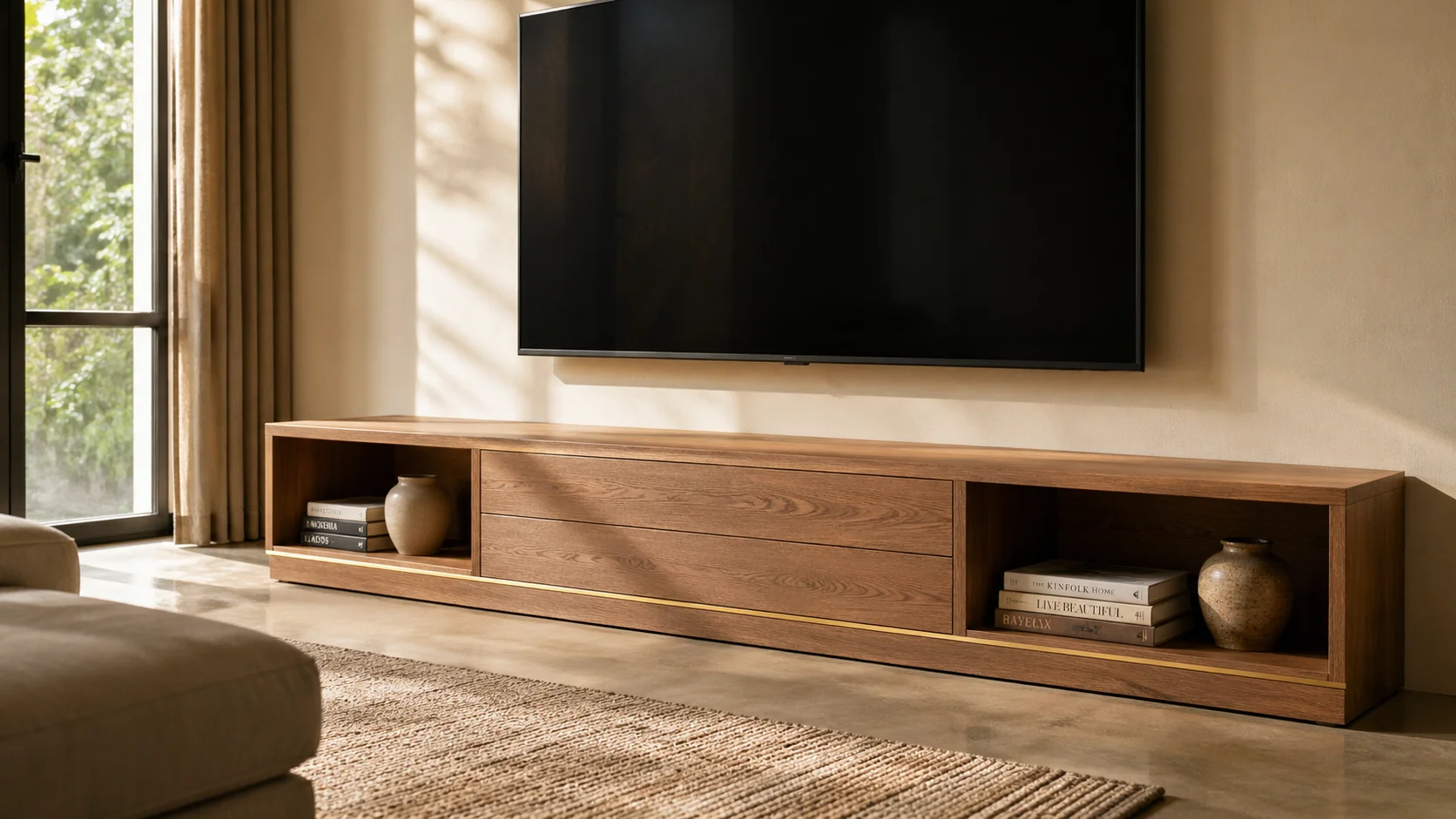
Established mid-premium TV consoles in Nigeria sit in the ₦520,000 to ₦7,400,000 collection range in 2026, with entry compact units from ₦520,000, mid-range storage units ₦900,000 to ₦2 million, and premium wall units ₦2 million plus. Sizing matches the TV screen first, then the room.
Why TV Console Pricing Has a 14x Spread
A TV console anchors the wall opposite the sofa and quietly determines how the entire living room reads — too small for the screen and the wall feels unbalanced, too large for the room and circulation tightens, wrong material for the climate and the doors begin to swell within a year. This 2026 buying guide walks through the four cost drivers, the floor-mount versus wall-mount versus media-wall decision framework, the sizing rules that match modern flat-screen TVs to Nigerian apartment living rooms, and a current price snapshot from Lagos, Abuja, and Port Harcourt showrooms.
Quick Summary
- Entry compact console (Vento Lovisa series start): from ₦520,000 for a 1200–1500 mm unit
- Mid-range modern with storage: ₦900,000–₦2 million
- Premium wall unit (Vento Armin / Harmony tier): ₦2–4.5 million
- Luxury entertainment unit (Vento Saltanat Royal flagship): ₦4.5–7.4 million
- Best for compact apartments: 1200–1400 mm floor-mount with closed storage
- Best for family rooms: 1800–2200 mm with open-and-closed storage mix
- Best for media walls: full-wall built-in 2400 mm-plus with integrated cable management
What Drives TV Console Cost in Nigeria
TV console pricing in Nigeria is built from four inputs, and like the wider furniture category they interact — choosing premium hardware on a particleboard carcass produces a unit that fails at the hinges within eighteen months. Reading all four together is what separates a fair quote from a fair-looking quote. The four inputs in order of cost-impact are carcass substrate, door and finish system, integrated features (cable management, soft-close hardware, lighting), and design or installation complexity. The relative weight of each shifts depending on whether you are pricing a 1200 mm freestanding console or a 3000 mm floor-to-ceiling media wall with concealed wiring. Our living-room consultations almost always test the TV console choice against the existing sofa anchor before any commitment because the two pieces face each other across the room and their material families need to read together.
Carcass substrate
Substrate accounts for the largest single cost variation in a TV console quote. A carcass built from marine-grade plywood typically costs 50–70 per cent more than the equivalent built from medium-density fibreboard, which in turn costs 30–50 per cent more than particleboard. Solid hardwood carcasses in iroko, oak, or African mahogany run two to four times the plywood baseline and are reserved for premium custom builds. Within our collection range, the substrate alone can swing a 1800 mm console quote from ₦520,000 (entry MDF and plywood mix) to ₦1.4 million (full plywood with hardwood doors) to ₦3.3 million (solid hardwood premium).
Door and finish system
The door system is the second cost driver and the most visible aging point on any TV console. Push-to-open or soft-close hinged doors require precise alignment and quality hardware (Hettich, Hafele, or Blum); generic Chinese hinges drift within twelve months and produce visibly misaligned doors. Sliding doors on a console are uncommon at this scale but appear on premium imported designs — they add ₦60,000–₦140,000 over comparable hinged doors. Finish quality varies even more — matte two-component lacquer, hand-rubbed oil, or melamine-foil edge banding outlast wipe-on stains by years and add ₦30,000–₦90,000 to a quote.
Integrated features
A plain console with shelves and doors is a basic build. Integrated features — concealed cable runs through pre-drilled grommets, soft-close drawer runners, push-to-open hardware, integrated LED strip lighting, ventilation cutouts for set-top boxes — push the unit from furniture to media-cabinet. Each feature adds ₦25,000–₦80,000 to the build cost depending on quality. For most family rooms the integrated cable management plus soft-close hardware combination is the highest-value upgrade pair.
Design and installation complexity
A freestanding console ships in 30–60 minutes of assembly. A floor-to-ceiling media wall requires site measurement, scribed-to-wall fitting, levelling against uneven Nigerian concrete walls, channel cutting for concealed wiring, and often coordination with electricians for wall-mounted TV brackets and power outlets. Built-in media walls add ₦150,000–₦480,000 to the carcass quote depending on room geometry and how much wall preparation the room actually needs.
Floor-Mount, Wall-Mount or Media Wall — The Decision Framework
The honest answer to “which TV console” depends on three things: how the living room is used during the week, whether the property is owned or rented, and how the wall opposite the sofa is constructed (plasterboard, hollow block, or solid concrete). The framework below is structured around installation type because that single dimension changes both the cost and the future-flexibility of the choice. Walk through the three cases below in order — they cover roughly 90 per cent of Nigerian household TV console purchases.
Floor-mount freestanding console
A freestanding floor-mount console is the right choice for tenants, short-stay owners, and any living room where the layout might change. It costs 30–60 per cent less than the equivalent media wall, ships in days rather than weeks, and can be relocated when the tenancy ends or when the sofa configuration changes. The trade-off is visual integration — a freestanding piece always reads as furniture sitting in front of a wall rather than as part of the wall itself. For a typical three-bedroom apartment family room, a 1800–2200 mm floor-mount console at the ₦900,000–₦2 million mid-range band is the most popular and most flexible choice. Vento Furniture’s TV stand collection carries this format across modern, transitional, and traditional aesthetic bands from the Lovisa entry series at ₦520,000 to the Armin and Harmony premium tiers around ₦3.3 to ₦4 million.
Wall-mount floating console
A wall-mounted floating console has visual appeal — the floor underneath stays clear and the room reads larger than its actual footprint. The trade-off is structural: floating consoles need solid wall fixing into concrete or hollow-block (not plasterboard), and the load capacity is limited to roughly 40–60 kg, which restricts what gets stored inside. Cost premium over equivalent floor-mount is 15–30 per cent because the bracket system and reinforced internal frame add carpentry hours. Best suited to rooms where the existing wall is solid and the storage requirement is moderate (set-top box, soundbar, a few items in shallow drawers). Avoid in rented Lagos apartments where wall holes can trigger deposit deductions.
Built-in media wall
A built-in media wall — full-height carpentry that integrates the TV, console, side shelves, and often a fireplace or art niche — is the highest tier of living-room investment. Mid-range builds at this scale quote ₦2–3.5 million and require 4–8 weeks lead time from quote acceptance to install. The visual integration is unmatched and the piece adds resale value to the property, but the choice locks the room around the TV-and-sofa configuration permanently. Best suited to owners staying five-plus years in three-and-four-bedroom apartments in Lekki, Ikoyi, and Wuse 2 where open-plan living rooms accommodate the visual scale.
Sizing TV Consoles to Modern Flat-Screen TVs
Three TV-to-room combinations cover roughly 80 per cent of the living rooms Nigerian buyers actually furnish. The console sizing that fits each is non-obvious until you measure with the TV mounted at the planned height. The geometry that matters is screen-to-console-width ratio (visual balance), screen-to-floor-height (eye-line comfort from the sofa), and console-to-side-wall clearance (circulation around the unit), which collectively determine whether the wall reads composed or chaotic.
55 inch TV configuration
A 55 inch TV (typically 1230 mm wide including bezel) pairs proportionally with a console 1500–1800 mm wide. The general rule is the console should be 25–40 per cent wider than the TV — going equal or smaller produces a top-heavy look, going much larger leaves visible dead space at either side that needs decor to fill. For a 1230 mm 55-inch screen, a 1500 mm console is the visual minimum and a 1800 mm console gives breathing room for a soundbar and a small plant or decor item at each end. Plan ₦600,000–₦1.2 million for a mid-range build at this size.
65 inch TV configuration
A 65 inch TV (typically 1450 mm wide) needs a console 1800–2200 mm wide to look proportional. This is the most common size in three-bedroom Lagos and Abuja family rooms in 2026 — the 65-inch screen hit price parity with 55-inch around 2024 and is now the default upgrade for most household replacements. Plan ₦900,000–₦1.6 million for a mid-range build. At this scale, a centre soundbar bay (acoustic transparent fabric panel or open compartment) is worth the ₦40,000–₦80,000 design upgrade.
75 inch and 85 inch TV configuration
A 75 inch (1670 mm wide) or 85 inch (1880 mm wide) TV demands a console of at least 2200–2800 mm. At this screen size the conversation tilts strongly toward built-in media walls or full-wall floating consoles because freestanding furniture starts to look undersized against the screen. Plan ₦1.5–2.5 million for mid-range freestanding at this width, ₦2.5–4.5 million for built-in media walls. This is the configuration most common in duplexes and four-bedroom apartments where the master family room is large enough to absorb a 2400 mm-plus piece without crowding.
2026 Price Snapshot — Lagos, Abuja, Port Harcourt
The prices below are 2026 ranges from established Lagos and Abuja showrooms and respected custom workshops. Currency volatility and import-cost shifts move these bands quarter-to-quarter, so treat the figures as orientation rather than firm quotes.
| TV Console Type | Entry / Budget | Mid-Range | Premium | Luxury |
|---|---|---|---|---|
| Floor-mount 1200–1500 mm (for 50–55 in TV) | ₦520,000–₦750,000 | ₦750,000–₦1.4 million | ₦1.4–2.5 million | — |
| Floor-mount 1800–2000 mm (for 60–65 in TV) | ₦600,000–₦900,000 | ₦900,000–₦2 million | ₦2–3.5 million | — |
| Floor-mount 2200–2600 mm (for 70–75 in TV) | ₦800,000–₦1.4 million | ₦1.5–2.5 million | ₦2.5–4.5 million | ₦4.5–6 million |
| Wall-mount floating 1500–1800 mm | ₦650,000–₦1 million | ₦1–2 million | ₦2–3.5 million | — |
| Built-in media wall 2400–3000 mm | — | ₦2–3.5 million | ₦3.5–5 million | ₦5–7.4 million |
| Full-wall media unit with fireplace | — | from ₦3.5 million | ₦4.5–6.5 million | ₦6.5 million-plus |
Entry / Budget = MDF and plywood mix carcass, basic finish, generic hinges (the Lovisa series starts here at ₦520,000 in our collection). Mid-range = plywood carcass, MDF or solid wood doors, Hettich or equivalent hardware, integrated cable management, soft-close drawers. Premium = solid hardwood, hand-finished joinery, imported soft-close hardware (the Armin series around ₦3.3 million and Harmony around ₦4 million sit here). Luxury = flagship craftsmanship, integrated LED, ventilation cutouts (the Saltanat Royal flagship). Vento Furniture’s Lagos and Abuja showrooms carry TV consoles across this ₦520,000 to ₦7.4 million collection band — the showroom is the most reliable way to test materials and joinery before quote acceptance.
Where to Buy and What to Verify Before Signing
Where you buy matters less than what you verify before signing. Three checks separate quotes that will deliver from quotes that will disappoint.
Verify the substrate behind the finish. Ask the showroom or carpenter to specify “plywood box, MDF doors with melamine edge banding” or “solid iroko frame, MDF panels” or whatever the actual construction is, and have it written into the quote. Verbal “premium quality” claims mean nothing; the written specification is what you can hold the supplier to if a substitution shows up at delivery. Tap the underside of any showroom console — solid wood thuds, particleboard sounds hollow.
Verify the hardware brand. Hettich, Hafele, and Blum are the three international brands that survive Nigerian humidity and daily use. Generic Chinese push-to-open mechanisms fail within twelve months — the soft-close dampers lose tension, doors begin to swing open under their own weight, drawer runners develop side-to-side play. Pay the ₦30,000–₦70,000 hardware premium per console; it is the single best longevity-for-money trade you can make.
Verify cable management and ventilation. Modern living rooms run a TV, soundbar, set-top box, gaming console, and often a streaming device — each needs power, often a network cable, and adequate ventilation. A TV console without rear cable cutouts, internal cable channels, and ventilation slots for the set-top box compartment forces visible cable runs and overheating set-top boxes. Insist on factory-cut cable grommets in writing on the quote, not as an after-delivery promise. For the broader living-room build that follows the TV console choice, Vento Furniture’s accessories range covers cable management trays, wall-mount brackets, and decor pieces that finish the wall around the unit.
For a wider view of where to shop in Lagos for living-room furniture coordination after the console decision is made, see our Lagos furniture stores guide, which maps the city’s retail clusters by district and price tier.
What Most Buyers Get Wrong on the First TV Console Purchase
Three patterns account for the majority of regret cases we hear about during second-time living-room consultations. The first is under-sizing the console relative to the TV — buyers see a 1500 mm console in the showroom (next to a 50-inch display screen), bring it home for the 65-inch TV they planned to upgrade to, and end up with a console that looks visually swallowed by the larger screen within a year. Always size the console for the next TV upgrade, not the current screen. The second is choosing wall-mount on a plasterboard wall without verifying the structural backing — floating consoles need solid concrete or hollow-block fixing, and a plasterboard installation will sag within months under any meaningful storage load. The third is ignoring cable management at purchase time — a beautiful console with no rear cable cutouts and no internal channels produces a visible spaghetti of wires within the first month of use, which no amount of decorative styling can hide.
Building the Living Room Around the TV Console Decision
The TV console anchors the wall opposite the sofa and its material and silhouette define how the room reads as you walk in. Once the console is chosen, the rest of the room narrows substantially: a sleek wall-mount floating console pairs awkwardly with a heavy traditional sofa in deep brown leather, and a full-wall built-in media unit dominates a room with a budget freestanding center table. Our living-room consultations typically test sofa, center table, and side table options against the console anchor rather than the reverse sequence, which produces noticeably better-coordinated rooms.
For the matched sofa step that pairs with the new console, our sofa sets range carries coordinated suites across modern, transitional, and traditional aesthetic bands. To compare format options across the broader TV stand collection or to map out the room context first, the Nigerian living room design ideas 2026 overview shows how the TV console anchors typical Lagos and Abuja living rooms. For the styling options themselves — floating, marble-top, wooden, high-gloss and POP-integrated — our guide to 9 TV console designs matches each style to your screen size, room and budget. Sequencing the TV console order first and the sofa within two to three weeks afterward keeps the colour-and-style conversation continuous and avoids the most common mid-furnishing regret of mismatched tones across the two largest pieces in the room.
Frequently Asked Questions
How much should a standard TV console cost in Nigeria in 2026?
A 1800 mm floor-mount TV console in mid-range plywood-and-MDF construction with soft-close Hettich-grade hardware should quote ₦900,000 to ₦2 million from a reputable Lagos or Abuja showroom in 2026, aligning with the established Nigerian premium furniture market range. Quotes substantially below ₦600,000 at this size are typically using particleboard or single-kit generic hinges; quotes above ₦2.5 million are pricing in solid hardwood throughout, integrated LED lighting, or designer imported pieces. The mid-range band suits 60–65 inch TVs and gives the best longevity-for-money trade for daily family-room use.
Is a wall-mount floating TV console better than a floor-mount?
Floor-mount wins for tenants and most family rooms because it works on any wall (plasterboard, hollow-block, or concrete), can be relocated, and supports unlimited storage weight. Wall-mount wins for owners with solid walls and minimalist aesthetics because the cleared floor underneath makes the room read larger and modernises the visual style. The trade-off: floating consoles need solid wall fixing (avoid plasterboard), are limited to roughly 40–60 kg storage capacity, and add 15–30 per cent to the equivalent floor-mount cost. For most three-bedroom Lagos apartments, floor-mount is the safer and more flexible long-term choice.
What size TV console fits a 65 inch TV?
A 65 inch TV (1450 mm wide including bezel) pairs proportionally with a TV console 1800–2200 mm wide. The general rule is the console should be 25–40 per cent wider than the screen to look balanced — a 1500 mm console under a 65-inch screen looks top-heavy and a 2400 mm console leaves dead space at each end. The 1800 mm length is the visual minimum; 2200 mm gives breathing room for a soundbar mounted on the console top plus small decor at each end. Plan ₦900,000–₦1.6 million for a mid-range build.
How do I hide cables on a TV console?
Three cable-management approaches work in 2026 Nigerian living rooms. Factory-integrated cable grommets — pre-drilled holes at the back of the console with rubber grommets — handle most freestanding installations and should be specified in writing at quote time. In-wall cable channels — plastic conduits routed inside the wall from console height to TV height — produce the cleanest look but require an electrician to cut the wall channel during installation, typically ₦25,000–₦60,000 extra. Surface-mount cable raceways — paintable plastic channels stuck to the wall surface — are the cheapest retrofit option at ₦8,000–₦20,000 but always read as visible add-ons. Plan the cable approach before installation, not after.
What height should a TV be mounted above the console?
The TV centre line should sit at eye-line height when seated on the sofa, typically 1100–1300 mm from the floor depending on sofa seat height and viewer eye-line. On a typical 600 mm tall TV console with a 65 inch TV, this works out to roughly 150–250 mm of clearance between the top of the console and the bottom of the TV bezel, which also leaves room for a soundbar mounted on the console top. Mounting higher than this forces viewers to tilt heads upward — comfortable for short viewing, painful for movie-length sessions. Mount the TV first with adjustable wall brackets, sit on the sofa, and confirm the eye-line before drilling final fixings.
Are MDF or solid wood TV consoles better for Nigerian humidity?
Plywood carcass with MDF doors is the best longevity-for-money combination for Nigerian living rooms. Marine-grade plywood resists moisture-driven delamination for fifteen-plus years; MDF doors hold finish well and are dimensionally stable across the humidity cycle. Solid hardwood is technically more durable but doubles the cost and adds weight that complicates wall-mount installations. Avoid particleboard throughout — coastal Lagos and Port Harcourt humidity swells particleboard edges within two to three years, particularly at the bottom of doors that absorb floor-cleaning moisture. The plywood-and-MDF mid-range band gives the best practical balance for most households.
How long should a quality TV console last in a Nigerian home?
A mid-range plywood-and-MDF TV console at the ₦900,000–₦2 million band should last ten to fifteen years in normal Nigerian living-room use — daily wiping, occasional cable changes, moderate door cycling. Premium solid hardwood consoles at the ₦2 million-plus band typically deliver fifteen-plus years and often gain visual character through wear. Particleboard consoles at the entry tier (under ₦500,000) typically fail within three to five years from edge swelling, hinge tear-out, or shelf sagging under heavy set-top boxes. Built-in media walls last as long as the property because they cannot be relocated.
Where can I find quality TV consoles in Abuja?
Abuja’s Wuse 2 and Jabi corridors carry the deepest concentration of mid-premium contemporary furniture showrooms with strong TV console selections, anchored around Adetokunbo Ademola Crescent in Wuse 2 (where the Vento Wuse 2 showroom in Kokkies Mall sits) and the Jabi Lake Mall area. Maitama and Asokoro host the premium import-and-custom hybrid tier for buyers spending above ₦2.5 million per console. Karu, Kubwa, and Nyanya cover the budget custom carpentry segment — variable quality, good value when you find a workshop with strong joinery and reliable hardware sourcing. The most reliable filter: ask to see two or three completed installations in client homes before signing a custom build quote.
Can I use a sideboard or buffet as a TV console?
Yes, with two important caveats. Sideboards and buffets typically sit at 800–950 mm height versus 500–700 mm for purpose-built TV consoles — the higher surface forces viewers to tilt heads upward when watching from a standard sofa, which is comfortable for short viewing but tiring for movies. Most sideboards also lack rear cable cutouts and ventilation slots for set-top boxes, requiring after-purchase modification with a hole saw to retrofit cable management. Sideboards work best as TV consoles in rooms where the sofa has a higher seat profile (550 mm-plus) or where the TV will be wall-mounted with the sideboard serving primarily as storage rather than as a TV anchor.
What is the difference between a TV console, TV stand and TV unit?
In Nigerian usage the three terms are largely interchangeable for the furniture piece that sits below or beside a flat-screen TV. International furniture taxonomy distinguishes them slightly — a “TV stand” typically describes a smaller, often legged piece designed to hold the TV directly on top, while a “TV console” describes a longer, lower piece designed for flat-screen TVs that mount on the wall above and integrated storage below. A “TV unit” usually implies a built-in or full-wall design with multiple storage zones. In practice, Lagos and Abuja showrooms label the same product all three ways and the search results overlap heavily. Buy by use case (TV size, storage need, mounting type) rather than by terminology.
One thought on “TV Console Buying Guide for Nigerian Living Rooms (2026)”
Comments are closed.