

Blog
Office Table Price Guide for Nigerian Workspaces (2026)
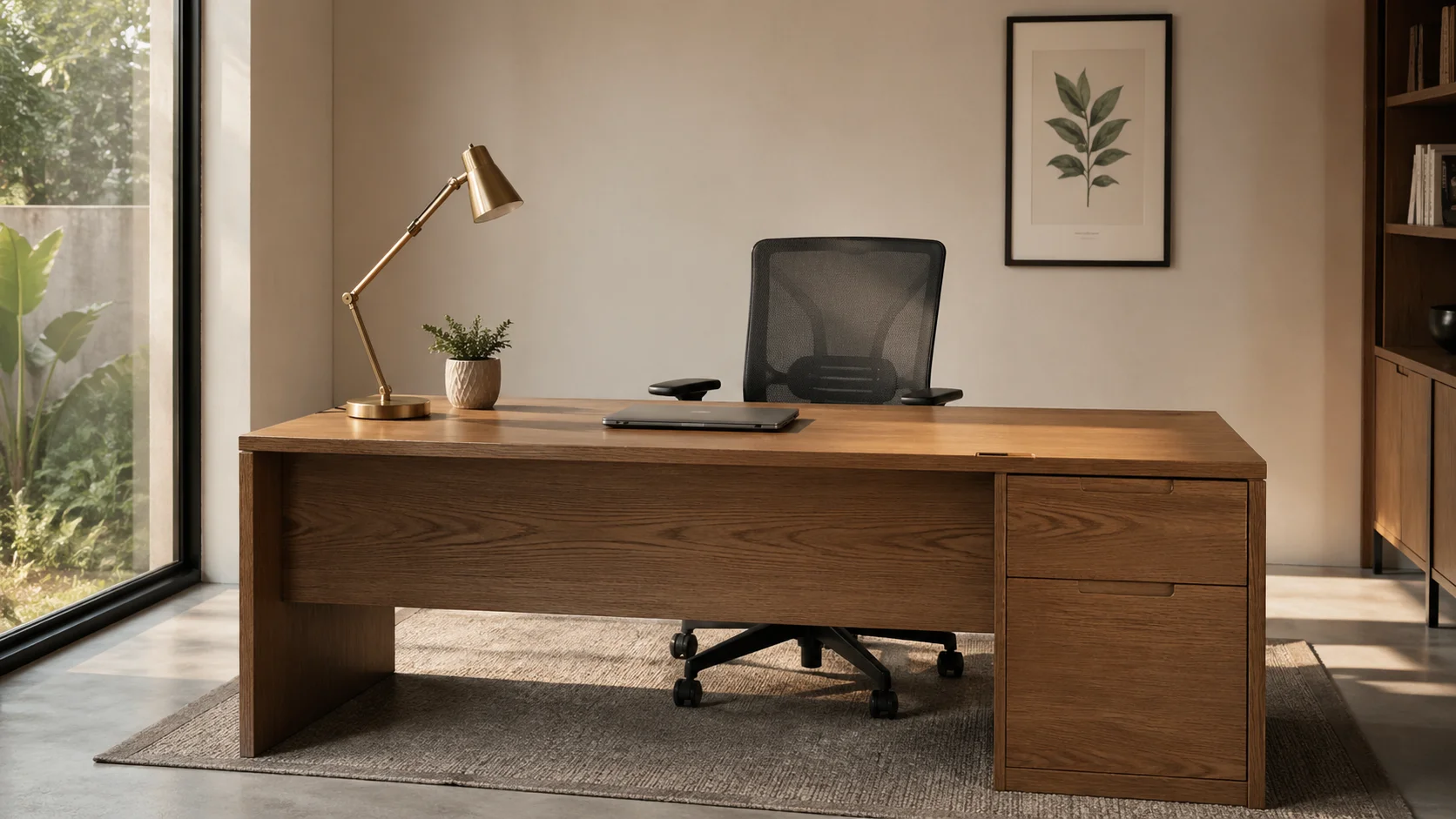
A quality office table in Nigeria costs ₦120,000 to ₦350,000 for budget home-office builds, ₦350,000 to ₦800,000 for mid-range pedestal-storage units, and ₦800,000 to ₦2 million for executive solid hardwood desks in 2026. Match the desk size and quality tier to daily use intensity rather than to aesthetic aspiration.
Why Office Table Pricing Has a 16x Spread
An office table is the second-most-used furniture purchase in any working Nigerian household after the bed, often used for eight to twelve hours daily, and the price spread across the category is wider than buyers expect — the same daily-work function can be served by a ₦150,000 MDF home-office desk at one end and a ₦1.6 million solid wood executive table at the other, and both can be the right answer depending on the use intensity, the room, and how the desk pairs with the chair across long working sessions. This 2026 price guide walks through the four cost drivers, the executive versus home-office versus L-shape decision framework, the sizing rules that fit Nigerian apartment workspaces, and a current price snapshot from Lagos, Abuja, and Port Harcourt showrooms.
Quick Summary
- Budget home-office desk: ₦120,000–₦350,000 for a 1200–1400 mm unit
- Mid-range plywood-and-solid-wood with storage: ₦350,000–₦800,000
- Premium executive solid hardwood or imported design: ₦800,000–₦2.0 million
- Best for occasional work: 1200 mm rectangular home desk with single drawer
- Best for daily home office: 1400–1600 mm rectangular with pedestal storage
- Best for client-facing work: 1800–2200 mm executive desk with modesty panel
What Drives Office Table Cost in Nigeria
Office table pricing in Nigeria is built from four inputs, and like other furniture categories the inputs interact — choosing premium hardware on a particleboard top produces a desk that fails at the drawer runners within eighteen months of daily use. Reading all four together is what separates a fair quote from a fair-looking quote. The four inputs in order of cost-impact are top material, base or pedestal substrate, integrated storage and cable management, and design tier (home office versus executive versus L-shape). The relative weight of each shifts depending on whether you are pricing a 1200 mm home-office desk for occasional use or a 2000 mm executive table for daily client meetings. Our home-office consultations almost always test the desk choice against the chair already in the room because the desk-and-chair pair shapes posture across long working sessions and the wrong height combination produces back pain within months.
Top material
Top material accounts for the largest single cost variation in an office table quote. MDF tops with veneer or melamine surfaces are the cheapest entry — adequate for low-use home offices, but the edges chip from chair impacts within three years and the surface scratches under daily laptop and notebook use. Solid hardwood tops in iroko, oak, mahogany, or walnut run two to four times the MDF baseline, accept refinishing every five to ten years, and outlast the rest of the desk. Engineered wood with solid edge banding sits between the two — the top is plywood-and-veneer but the edges are solid wood that resists chipping. Glass tops appear on some executive designs but require daily wiping and crack from impact within five years; uncommon in Nigerian office tables above the budget tier.
Base or pedestal substrate
The base is the structural element that determines whether the desk will still be square after a decade of daily use. A solid hardwood pedestal costs 80–120 per cent more than the equivalent in plywood-and-veneer, which in turn costs 40–60 per cent more than particleboard. Steel-frame bases — increasingly common on contemporary home-office designs — sit between mid-range plywood and premium walnut depending on gauge, weld quality, and powder-coat finish. Avoid bases described only as “wood” without species or substrate detail; the ambiguity almost always means particleboard with a thin veneer.
Integrated storage and cable management
A plain four-leg desk with a single top is a basic build. Add a drawer pedestal (typically two or three soft-close drawers with a file-hanging rail in the bottom drawer), a top-mounted modesty panel for the front edge, integrated cable management cutouts at the back edge, and the carpentry labour and hardware cost scale up by 60–120 per cent. Storage features are worth the cost premium for daily-use home offices where the desk holds reference documents, charging cables, and small office supplies; for occasional-use desks the plain top often looks better in the room and costs less. Quality drawer hardware (Hettich, Hafele, or Blum) matters more on office desks than on any other furniture category because the drawer cycling frequency is highest.
Design tier
Design tier shifts the cost band substantially. Home office desks at the budget-to-mid range tier are essentially functional pieces with simple silhouettes. Executive desks at the premium tier add modesty panels, larger pedestal storage, optional return wings (the side extension that creates an L-shape), and finished detail on all four sides (because executive desks often sit centred in the room rather than against a wall). Imported designer desks from Italy, Turkey, or India command another tier above the equivalent locally-built executive at 30–80 per cent premium for the brand and design-language value.
Choosing the Right Office Table — The Decision Framework
The honest answer to “which office table” depends on three things: how many hours per day the desk will see actual work use, whether the workspace is shared with other room functions (bedroom, living room) or has a dedicated room, and whether client meetings or video calls take place at the desk. The framework below is structured around use intensity because that single dimension drives both the build quality requirement and the storage configuration more than any other input. Walk through the three cases below in order — they cover roughly 90 per cent of Nigerian household and small-business office desk purchases.
Occasional home office desk
An occasional home office desk is the right choice for households where the desk sees use for two to four hours per day — paying bills, occasional remote work, study sessions for older children. A 1200–1400 mm rectangular desk with a single drawer or no storage at all fits compact bedroom corners, balcony nooks, and shared-room arrangements without dominating the space. Mid-range plywood-and-veneer build at ₦150,000–₦320,000 covers this case well. The lower price point reflects the lower use intensity — a desk used three hours daily wears at one-third the rate of a desk used eight to ten hours daily.
Daily home office desk
A daily home office desk is the right choice for full-time remote workers, small business owners, and anyone using the desk eight or more hours per day. Build quality matters at this use intensity — particleboard fails within five years, plywood-and-MDF lasts ten to twelve, solid hardwood lasts twenty-plus. A 1400–1600 mm rectangular desk with a drawer pedestal handles dual-monitor setups, document storage, and daily cycling without strain. Plan ₦450,000–₦800,000 for a mid-range plywood-and-solid-wood build at this size. Vento Furniture’s office table collection carries this format alongside our office chair range — the desk-and-chair pair is best chosen together.
Executive or client-facing desk
An executive desk is the right choice for senior managers, business owners with clients in the office, and home offices that double as occasional video-call meeting spaces. A 1800–2200 mm rectangular or L-shape desk with a finished modesty panel, full pedestal storage, and finished detail on all four sides supports both the daily work load and the visual-statement requirement of client-facing rooms. Plan ₦680,000–₦1.4 million for a mid-to-premium solid hardwood build, ₦1.4 million-plus for premium imported pieces. The cost premium over a daily home office desk reflects both larger size and the all-sides finishing requirement that lower-tier desks skip on the back panel and unseen edges.
Sizing Office Tables to Nigerian Apartment Workspaces
Three workspace geometries cover roughly 80 per cent of Nigerian home offices and small business setups. The desk sizing that fits each is non-obvious until you walk the room with a tape measure including the chair pull-out clearance behind the desk. The geometry that matters is desk footprint plus chair clearance (minimum 700 mm behind the desk for comfortable seated working and pull-out room), monitor depth (modern flat-screen monitors need only 150–200 mm of desk depth, but older CRT replacements or curved ultrawide monitors need 300–400 mm), and desk-to-side-wall clearance (at least 600 mm for circulation around an open drawer pedestal).
Bedroom corner workspace
A bedroom corner workspace fits a 1200–1400 mm rectangular desk against the long wall with the chair pulled out into the bedroom centre when in use. Avoid wider desks at this configuration — they crowd the bed and disrupt bedroom sleep zoning. Plan ₦180,000–₦380,000 for a mid-range build at this size. The single-drawer or no-storage configuration works here because the desk is for occasional rather than daily-intensive use and visible storage clutters the bedroom feel.
Dedicated home office room
A dedicated home office room (typically 6–12 square metres in three-bedroom Lagos and Abuja apartments) fits a 1400–1800 mm rectangular desk against a wall or under a window, with the chair behind it and a full pedestal storage configuration. This is the most common daily-use home office setup. Plan ₦340,000–₦780,000 for a mid-range solid-wood build. Add a separate filing cabinet or short bookshelf along an adjacent wall for documents and reference materials that don’t fit in the desk pedestal.
Open-plan or executive office
An open-plan workspace or executive office room in a four-bedroom apartment, duplex, or small business premises fits an 1800–2400 mm rectangular desk or L-shape configuration with full storage, modesty panel, and often a separate guest chair pair on the front side of the desk. Plan ₦780,000–₦1.6 million for the mid-to-premium tier. L-shape configurations work best when the room geometry includes a corner that can accept the longer side of the L; rectangular desks work better in centred-in-room placements where the desk visually anchors the space.
2026 Price Snapshot — Lagos, Abuja, Port Harcourt
The prices below are 2026 ranges from established Lagos and Abuja showrooms and respected custom workshops. Currency volatility and import-cost shifts move these bands quarter-to-quarter, so treat the figures as orientation rather than firm quotes.
| Office Table Type | Budget Build | Mid-Range Build | Premium Build |
|---|---|---|---|
| 1200 mm home office (no pedestal) | ₦120,000–₦250,000 | ₦250,000–₦400,000 | ₦400,000–₦650,000 |
| 1400 mm home office with single drawer | ₦180,000–₦300,000 | ₦300,000–₦500,000 | ₦500,000–₦800,000 |
| 1600 mm home office with full pedestal | ₦220,000–₦350,000 | ₦400,000–₦700,000 | ₦700,000–₦1.0 million |
| 1800 mm executive with modesty panel | ₦300,000–₦450,000 | ₦500,000–₦900,000 | ₦900,000–₦1.4 million |
| 2000–2200 mm executive solid hardwood | ₦400,000–₦600,000 | ₦700,000–₦1.2 million | ₦1.2–2.0 million |
| L-shape 1800 mm + 1400 mm return | ₦350,000–₦550,000 | ₦600,000–₦1.0 million | ₦1.0–1.8 million |
| Imported designer executive | from ₦600,000 | ₦1.0–1.5 million | ₦1.5–2.0 million |
Budget = MDF or particleboard with veneer top, generic drawer runners, basic finish, no cable management. Mid-range = plywood carcass, solid wood top edge or full solid wood top, Hettich or equivalent hardware, integrated cable management cutouts, soft-close drawer runners. Premium = solid hardwood throughout, hand-finished joinery, imported soft-close hardware, finished all four sides, full pedestal with file-hanging rail. Vento Furniture’s Lagos and Abuja showrooms carry office tables across this ₦120,000 to ₦2 million collection band — the showroom is the most reliable way to test desk-and-chair pairing before quote acceptance.
Where to Buy and What to Verify Before Signing
Where you buy matters less than what you verify before signing. Three checks separate quotes that will deliver from quotes that will disappoint.
Verify the substrate behind the finish. Ask the showroom or carpenter to specify “solid iroko top, plywood pedestal carcass, MDF drawer fronts” or whatever the actual construction is, and have it written into the quote separately for top, pedestal, and drawers. Verbal “premium hardwood” claims mean nothing; the written specification is what you can hold the supplier to if a substitution shows up at delivery. Pull out every drawer in the showroom display — quality drawer construction shows full-extension runners, dovetailed or doweled joinery, and dust-bottom panels; budget construction shows partial-extension runners, stapled joinery, and missing dust bottoms.
Verify the hardware brand. Hettich, Hafele, and Blum are the three international brands that survive Nigerian humidity and the high-cycle-frequency demands of daily office desk use. Generic drawer runners fail within twelve to eighteen months — develop side-to-side play, fall off the rails under load, lose the soft-close damper. Pay the ₦25,000–₦60,000 hardware premium per desk; on a daily-use desk it is the single best longevity-for-money trade you can make.
Verify cable management and ergonomic compatibility. Modern home offices run a laptop or desktop, an external monitor or two, often a docking station, charging cables, and frequently a printer or scanner. A desk without rear cable cutouts, internal cable channels, and adequate front-edge clearance for keyboard tray (if used) creates daily friction across years of use. Test the desk height (standard is 740–760 mm) against your existing chair before buying — the desk-and-chair height pair is what determines back, neck, and shoulder posture across long working sessions. For the matched chair that pairs with the office desk, our office chair buying guide covers the ergonomic mesh, executive leather, and home-office task-chair categories — and the home office setup guide covers the broader workspace planning around the desk-and-chair pair.
For a wider view of where to shop in Lagos for office furniture coordination after the desk decision is made, see our Lagos furniture stores guide, which maps the city’s retail clusters by district and price tier.
What Most Buyers Get Wrong on the First Office Table Purchase
Three patterns account for the majority of regret cases we hear about during second-time office desk consultations. The first is choosing a desk that looks executive in the showroom (large, statement-presence) but sits in a small home office room where the scale dominates the space and forces every other piece against walls — match desk size to room size, not to aesthetic aspiration. The second is buying the desk without testing it against the chair already owned — desk heights vary 720–780 mm and chair seat heights vary 420–520 mm, and the wrong combination produces wrist, shoulder, and back strain that compounds across daily use into chronic pain by year two. The third is skipping cable management at purchase time because “I’ll figure it out later” — desks without integrated cable cutouts produce a permanent visible spaghetti of wires that no amount of after-purchase tidying fully resolves, particularly for desks placed centred in the room rather than against a wall.
Sequencing the Workspace Build Around the Office Table
The office desk is the largest single piece in any Nigerian home office and its material and silhouette anchor every other choice in the room — the chair, the storage units, the lighting, even the wall colour behind the screen. Once the desk is chosen, the rest of the workspace narrows substantially: a sleek modern home-office desk pairs awkwardly with a heavy traditional executive chair in studded leather, and a solid hardwood executive table demands a more substantial chair than a budget mesh task model. Our workspace consultations typically walk through the desk first, then test chair, storage, and lighting options against that anchor, which produces noticeably better-coordinated workspaces than the reverse sequence.
For the matched chair step that follows the desk decision, our office-chair range carries ergonomic mesh, executive leather, and home-office task models that pair cleanly with each desk tier — the desk-and-chair pair sets working posture for the next decade of use. For the broader workspace pieces that complete the room — bookshelves, filing cabinets, desk lamps, monitor arms — Vento Furniture’s accessories range covers the secondary items that finish the workspace without requiring a separate showroom visit. Sequencing the desk order first and the chair within one to two weeks afterward keeps the ergonomic-pairing conversation continuous and avoids the most common workspace-completion regret of incompatible desk and chair heights.
Frequently Asked Questions
How much should a quality home office desk cost in Nigeria in 2026?
A 1400–1600 mm home office desk in mid-range plywood-and-solid-wood construction with a soft-close drawer pedestal and integrated cable management should quote ₦450,000 to ₦800,000 from a reputable Lagos or Abuja showroom in 2026, aligning with the established Nigerian premium furniture market range. Quotes substantially below ₦300,000 at this size are usually using particleboard or generic drawer runners that fail within five years; quotes substantially above ₦1 million are typically pricing in solid hardwood throughout, executive-tier finishing, or imported designer pieces. The mid-range band gives the best longevity-for-money trade for daily home office use across a 10–15 year ownership.
What size office desk fits a typical Nigerian home office room?
A typical 6–12 square metre home office room in three-bedroom Lagos and Abuja apartments fits a 1400–1800 mm rectangular desk comfortably — the 1400 mm size leaves room for a separate filing cabinet along an adjacent wall, while the 1800 mm size accommodates dual-monitor setups and broader work-surface needs. L-shape desks (1800 mm + 1400 mm return) work in rooms with a usable corner geometry but require 9-plus square metres of room area to leave circulation around the desk. Always measure the room first and add the chair pull-out clearance (minimum 700 mm behind the desk) before selecting the desk dimension.
Should I buy an executive desk for a home office?
Executive desks are worth the cost premium for two specific scenarios. First, home offices that double as client-meeting rooms or video-call backgrounds — the larger desk size and finished-all-sides construction read as professional presence and shape the visual impression of the meeting. Second, owner-occupied homes where the desk will stay in the room for fifteen-plus years — the build quality of an executive desk justifies the cost premium across the longer ownership period. Avoid executive desks in compact home offices under 8 square metres (the scale dominates), in rented apartments where you may move within five years, and in workspaces that see only personal use without external visibility.
What desk height works best for a Nigerian average user?
The standard office desk height is 740–760 mm from floor to top surface, which suits average adult heights of 165–180 cm with an appropriately matched chair seat height of 440–470 mm. Users above 185 cm benefit from desks at the 760–780 mm range; users below 160 cm benefit from desks at the 720–740 mm range. Always test the desk-and-chair pair together before buying — the relationship between desk height, seat height, and elbow position when typing determines wrist, shoulder, and neck strain across long working sessions. Adjustable-height desks (sit-stand) start at ₦480,000 in mid-range and resolve the height-matching challenge for households where multiple users share the desk.
Is a wooden or steel-frame office desk better for Nigeria?
Wooden desks win for traditional and transitional aesthetic rooms because the warmer material reads better against most Nigerian interior styles and ages gracefully through minor wear. Steel-frame desks with wooden tops win for contemporary home offices because the lighter visual profile suits minimalist rooms and the steel resists humidity-driven warping better than all-wood construction. Pure steel desks (no wood top) appear on some industrial-style designs but the cold surface is less comfortable for daily work. For most Nigerian households, a wooden top with a steel frame at the mid-to-premium tier delivers the best combination of durability, comfort, and visual flexibility.
How long should a quality office desk last in a Nigerian workspace?
A mid-range plywood-and-solid-wood office desk at the ₦340,000–₦680,000 band should last ten to fifteen years in daily home-office use. Premium solid hardwood executive desks at the ₦880,000+ band typically deliver fifteen-plus years and often gain visual character through wear and refinishing. Particleboard desks at the budget tier (under ₦150,000) typically fail within three to five years from edge swelling, drawer-runner failure, or pedestal-joint loosening — particularly when used eight or more hours daily. The wear rate scales directly with use intensity: a desk used three hours daily lasts roughly three times longer than the same desk used nine hours daily.
What is the difference between an office table and an office desk?
In Nigerian usage the two terms are largely interchangeable for the work-surface furniture in a home office or workspace. International furniture taxonomy distinguishes them slightly — a “desk” typically describes a smaller, often pedestal-storage piece designed for personal work, while an “office table” describes a larger, often plain-top piece designed for meetings or conference use. In practice, Lagos and Abuja showrooms label the same product both ways and the search results overlap heavily. Buy by use case (daily personal work versus meeting use, storage need, room size) rather than by terminology.
Where can I find quality office desks in Abuja?
Abuja’s Wuse 2 and Jabi corridors carry the deepest concentration of mid-premium office furniture showrooms with strong desk selections, anchored around Adetokunbo Ademola Crescent in Wuse 2 (where the Vento Wuse 2 showroom in Kokkies Mall sits) and the Jabi Lake Mall area. Maitama and Asokoro host the premium import-and-custom hybrid tier for buyers spending above ₦1.2 million per desk. Karu, Kubwa, and Nyanya cover the budget custom carpentry segment — variable quality, excellent value when you find a workshop with strong joinery and reliable hardware sourcing. The most reliable filter: ask to see two or three completed installations in client home offices, paying attention to how the drawers operate after a year of daily use and whether the desk surface shows wear at the edges.
How important is cable management on an office desk?
Cable management is one of the highest-value features on any daily-use office desk. A modern home-office workstation runs five to twelve cables (laptop charger, monitor power, monitor video, network cable, USB hub, charger cables, often a printer cable, sometimes a desk lamp cable), and a desk without rear cable cutouts produces a permanent visible spaghetti that compounds across years of use. Pre-drilled cable grommets at the back edge of the top, a hidden cable tray under the desk surface, and a power outlet integrated into the desk surface (often called a “pop-up power module”) together cost ₦35,000–₦95,000 above a plain desk top and resolve the cable problem for the life of the desk. On daily-use desks this upgrade is worth specifying at purchase rather than retrofitting.
Should I match my office desk to my home or to my office aesthetic?
Match the office desk to the room it sits in, not to the rest of the home. A home office in a separate dedicated room reads as its own visual zone and benefits from a desk-and-chair aesthetic that suits working concentration (calmer colours, less visual stimulation than living areas). A home office tucked into a bedroom corner or living room benefits from a desk that visually integrates with the surrounding furniture — match wood tone or material family to the bed frame, wardrobe, or sofa frame in the same room. Executive home offices that double as client-meeting spaces benefit from a more substantial aesthetic than personal-use home offices, even when the underlying use intensity is similar.