

Blog
MDF vs HDF vs Plywood — Differences, Uses and Particle Board

MDF and HDF are both boards made from wood fibre and resin, but HDF is pressed harder, so it is denser, thinner and more moisture resistant, while MDF is thicker and easier to shape. Plywood is built from cross-layered wood veneers and holds screws best, and particle board is the cheapest and weakest of the four.
Last updated: 16 November 2026 — densities and properties checked against Wikipedia’s MDF entry, Civil Today, Skirting 4 U, Skirting World, CenturyPly and Cworkshop, and Vento product details checked against the live catalogue. This guide explains what each board is, compares density, strength and screw-holding, covers humidity and termites in Nigerian homes, shows where each board is used in wardrobes, TV consoles and kitchen cabinets, and explains how to tell MDF from solid wood before you buy.
What MDF, HDF, Plywood and Particle Board Are
All four are engineered wood, which means they are made from wood that has been broken down and bonded back together with glue under heat and pressure. They differ in what the wood is broken into, from fine fibres to chips to thin sheets, and in how hard the board is pressed. Those two choices decide how strong, heavy and water tolerant each board is.
MDF meaning and what it is made of
MDF stands for medium-density fibreboard. Wikipedia describes it as hardwood or softwood residue broken down into fibre, mixed with wax and a resin binder and pressed into panels, typically about 82% wood fibre, 9% urea-formaldehyde glue, 8% water and 1% wax. The result is a smooth, knot-free board with no grain, which is why it takes paint so well.
HDF, the denser fibreboard
HDF means high-density fibreboard. It is made by the same process as MDF but pressed under much higher pressure, so it is harder and more impact resistant. Skirting 4 U notes that HDF usually comes as a thin sheet of 3 to 8 mm, which is why you mostly meet it as laminate flooring, door skins and the back panels of wardrobes and drawers.
Plywood and its cross layers
Plywood is made from thin sheets of real wood veneer glued on top of each other, with the grain of each layer turned at right angles to the one below. Cworkshop explains that this cross-layered build gives plywood most of its strength and stiffness. Grades range from dry indoor board to marine and boiling waterproof (BWP) plywood made for wet areas.
Particle board and chipboard
Particle board, also called chipboard, is pressed from wood chips and sawdust rather than fine fibres. It is lighter and less dense than MDF and has a rougher core, so it is nearly always sold covered in melamine or laminate. It is common in flat-pack furniture and low-cost shelving, where the load is light and the board stays dry.
Density, Strength and Screw-Holding Compared
Density is the easiest way to compare the three fibre and chip boards, because a denser board is usually harder, stronger and slower to absorb water. Plywood is measured differently, since its strength comes from its layers rather than from how tightly it is pressed. The table sets out the main differences, with density figures from Wikipedia and Civil Today.
| Board | Made from | Density | Best for |
|---|---|---|---|
| MDF | Fine wood fibre and resin | 600 to 800 kg/m³ | Painted doors, panels, TV consoles |
| HDF | Fine fibre, pressed harder | Above 800 kg/m³ | Back panels, flooring, door skins |
| Plywood | Cross-layered wood veneers | Varies by species | Carcasses, shelves, bed bases |
| Particle board | Wood chips and resin | 500 to 800 kg/m³ | Light shelving, flat-pack units |
How to read the table: the density ranges overlap because each board comes in several grades. Skirting 4 U lists standard MDF at 680 to 730 kg/m³ and its moisture-resistant MDF at 800 kg/m³, while Skirting World puts HDF at 850 to 1,000 kg/m³. Ask for the grade, not only the board name.
Density and weight
Skirting World says HDF packs about 30% more material into the same space as MDF. That makes HDF heavier for its thickness but also harder to dent. MDF is heavy too, and Homeyou and Cworkshop both note that plywood is usually lighter than MDF at the same thickness, which matters when you lift a large wardrobe door or a wall-hung unit.
Screw-holding and edges
Plywood holds screws best because the alternating grain gives the thread something to grip, according to George Hill Timber. MDF holds screws reasonably well in its face but poorly in its edge, where Wikipedia notes a screw can split the board. That is why good MDF furniture uses coarse-thread screws, cam fittings or dowels and is pre-drilled before assembly.
Strength under load
CenturyPly describes plywood as more resistant to impact, bending and warping than MDF because of its layers. MDF can sag on a long shelf carrying books or a heavy television, and Cworkshop advises thicker shelves or extra supports when an MDF span is loaded. Particle board sags soonest. HDF is strong for its thickness, but it is too thin to carry weight alone.
Moisture, Humidity and Termite Resistance in Nigeria
Water is the biggest risk for engineered wood in a Nigerian home. Humid coastal cities such as Lagos and Port Harcourt, rainy-season damp and a mopped floor all test the board at its weakest point, which is any edge or hole that is not sealed. Choosing the right board for each room matters more than choosing the most expensive one.
Humidity and swelling
George Hill Timber warns that MDF soaks up water like a sponge and swells unless every face and edge is sealed, and particle board behaves the same way. Swollen fibreboard rarely shrinks back. HDF is far less prone to swelling, Muskoka Timber Mills notes, but it is not waterproof. Plywood handles damp better, and its BWP grades are made for wet conditions.
Kitchens, bathrooms and wet floors
CenturyPly recommends plywood for kitchen cabinet boxes, with MDF kept for doors and inner panels. Moisture-resistant MDF, usually sold as MR MDF, is made for humid rooms but is still not meant for direct water. Keep the bottom edge of any board off a wet floor with plastic or metal legs, and seal every cut-out for pipes.
Termites and treatment
Termites feed on wood fibre, so none of these boards is termite-proof simply because it is engineered. Treated plywood and boards made with termite-resistant resins slow an attack, and a sealed, laminated surface gives insects fewer ways in. In areas with termite activity, ask the seller whether the board is treated and keep furniture slightly away from damp walls.
Where Each Board Is Used in Wardrobes, TV Consoles and Kitchen Cabinets
Most modern furniture mixes boards rather than using one. CenturyPly notes that plywood is chosen for parts that carry weight, such as bed bases and cabinet frames, while MDF is used for doors and decorative panels. HDF often appears as the thin back panel, and particle board sits inside lower-cost flat-pack pieces.
Wardrobes and bedroom sets
Wardrobe doors are often MDF because the flat, grain-free face takes paint, high gloss and lacquer evenly. The carcass and shelves benefit from plywood or thick MDF, and the back panel is usually thin HDF. When you compare a bedroom set, check the shelf thickness and how the hinges are fixed, because hinge screws are where weak board fails first.
TV consoles and wall units
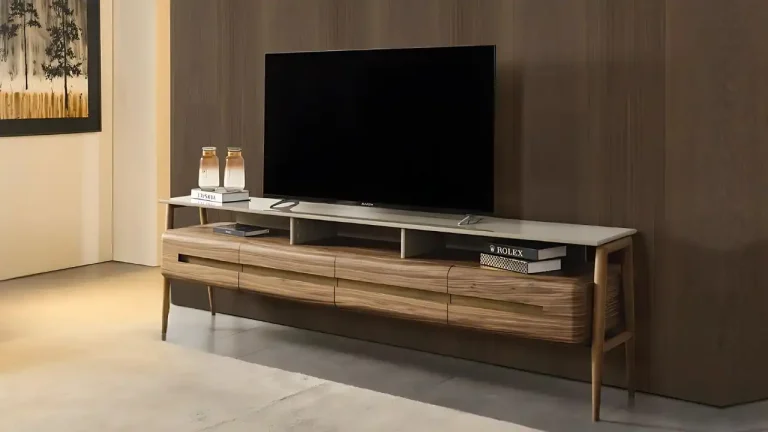
TV consoles and built-in wall units use MDF for fluted, curved and painted fronts that are hard to cut from plywood. A wall unit set into a pop design for sitting room layout also leans on MDF, because the panels are routed to fit lighting channels. Check that a long console has a centre support under the television.
Kitchen cabinets
A kitchen is the room where the board choice matters most. Plywood or moisture-resistant board for the cabinet boxes, especially under the sink, avoids the swelling that ends many cheap kitchens. Painted MDF doors are fine above the worktop and away from the cooker steam, provided every edge is sealed and the hinge holes are not left raw.
Office tables and desks
Desks carry computers, printers and elbows all day, so the top needs to resist sagging. Many office desks use a laminated or veneered MDF top on a steel or wooden frame, while heavier executive desks use thicker board or solid wood. Browse the office table range and ask what the top is made of.

How to Tell MDF From Solid Wood When Buying
A veneer or a printed wood-grain foil can make MDF look exactly like solid wood from the front. Veneered MDF, as Wikipedia explains, puts a thin layer of real wood over an MDF core. That is a legitimate product, but you should know what you are paying for. These checks take a few minutes in a showroom or at a carpenter’s workshop.
- Look at a cut edge or the inside of a drawer, where MDF shows a uniform brown core with no grain or growth rings.
- Check whether the grain on the top runs over the edge, because on solid wood the pattern continues and on veneer it stops at a line.
- Lift a door or a drawer front, since MDF feels heavy and dense for its size.
- Look inside a screw hole, where MDF and particle board show fibres or chips instead of wood grain.
- Ask the seller to name the core material, the edge banding and the grade in writing.
Check the back panel and the joints
The back of a wardrobe or TV unit tells you a lot. A thin, smooth hardboard back is HDF, which is normal. Corners joined with cam locks and dowels point to engineered board, while dovetails and mortise joints suggest solid wood. A mix is common and not a fault, as long as each part suits its job and the load it carries.
Questions to ask the seller
Ask whether the board is standard MDF, moisture-resistant MDF, plywood or particle board, and whether it is veneered, laminated or painted. Ask which formaldehyde class it meets, since Wikipedia lists E0, E1 and E2 classes, with E0 the lowest emission. A seller who can answer clearly usually knows how the piece was built.
Lifespan and Value — When Engineered Wood Is the Right Choice
Engineered wood is not the cheap option by default. Good MDF and plywood are stable, flat and resistant to the cracking and warping that solid wood can suffer in changing humidity. The real question is whether the board suits the room and the load, and whether its edges are properly sealed. Cworkshop puts it well: price should be weighed against performance.
When MDF or HDF makes sense
MDF is the right choice for painted and lacquered doors, fluted fronts, decorative wall panels and furniture in dry rooms. HDF suits back panels, drawer bottoms and flooring. If you plan the whole room at once, as in a full sitting room design in nigeria, MDF lets the TV console, side panels and wall cladding share one finish.
When plywood or solid wood is worth it
Pay for plywood where the furniture carries weight or meets water, such as kitchen boxes, bed bases, long bookshelves and bathroom vanities. Solid wood earns its place in table tops, chair frames and legs that take knocks every day. When you work out how to furnish a home, put the stronger materials where daily wear is highest.
Care that makes boards last
Wipe spills from MDF and particle board at once, and never leave a wet cloth or a potted plant on the surface. Keep furniture a few centimetres off damp walls so air can move behind it. Tighten loose hinges early, because a hinge screw that turns in MDF widens its hole quickly. Use felt pads under heavy objects to protect laminated tops.
Materials in Vento TV Stands and Office Tables
Vento lists materials only where the product description states them, so this section quotes those descriptions as of November 2026 and does not generalise across the catalogue. Where a listing does not name the core material, ask the sales team before you buy, particularly for pieces going into a kitchen area or a humid room.
TV stands with stated materials
The Lucca TV Stand description lists “engineered wood and metal accents”. The Soffice TV Stand mentions sturdy materials supported by “solid wooden legs” and fluted cabinet doors. The Vera TV Stand description says it is made from high-quality wood with a robust wooden frame. Compare all the TV stands to see finishes and storage.

Office sets and how to confirm a material
The Estilo Office Table Set description states that the tables and chairs are made from solid wood and steel. For any piece whose description does not name the board, ask at a Vento showroom in Lagos, Abuja or Port Harcourt what the carcass, doors and back panel are made of, and whether the edges are sealed.
MDF vs HDF vs Plywood FAQ
What is the difference between MDF and HDF?
The difference is density. MDF is pressed to roughly 600 to 800 kg/m³, while HDF is pressed above 800 kg/m³, so HDF is harder, stronger and less prone to swelling. HDF usually comes in thin 3 to 8 mm sheets, while MDF comes in thicker boards that are easier to cut and shape.
Is HDF better than MDF?
HDF is better where hardness and moisture resistance matter, such as flooring, door skins and back panels. MDF is better for thick furniture parts, routed shapes and painted doors, because HDF is mostly made in thin sheets. Neither is waterproof, so the right choice depends on the job rather than on density alone.
Is HDF more expensive than MDF?
Yes, HDF usually costs more than MDF of the same size because it uses more wood fibre and higher pressing pressure. Forest Plywood describes MDF as the much cheaper board. The gap varies by thickness, grade and supplier, so compare the exact specification when you get quotes for a project.
What does MDF mean?
MDF means medium-density fibreboard. It is an engineered wood board made by breaking hardwood and softwood residue into fibres, mixing them with wax and resin and pressing them into flat sheets under heat. It has no knots or grain, which makes it smooth to paint, veneer or laminate.
Is MDF waterproof?
No, standard MDF is not waterproof. Water that enters through an unsealed edge makes the fibres swell, and the damage is very hard to repair. Moisture-resistant MDF copes better with humid rooms such as kitchens, but it is still not made for direct water or outdoor use, so seal every edge.
What are the disadvantages of HDF board?
HDF is heavy for its thickness, hard to work by hand and mostly made in thin sheets of 3 to 8 mm. That makes it unsuitable for thick parts such as mouldings or carcasses. Like MDF, it contains formaldehyde-based resin and still swells if water gets in, even though it resists moisture better.
Which is better, plywood or MDF?
Plywood is better for strength, screw-holding and damp areas, which makes it the safer choice for kitchen cabinets, shelves and bed bases. MDF is better for smooth painted finishes, fluted fronts and decorative panels in dry rooms. Many good wardrobes and kitchens combine both, using plywood for the box and MDF for doors.
What is particle board?
Particle board, also called chipboard, is an engineered board pressed from wood chips, sawdust and resin. It is lighter, cheaper and weaker than MDF, with a density of about 500 to 800 kg/m³. It is usually covered in melamine or laminate and suits light shelving and flat-pack furniture kept dry.
Is MDF good for wardrobes in Nigeria?
Yes, MDF is good for wardrobe doors and panels in Nigeria if every edge is sealed and the wardrobe stands away from damp walls. The flat face takes paint and lacquer evenly. For shelves carrying heavy loads, choose thick MDF or plywood, and check that hinges are fixed with suitable screws.
Can termites eat MDF and plywood?
Yes, termites can damage MDF, plywood and particle board, because all three are made from wood. Treated plywood, termite-resistant resins and sealed or laminated surfaces slow an attack, but no standard board is fully proof. In termite areas, ask whether the board is treated and keep furniture off damp walls and floors.