

Blog
Furniture Materials in Nigeria — Wood, Marble, Fabric, Metal

The main furniture materials are solid wood and engineered boards for frames, leather and fabric for upholstery, marble and other stone for table tops, metal for bases and accents, foam for cushions and a finish that seals the surface. In Nigeria, the right choice depends on humidity, heat, termites and daily use.
Last updated: 16 November 2026 — material descriptions checked against the 377 in-stock listings in Vento’s live catalogue. This guide explains what each material is, where it performs well, where it fails in a Nigerian home, and how to read a product listing so that a marble-effect top is never sold to you as solid marble. It ends with a room-by-room guide and ten short answers to the questions buyers ask most.
Types of Furniture Materials at a Glance
Almost every piece of furniture combines several materials. A sofa has a wooden frame, foam cushions and a fabric or leather cover, while a center table may pair a stone top with a metal base. The table sums up the main groups before each one is explained in its own section. Window fabrics are a separate choice, and our guide to the sheer curtain and other curtain fabrics explains them.
| Type | Best for | Watch for | Care |
|---|---|---|---|
| Solid wood | Frames, tables, beds | Pests, cracks in dry air | Dust, polish, keep off wet floors |
| Wood veneer | Doors, table tops | Lifting edges after spills | Wipe dry at once |
| Leather | Sofas, office chairs | Drying out near AC or sun | Use leather balm twice a year |
| Fabric | Sofas, dining chairs | Stains, fading in sunlight | Vacuum, spot clean |
| Marble | Center and side tables | Etching from acid, stains | Use mats, seal, mild soap |
| Metal | Bases, legs, accents | Rust on bare iron | Dry cloth only |
| Foam | Seat and back cushions | Sagging if density is low | Turn and plump cushions |
How to use the table: start with the room and the way the piece will be used, then pick the material. A dining table that hosts children every day needs a different top from a center table in a formal parlour, even when both are made by the same maker.
How to read a product listing
Material words in listings are precise when sellers use them carefully and vague when they do not. “Marble top” should mean natural stone, while “marble-effect”, “marble-style”, “marble-coated” or “marble-like” describe a surface that only looks like marble. “Solid wood frame” is a stronger claim than “wooden finish”. When a listing is unclear, ask what the frame, the top and the cushions are made of before you pay, and ask for the answer in writing.
Solid Wood vs Engineered Boards
Wood is the backbone of most furniture, but it reaches you in three forms. Solid wood is cut straight from the tree. Wood veneer is a thin slice of real wood glued over a core. Engineered boards are made from wood fibres, chips or layers pressed together with resin. Each has a place, and a well-made piece often uses all three.
Solid hardwood frames
Solid hardwood carries load well, holds screws and joints firmly and can be sanded and refinished when the surface wears. That is why upholstery makers use it for sofa frames, where the joints take the weight of several people every day. In Vento’s catalogue, 32 in-stock listings describe solid wood or solid hardwood construction, including the frames of the Vera and Nove sofa sets and the Nove dining table. The weakness of solid wood is movement, because it swells in damp air and shrinks in dry air.

Wood veneer over a board core
A wood veneer is a sheet of real timber, usually well under a few millimetres thick, glued to a stable core such as plywood or fibreboard. It gives the look of walnut or oak across a wide surface without the warping risk of a single wide solid panel. Good veneer is not a cheat; it is how most large cabinet doors and table tops are built. The Magnum Dining Set listing, for example, states that it is crafted from solid wood or high-quality veneers. The weak point is the edge, where water can creep under the veneer and lift it.
Engineered boards inside cabinets
Fibreboard, particle board and plywood are the boards hidden inside wardrobes, TV units and sideboards. They are flat, stable and easy to machine, which suits clean modern lines and painted or lacquered fronts. Their limit is water, because a board that soaks up a spill at a raw edge swells and does not shrink back. For the timber species behind solid pieces, such as iroko, mahogany and teak, see our guide to the types of wood for furniture used in Nigeria.
Leather, PU Leather and Fabric Upholstery
The cover is the part of a sofa or chair you touch every day, and it decides how the piece feels in the heat, how it ages and how hard it is to clean. Most sofas in Nigeria are covered in genuine leather, a synthetic leather such as PU leather or leatherette, or a woven fabric. Browse the full range of sofa sets to compare covers side by side.
Genuine leather
Genuine leather is strong, resists tearing and develops a softer feel and a patina as it ages. Full-grain and top-grain hides are the most durable grades, while split and corrected-grain leathers are thinner and more processed. Leather stays cool to the touch in an air-conditioned room but can feel warm in direct sun. It also dries out, so it needs a leather conditioner a few times a year, particularly during harmattan. In Vento’s catalogue, the Focus Sofa Set listing describes soft leather over a solid wood structure.
PU leather and leatherette
PU leather is a fabric backing coated with polyurethane to look and feel like leather. It wipes clean easily, comes in uniform colours and is lighter on the pocket than hide. Its limit is age, because the coating can crack or peel after several years, faster in strong sun or with harsh cleaners. Ask the seller whether a cover is genuine leather, PU leather or a leather-accent fabric. Vento listings for the Woody Sofa Set and the Perla Dining Chair offer fabric or leatherette upholstery.
Fabric, velvet and textured weaves
Fabric breathes, so it feels cooler than leather on a hot afternoon and suits a family sitting room. Tight weaves and synthetic blends resist wear and stains better than loose natural weaves, and velvet adds depth of colour but shows marks where it is pressed. Sunlight fades most fabrics, so keep a fabric sofa out of direct afternoon sun. Our fabric vs leather sofa guide compares the two covers in detail for Nigerian homes, including children and pets.
Marble, Travertine and Sintered Stone Tops
Stone tops bring weight, a cool surface and a natural pattern that no two pieces share. They are the defining material of most luxury center tables, side stools and many dining tables. The same three words, marble, travertine and sintered stone, cover very different materials, and listings often blur them, so it pays to know what each one is.
Natural marble
Marble is a natural metamorphic stone, mostly calcium carbonate, with veins that run through the whole slab. It is hard-wearing in normal use, but acids such as lemon juice, vinegar and some cleaners etch it, and red wine or palm oil can stain it if left. Use coasters, wipe spills quickly and clean it with mild soap and water. Of Vento’s in-stock furniture, five pieces are described as having a marble top, among them the Iron and Marble Center Table, the Round Marble Center Table and the Round Marble Side Stool.
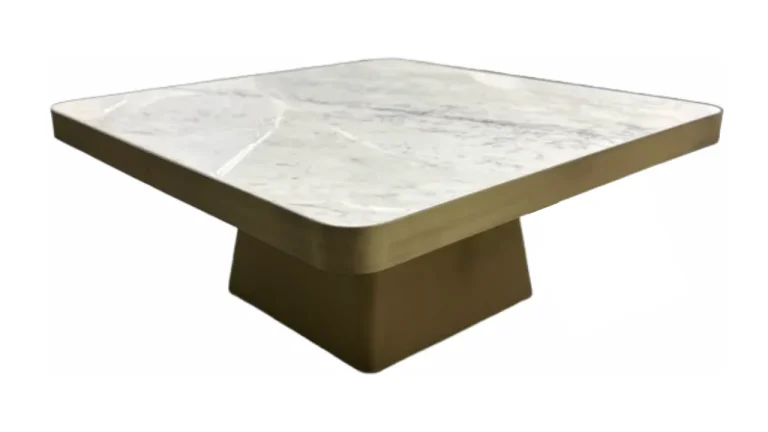
Marble-effect and marble-coated tops
A marble-effect top is a printed, glazed or coated surface made to look like marble. It is lighter, more uniform and less likely to etch than real stone, which suits a busy dining room. Four in-stock Vento pieces describe this kind of surface in their own words, the Voyance Dining Set as marble-effect, the Champange Royal Dining Set as marble-style, the Urgup Center Table as marble-coated wood and the Sebastian TV Stand as marble-like. None of Vento’s current dining sets lists a natural marble top. Browse the dining room sets to compare table surfaces.
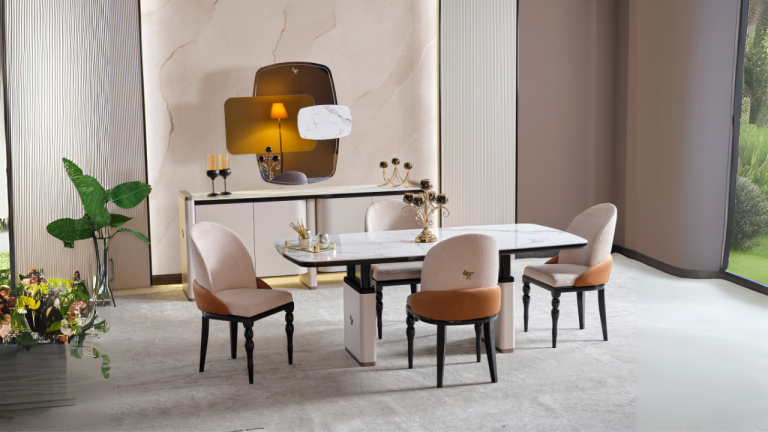
Travertine
Travertine is a form of limestone laid down by mineral springs. Its surface has natural pits and channels that are usually filled with resin for furniture, and its colours run from cream to warm beige and walnut. Like marble, it is calcium carbonate, so it reacts to acids and benefits from sealing. Travertine tables are popular in modern interiors for their soft, matte look. Vento’s current catalogue does not list a travertine piece, so the stone choices in the showroom today are marble and marble-effect.
Sintered stone
Sintered stone is an engineered surface made by pressing natural minerals under very high pressure and heat until they fuse into a dense slab. It has very low porosity, so it resists stains, heat and scratches better than marble, and it can be printed with a marble or concrete pattern. The trade-off is that it is a manufactured look rather than a unique natural slab. Vento does not currently list a sintered stone top. For stone and wood options in the living room, see the center tables range.
Metal Frames and Gold or Brass Finishes
Metal gives slim, strong bases and legs that wood cannot match at the same size. In luxury furniture it is also the main source of shine, through gold-tone and brass finishes on legs, trims and handles. The base metal and the finish are two separate things, so a listing that says gold legs describes a colour and a look, not solid gold.
Iron and steel bases
Iron and steel carry heavy stone tops without bending, which is why a marble top often sits on a metal base. Bare iron rusts in humid air, so furniture metal is painted, powder-coated or plated to seal it. Check welds and joints for smooth seams and look underneath for any bare metal. The Iron and Marble Center Table pairs an iron base with its marble top, and the Metal Marble Side Stool uses a metal frame under its marble top.
Gold-tone legs and accents
Gold-tone metal is the signature of many luxury Nigerian sitting rooms, used for table legs, frames around stone tops and trims on sideboards. Most of this shine comes from a plated or coated finish on steel or iron. Clean it with a soft dry cloth and never with scouring pads, which scratch through the finish. The Gold Leg Center Table and the Black Gold Center Table are two examples, and more pieces sit in the luxury collection.
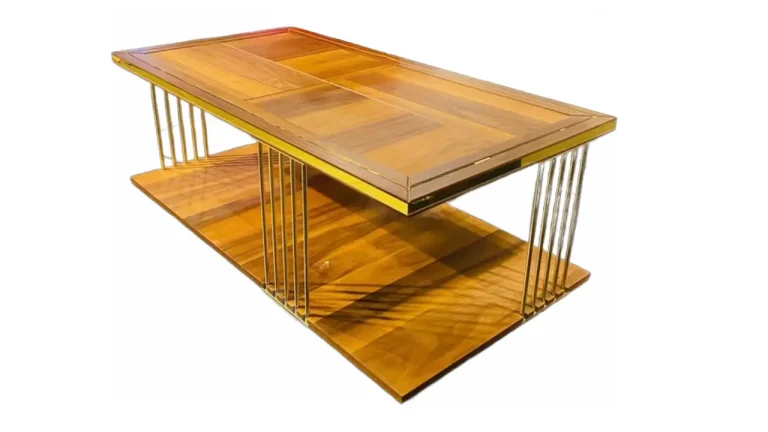
Antique and matt brass
Brass is a warm yellow alloy of copper and zinc. Antique and matt brass finishes are deliberately softened, so they hide fingerprints and look older than polished brass, which suits classic and transitional rooms. Brass darkens slowly in humid air, and many owners accept that change as character rather than damage. The Matt Antique Brass Side Stool stands 51 cm tall, according to its listing, and works beside an armchair or as a small bedside table.

Foam Density and Cushion Quality
Foam decides whether a sofa still feels good after two years or sags within months. Two numbers matter, density and firmness, and they are not the same thing. Density is the weight of foam per cubic metre, while firmness is how hard the foam feels when you sit down. A cushion can feel firm in the showroom and still be made of low-density foam.
What high-density foam means
Higher-density foam has more material packed into each cubic metre, so it recovers its shape after each sitting and lasts longer under daily use. Lower-density foam feels soft at first but compresses into a permanent dip where people sit most. Twelve in-stock Vento listings describe high-density foam cushions, including the Otello, Vera, Nove, Pietra and Zelve sofa sets. When a listing does not say, ask for the foam density figure in kg/m³ and compare it with other sofas you are considering.
How to test a cushion in a showroom
Sit for at least two minutes in the seat you will use most, then stand and watch the cushion. Good foam springs back fully within a few seconds. Press the front edge of the seat with your hand to feel whether a frame rail sits close under the foam. Unzip a cushion where the seller allows it and look for foam wrapped in fibre or a lining, which keeps the cover smooth. Ask whether the seat and back cushions use the same foam.
Furniture Finishes — Lacquer, PU Paint and French Polish
A finish is the coating that seals wood and veneer, gives colour and sheen and protects the surface from water, heat and wear. The same wood can look and behave very differently under different furniture finishes, so ask what finish a piece has, not just what it is made of. These are the finishes Nigerian buyers meet most often.
Lacquer
Lacquer is a sprayed finish that dries quickly into a hard, smooth film, from matt to high gloss. It is common on modern cabinets, TV units and painted fronts because it gives an even colour across large flat surfaces. Small scratches can often be blended out by a finisher. Lacquer resists everyday spills when it is wiped promptly, but very hot dishes can mark it, so use mats and coasters on lacquered tops.
PU paint and polyurethane coats
Polyurethane, often called a PU finish or PU paint by Nigerian carpenters, cures into a tough, water-resistant and heat-resistant coat. It is a popular choice for high-gloss furniture and for surfaces that see daily use, such as dining tables and bedside units. A good PU finish has an even depth with no runs, bubbles or dust trapped in it. Look across the surface at an angle under light to check, because flaws show clearly at a low angle.
French polish
French polish is a traditional finish built from many thin coats of shellac rubbed into the wood by hand. It gives a deep, warm shine that suits classic carved furniture. It is also the most delicate finish in this list, because water and heat leave white rings and alcohol dissolves it. Reserve French-polished pieces for formal rooms, use coasters at all times and ask a skilled polisher to repair any damage rather than sanding it yourself.
Oil and wax finishes
Oil soaks into the wood and hardens inside the grain, giving a natural, low-sheen look that is easy to refresh with another coat. Wax sits on top and adds a soft glow. Both feel more natural to the touch than a hard film, but they protect less against water and need regular care. They suit solid wood pieces that you are happy to maintain, and they make small scratches easy to blend in.
Which Materials Survive Nigerian Heat, Humidity and Termites
Climate shapes how furniture ages in Nigeria more than almost anything else. Coastal cities such as Lagos and Port Harcourt are humid for most of the year, while harmattan brings dry, dusty air to Abuja and the north from around November to February. The same sofa or table behaves differently in each, so plan the material for the city and the room.
Humidity, rain and swelling
Damp air makes solid wood swell and engineered boards soak up moisture at any raw edge. Keep wooden legs off floors that are mopped daily, raise cabinets slightly on feet or glides and wipe up water at once. In humid homes, sealed finishes such as PU and lacquer protect better than oil or wax. When you plan a whole sitting room around these materials, our guide to sitting room design in Nigeria shows how to balance wood, fabric and stone in one space.
Termites and wood borers
Termites and wood-boring beetles attack untreated and poorly seasoned wood, and engineered boards are not immune. Signs to look for are mud tubes on walls or legs, small piles of powder below a piece and hollow-sounding wood when you tap it. Buy from makers who season and treat their timber, keep furniture away from damp walls and inspect older pieces each rainy season. Ask the seller how the wood in a piece was treated before you buy it.
Sun, heat and harmattan dust
Strong sunlight fades fabric and dries out leather and PU coatings, while harmattan air draws moisture out of solid wood and can open small cracks along joints. Use curtains or blinds on west-facing windows, keep sofas a little away from air-conditioning vents and condition leather before the dry season. Dust works into fabric weaves, so vacuum upholstery weekly from November to February. Stone and metal shrug off heat but still need dusting to keep their shine.
The ceiling, walls and floor matter too
Furniture materials sit inside a room, and the finishes around them change how they look and wear. A glossy POP ceiling with warm lighting brings out gold-tone metal and veined marble, while a matt ceiling suits oiled wood and textured fabric. See our pop design for sitting room ideas for ceilings that match your furniture. Tiled floors are kind to stone and metal bases, while rugs protect wooden legs and soften the echo of hard surfaces.
Matching Materials to Each Room
The best material for a piece depends on the room it lives in and who uses it. A formal parlour can carry delicate finishes and natural marble, while a family sitting room needs tough fabric and sealed surfaces. Use this list as a starting point when you plan a room or replace one piece at a time.
- Family sitting room: solid wood sofa frames, high-density foam, a tightly woven fabric or leather cover and a sealed center table top.
- Formal parlour: genuine leather or velvet, a natural marble center table, gold-tone or brass accents and a French-polished or lacquered cabinet.
- Dining room: a marble-effect, sintered or PU-finished table top that shrugs off spills, with wipe-clean chair covers.
- Bedroom: solid wood or veneered bed frames, lacquered or PU-finished wardrobes and fabric headboards away from direct sun.
- Home office: a hardwood or veneer desk and a leather or leatherette chair that stands up to long hours.
Mixing materials in one room
Rooms look richer when two or three materials repeat across several pieces. Pair a marble center table with gold-tone legs and echo the gold in a mirror frame or side stool, then let a wooden sideboard add warmth. Keep one material dominant and use the others as accents. If you are furnishing from scratch, read our guide on how to furnish a home in Nigeria, which sets out what to buy first and how to plan each room.
Know the pieces before the materials
Each kind of furniture puts different demands on its materials. A dining chair needs a strong frame and wipeable cover, a wardrobe needs stable boards and smooth hinges, and a center table needs a top that resists heat and spills. Our guide to the types of furniture describes each piece and its job. Vento showrooms in Lagos, Abuja and Port Harcourt let you see marble, leather and finishes up close before you choose.
Furniture Materials FAQ
What are the main types of furniture materials?
The main types of furniture materials are solid wood, wood veneer and engineered boards for structure, leather and fabric for upholstery, marble and other stone for tops, metal for bases and accents, foam for cushions and a finish such as lacquer, PU or French polish that seals the surface. Most pieces combine several of them.
What is the most durable furniture material?
Solid hardwood and metal are among the most durable furniture materials for frames and bases, because they carry heavy loads for years and can be repaired. For tops, sintered stone resists heat, stains and scratches best. Durability also depends on construction and finish, so check the joints, the foam and the coating as well.
Is marble furniture good for Nigerian homes?
Yes, marble furniture suits Nigerian homes well because it stays cool, handles heat from the climate and lasts for decades. It does need care, since acids such as lemon juice and vinegar etch it and oils can stain it. Use coasters, wipe spills quickly and keep a natural marble top for the sitting room rather than daily dining.
What is the difference between marble and travertine?
Marble is a metamorphic stone with veins running through it, while travertine is a limestone formed by mineral springs, with natural pits that are filled for furniture. Both are mostly calcium carbonate, so both etch with acid and benefit from sealing. Marble is usually polished and veined, and travertine has a softer, matte, earthy look.
What is wood veneer?
Wood veneer is a thin sheet of real wood glued onto a stable core such as plywood or fibreboard. It gives the look of solid walnut or oak across wide surfaces without the warping risk of one large solid panel. Good veneer is durable, but water must be wiped away quickly so that the edges do not lift.
Is PU leather good for a sofa in Nigeria?
PU leather is a reasonable choice for a sofa in Nigeria if you want a leather look that wipes clean easily. It is lighter on the pocket than genuine leather but can crack or peel after several years, faster in strong sun. Keep it out of direct sunlight and clean it with a damp cloth, not solvents.
What foam density is best for sofa cushions?
High-density foam is best for sofa cushions because it recovers its shape after each sitting and resists sagging. Density is the weight of foam per cubic metre, which is different from firmness. Ask the seller for the density figure in kg/m³, compare it between sofas and sit on each one for a few minutes before you decide.
Which furniture finish lasts longest?
A polyurethane finish, often called PU, usually lasts longest on everyday furniture because it cures into a hard coat that resists water, heat and wear. Lacquer is also tough and easy to repair. French polish looks beautiful but marks easily, so it suits formal rooms. Oil and wax need regular top-up coats to keep protecting the wood.
How do I protect wooden furniture from termites?
Protect wooden furniture from termites by buying pieces made from seasoned and treated timber, keeping them away from damp walls and floors and inspecting them each rainy season. Look for mud tubes, fine powder under the piece and hollow-sounding wood. If you see signs of termites, move the piece away and call a pest control service quickly.
How can I tell if a table top is real marble?
Real marble feels cold and heavy, and its veins are irregular and continue around the edge of the slab. A printed or marble-effect top repeats its pattern and often feels warmer and lighter. Check the listing wording, since marble-effect, marble-style and marble-coated all describe a look, and ask the seller to confirm the material in writing.